
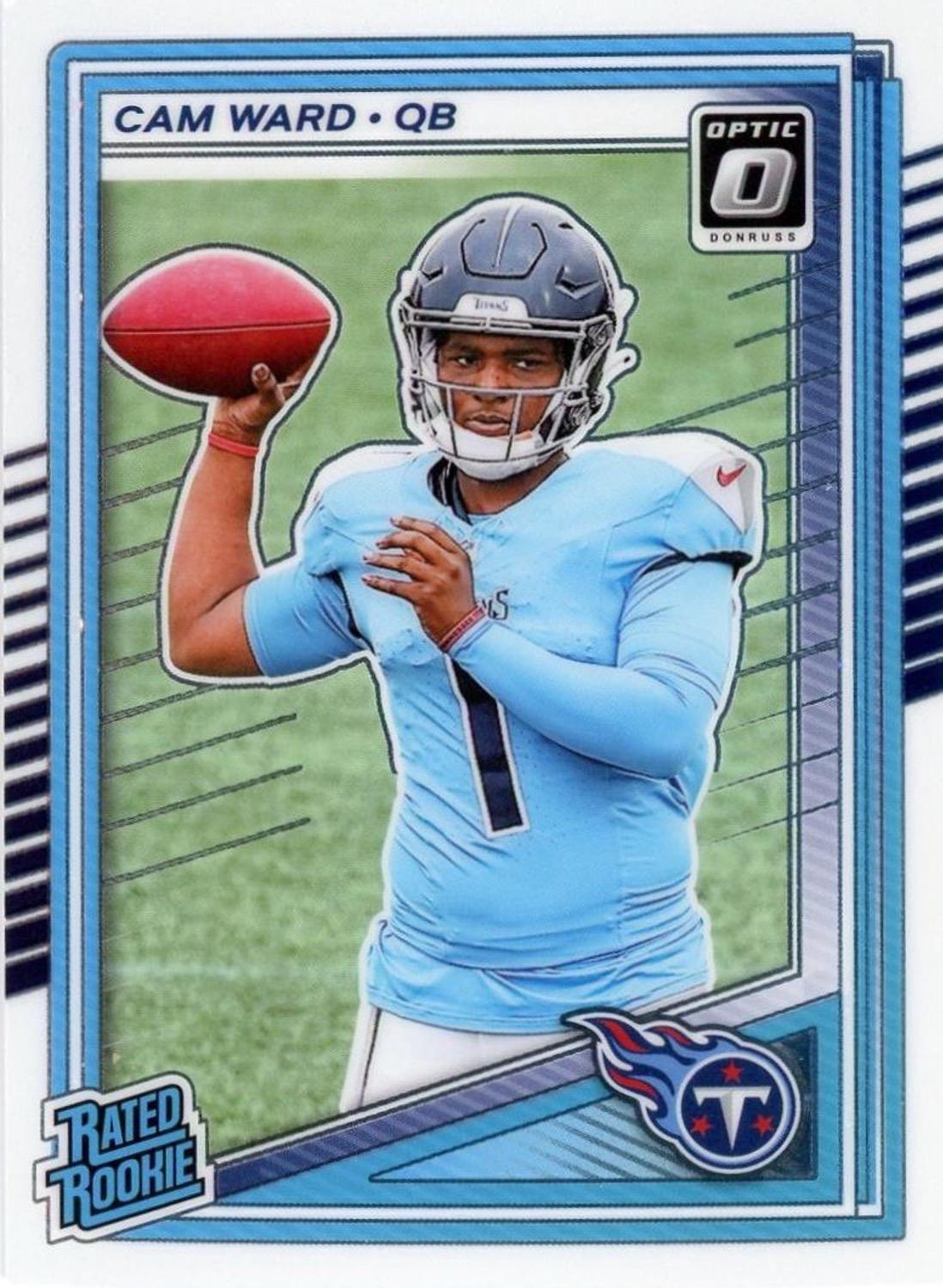
Football is one of the most active corners of the card hobby right now. The money chasing rookie quarterbacks runs deep, and Topps holding the NFL license starting in 2026 only sharpens the spotlight. But none of that tells you what to actually buy. The good news is that the math behind a smart football pickup is simpler than most people make it. Three levers move almost every card's price: the player, the grade, and the parallel. Read those three correctly and you stop overpaying.
The Player Comes First
Rookie cards carry the position. In football that means quarterbacks, then the elite skill guys at receiver and running back. A quarterback who strings together a strong first month can drag his whole rookie class up with him, and the base cards move first because that's what most people can afford.
Look at what a proven name does to a price. The 2017 Panini Prizm Patrick Mahomes II Silver rookie sells around $702.28 raw and $6,375 in a PSA 10. That is not a parallel for the masses anymore. It's a blue-chip card. Compare that to a more recent star still building his case: the 2023 Panini Prizm C.J. Stroud Silver sits near $61.76 raw and $325 in a PSA 10. Same brand, same parallel tier, wildly different price, and the gap is almost entirely the player's track record and his card's age in the market.
The Grade Is the Multiplier
Condition is where most of the profit hides. The jump from a raw card to a clean PSA 10 is the single biggest swing you control. Take the 2020 Panini Prizm Joe Burrow base rookie. Raw, it trades around $15.39. A PSA 9 brings about $27.05. A PSA 10 hits $100. That is a base card, no parallel, and the top grade is worth several times the raw price.
Justin Herbert from the same set tells the same story. His 2020 Prizm base rookie sells near $6.89 raw and $56.72 in a PSA 10. The pattern repeats across every player and every brand because grading rewards two things: scarcity at the top grade and demand for the name. Before you send anything in, pull the raw comp and the PSA 10 comp side by side. If the spread covers your grading cost with room left over, and the card has sharp corners and clean centering, sending it in is the play.
If you want to see the grading premium taken to its limit, step outside football for a second. The 2003 Topps Chrome LeBron James base rookie runs about $1,400 raw and $12,611.65 in a PSA 10. That is what a generational player plus a perfect grade looks like at the top of the market. Football has not produced a single card at that altitude, but the mechanics are identical.
Parallels Are the Real Money
Modern football is built on the rainbow. The base card sets the floor. The low-numbered parallels set the ceiling. The further you climb the parallel ladder, the steeper the price gets, and it compounds with the grade.
Herbert makes this concrete. His base 2020 Prizm rookie is a $6.89 raw card. The Silver parallel of that same card jumps to $108.46 raw and $1,081.43 in a PSA 10. Same player, same set, same year. The only difference is the finish, and it turns a $7 card into a four-figure slab at the top grade. That is the multiplier you are paying for when you chase color.
The lesson scales all the way up. The 2003 Topps Chrome LeBron base rookie is a $1,400 raw card. The Gold Refractor version of that same card, numbered to 50, trades around $99.99 raw and $506,880 in a PSA 10. The raw price looks low because almost nobody sells one ungraded. Print run and grade do the rest.
How to Actually Hunt
Here is the order of operations that keeps you grounded. Start with the player and his rookie year, because that's the floor under everything. Pin down which parallel you are buying, since the same name spans a $7 base and a four-figure refractor. Then check the raw comp against the graded comp before you decide whether to slab it. Real sold prices, not asking prices, are the only numbers that matter.
You do not need a six-figure card to do this well. A clean base rookie of a young quarterback, bought raw and graded right, can return more than its cost the moment it comes back a 10. The Burrow and Herbert numbers prove the move works on cards anyone can afford. The expensive stuff just shows you how far the same three levers can stretch.
Football rewards patience and a sharp eye more than a deep wallet. Know the player, respect the grade, and price the parallel. Do that consistently and the value finds you.