
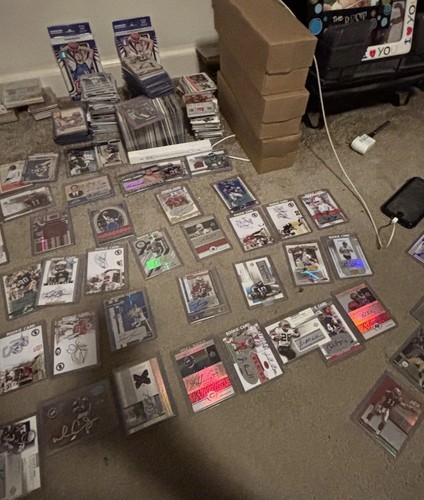
Everyone wants to know what's hot. The latest Prizm drop, some prospect nobody outside Double-A has heard of, the flavor of the week. Chasing the next big thing is a fine way to lose money. While the crowd loses its mind over a parallel that could be worthless by next season, the real hobby sits in a dusty shoebox. Pre-1980 cardboard. The cards your grandfather had. New wax is fun. The colors pop, the autos are slick, the chase feels real. But staying power lives in the old stuff, and it always has.
Why Old Cardboard Still Holds
Vintage is the bedrock. It's what built the hobby. Mantle, Mays, Aaron and Clemente aren't going anywhere. Their stats are set. Their legends are cemented, and no injury report or cold streak craters a 1953 Topps Mickey Mantle. That card is tied to history, not to last week's batting average. Pull the long-term price line on any of these legends and it grinds steadily upward. A 30-day chart on a 1950s card might look flat. Stretch it to five or ten years and the climb is real.
Scarcity backs it up. These were not printed in runs of hundreds of thousands. Old cards got chewed up in bicycle spokes, taped into scrapbooks and thrown out by the boxful. A 1952 Topps card is inherently rarer than almost anything printed after 1980, and surviving copies in a PSA 7 or better are scarce. That is the whole equation on vintage value: the player, the condition, and how few graded high. A 1952 Topps Mickey Mantle has sold loose around $46,960, and that is for a well-handled copy, not a pristine one.
Condition Grades Differently On Vintage
Adjust your brain on grades. A PSA 7 on a 1952 Topps card isn't the same as a PSA 7 on a 2012 Topps Chrome. Not close. The old stock was rough, the cuts were sloppy, and kids handled them like garbage. Centering was an afterthought. So a high-grade vintage card, a PSA 8 or 9, is a small miracle, because it survived decades when almost none of its siblings did. A PSA 10 on the truly old stuff is nearly mythical.
The gap between grades is enormous. A 1953 Topps Mickey Mantle in top graded condition has changed hands north of half a million dollars, with sold comps near $536,986. The same card loose, well-loved and raw, sits around $2,300. Do not dismiss a card because it is only a PSA 4 or 5. On vintage, that is often a strong, good-looking grade, and it is usually the entry point for serious pieces. For a $500 to $5,000 budget, mid-grade Hall of Fame rookies from the late 1950s and early 1960s are exactly where you want to be.
Getting In for a Few Grand
You can build a meaningful vintage collection without selling a kidney. A 1952 Mantle in any grade is out of reach under five grand, but plenty of icons are not. Here is where the money goes furthest.
Start with mid-grade Hall of Fame rookies. The 1957 Topps Frank Robinson rookie trades loose around $152, and even its top-graded comps land near $30,946, so a mid-grade copy is genuinely affordable. The 1955 Topps Harmon Killebrew rookie is similar, with a loose price near $120 and graded comps reaching about $37,104. The 1963 Topps Pete Rose rookie, the famous four-player panel, runs roughly $839 loose. These are iconic, future-proof cards. Watch for dips and pounce when one shows up.
Next, look at key non-rookie cards of the all-time greats. A player's second or third year card is often a stunner and far more affordable than the rookie. A 1956 Topps Mickey Mantle sits around $1,268 loose for the gray-back, with that classic Topps look and proven demand. A 1954 Topps Hank Aaron, an early card though not his true rookie, runs about $2,194 loose. The 1955 Topps Roberto Clemente rookie is loose near $1,367, and its high-grade comps have reached roughly $697,500, which tells you exactly how much room the condition ladder holds.
For the under-$50 win, late-vintage commons deliver. The 1971 Topps Willie Mays trades loose around $34, and that brutal black border is a condition killer, so a clean raw copy is a steal. The 1974 Topps Nolan Ryan is even cheaper loose, near $17, yet its top-graded comps run past $73,000. Grab a decent raw copy for a song and you are holding a legend.
On grading, slab anything you spend real money on. PSA is the standard for vintage, and it matters most if you ever plan to sell. Everyone talks about investing in the hobby, but most of it is speculation on hot rookies. Vintage is different. It is a true store of value, a piece of sports history you can hold, and that is something a modern parallel will never give you.