
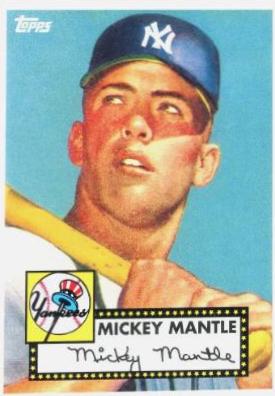
Modern cards get the attention. Stroud, Luka, the shiny Prizm parallels stacked at every show. The vintage market does not need the spotlight. The icons have held their ground, and the cream of it has kept climbing through stretches where modern cooled off. The hobby has long memory, and the cards that started it all still command the room.
Condition Works Differently In Vintage
You cannot judge a 70-year-old card the way you judge something out of a pack today. Pull a Prizm and anything under a PSA 10 or BGS 9.5 gets picked apart for centering and soft corners. A 1952 Topps card lived a different life. These were handled by kids, tucked into bicycle spokes, taped into scrapbooks. A clean PSA 5 or 6 with strong color and honest corners is a survivor, and survivors carry weight. The base 1952 Topps Mantle #311 sits around $46,960 in raw, beat-up condition. That is the floor on a card most collectors will only ever own ungraded.
Grade still drives the price, just on a steeper curve. High-grade survivors are brutally scarce, and every point of grade can multiply the number several times over. A modern parallel manufactures its scarcity through a print run. Vintage scarcity is real attrition. Most of these cards did not make it out of childhood, so the population at the top is thin and the premiums are enormous.
What Separates $50 From Five Figures
Player first. Nobody pays serious money for a vintage common, no matter how well centered. A Hall of Fame rookie plays by other rules. The 1955 Topps Roberto Clemente rookie #164 runs about $1,367 ungraded, and a PSA 10 has sold for roughly $697,500. The 1954 Topps Hank Aaron rookie #128 sits near $2,193 in raw form, while a gem-grade copy has reached around $470,430. These are foundational cards, and even mid-grade copies hold their value because the name on the front never goes out of style.
The 1951 Bowman Mickey Mantle #253 tells the same story louder. Around $9,475 ungraded, and a gem copy has reached roughly $1,946,978. That is not a typo. A single card, two grades apart, spans from a few thousand dollars to nearly two million. The disconnect modern collectors miss is simple. They see PSA 4 and think damaged goods. In vintage, PSA 4 means a card that survived seventy years and still grades.
Why The Population Report Matters
Pull the population report on any high-grade pre-war or 1950s icon and the top of the scale is tiny. Single digits, low double digits, for cards that are 70 years old. That is the engine behind the value. With a modern ultra-rare parallel, thousands of perfect copies still exist, just spread across a dozen variations. With vintage, the perfect copies were never made, or never survived. So the curve from PSA 6 to PSA 7 to PSA 8 climbs hard, and it climbs because of population reality, not hype.
This is why serious money treats top-grade vintage like rare coins or fine art. The buyers are not chasing a low-pop parallel they ripped from a box. They are holding cards with a proven appreciation record, real scarcity, and global recognition. The 1968 Topps Nolan Ryan rookie #177 is a good example of the demand. About $733 ungraded, and a top-grade copy has changed hands near $105,084. That is a rookie of a legend, within reach of a regular collector as a raw card, with a ceiling that keeps the high end interesting.
The Average Collector Is Not Priced Out
You do not need a high-grade 1952 Mantle to build a real vintage collection. Adjust the target. Chase a high-grade common from an iconic set. Pick up a mid-grade star. A 1954 Topps Ted Williams #1 runs about $133 ungraded, and a gem example has sold near $25,479, so there is room on both ends. A 1961 Topps Mantle #300 sits around $267 in raw form, with high-grade copies near $59,167. An honest raw card with a little corner wear still looks great in a one-touch, and it still carries the history.
Value in vintage is not only the number on the comps. It is holding a piece the hobby was built on, knowing what it survived. The run on high-grade icons is not slowing down, and the names driving it have not changed in decades. If you have been sleeping on the old stuff, or sitting on a mid-grade you assumed was nothing, take another look. They are not making any more of them, and nearly every one has a story.