
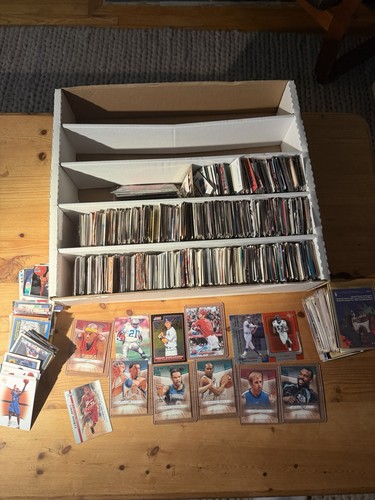
Most cards people send in for grading should never leave the box. Grading is a financial decision, not a reflex. You are paying a fee and waiting weeks for a number that either multiplies the card's value or does nothing at all. The market knows the difference. You should too.
The rule is simple. A card earns a slab when the graded comp beats the raw comp by enough to cover the fee with room to spare. Everything else gets sold raw. Pull the numbers first. Decide second.
Stop Sending Base Rookies In
Crack a box, pull a base prospect, and the instinct is to grade it. Resist that. Take the 2023 Bowman Chrome Prospects Druw Jones. Raw, it sells for about $1.87. A PSA 10 brings roughly $12. You would pay a grading fee, wait two months, and surrender a chunk of that $12 to the slab. The math does not work. Base prospects of a top name still trade like commodities until the player arrives, and a commodity belongs in a bulk lot, not a PSA holder.
The discipline applies across your low end. If the jump from raw to a clean grade does not at least triple your grading cost, you are working for the grading company. Sell it raw and move to the next card.
What Actually Earns the Slab
Three buckets justify the fee: high-end modern rookies and autos, vintage, and key parallels. Usually the card checks more than one box.
Start with modern parallels, because that is where the multiplier is easiest to see. The 2014 Bowman Chrome Prospects Jacob DeGrom Refractor trades around $75.50 raw. The PSA 9 sits near $100. The PSA 10 jumps to roughly $326.59. That is the spread you are grading for. A clean copy with crisp edges and honest centering is a layup. Compare that to the DeGrom base from the same set: $3.97 raw, $44.79 in a PSA 10. The base card can grade well too, but the parallel is where the real dollars live.
Autographed rookies behave the same way when the player has a ceiling. The 2025 Panini Prizm Shedeur Sanders Silver runs about $20 raw and $50 in a PSA 9, but the PSA 10 sits near $475. That is a ninefold move on a perfect grade. The catch is the same one that always applies to modern cards: you need the gem, not the nine. Print lines, soft corners, and off-center cuts kill that ceiling instantly.
Vintage Plays By Different Rules
Vintage is about authenticity and liquidity as much as the grade itself. A graded, authenticated slab is how serious vintage money moves, and centering decides the grade. You can carry soft corners and minor print noise and still land a strong number if the card is cut straight.
The 2003 Topps Chrome LeBron James rookie shows the stakes. Raw, it trades around $1,400. In a PSA 10, it has sold for roughly $12,611. That is the difference between a nice raw card and a blue-chip asset, and it comes entirely from the grade. Vintage and high-end modern share that trait: the slab does not nudge the price, it transforms it.
The Sweet Spot Grade
Everyone chases the PSA 10. The smart play is sometimes one notch down. A PSA 9 or a BGS 9.5 often captures most of the value of a 10 while costing far less to chase, because the card does not have to be flawless. Look again at that DeGrom Refractor. The PSA 9 at roughly $100 already beats the $75.50 raw price. If you are not confident in a perfect grade, the nine is a real outcome, not a consolation prize.
Company choice follows the card. For modern base and parallels you want to move fast, PSA carries the deepest liquidity and the highest 10 premiums. For ultra high-end cards where subgrades decide the sale, collectors lean on BGS and its 9.5 with strong subs. SGC has long owned vintage for its look and its grading standards, and CGC has earned a place for value-conscious submissions. Pick the slab the buyer for that specific card wants to see.
The Cards That Waste Your Money
Two mistakes burn the most cash. The first is grading flawed cards. Obvious print lines, dinged corners, or bad centering will not gem, and you eat the fee for a nine you could have predicted. The second is grading cards that lack value even as a perfect 10. The 2023 Panini Prizm UFC Anthony Hernandez Superstar autograph sells for about $24.51 raw and roughly $200 in a PSA 10. The spread exists, but the absolute dollars are thin once you net out the fee and the wait. For most of those, raw is the cleaner exit.
Then there is time. If a prospect is spiking now and the card is liquid raw, selling into that demand can beat waiting on a grade that lands after the run cools. Speed is part of the math.
None of this is complicated. Pull the raw and graded comps. If a raw card sells for $100 and a clean PSA 9 sells for $250, and you trust the card, send it. If the raw is $20 and the PSA 9 is $35, sell it raw and keep the fee. Let the numbers make the call.