
Football cards reward the people who learn the basics before they spend. The hobby looks chaotic from the outside, with dozens of products and a parallel rainbow on every rookie. It is not. A handful of brands carry the weight, a handful of rookies carry the value, and once you can read the tiers you can start buying with intent instead of guessing.
Here is how to start, what to chase, and how to keep your cards in the condition that protects their value.
Pick a Lane First
Decide why you are collecting before you buy a single pack. Some people collect their team. Some chase one player. Some are building toward resale. None of those are wrong, but they pull you in different directions. A team collector happily buys a star running back regardless of the comps. A resale-minded collector locks onto quarterbacks, rookie cards, and low-numbered parallels, because that is the stuff the market keeps bidding on.
Quarterbacks drive this hobby. The biggest rookie cards in football almost always belong to signal-callers, and the gap between a quarterback rookie and a skill-position rookie from the same set is usually enormous.
Reading the Product Tiers
Three tiers cover most of what you will buy. Learn them and the maze gets simple.
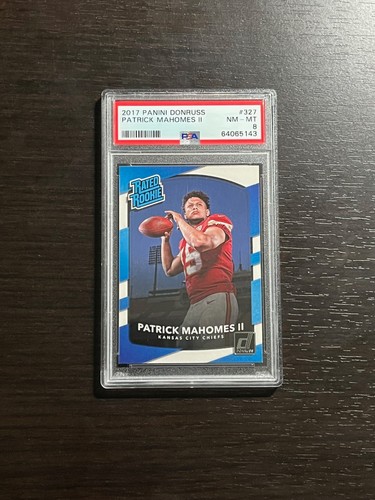
Entry-level products like Panini Donruss and Score are paper-based, cheap, and generous with the card count. Donruss is famous for its Rated Rookie logo, the same stamp collectors have chased for years. These are the right place to start. A base 2020 Donruss Joe Burrow rookie sells for around $11.77 raw and roughly $57.92 in a PSA 10, which tells you exactly what entry-level looks like: real cards of real stars, priced so you can actually collect them.
The mid-tier is where most of the hobby lives. Panini Prizm and Donruss Optic are the standard currency, built on the chrome-style finish that gives them that metallic shine and the resale demand to match. This is where a player's rookie really gets tiered out by parallel. A base 2020 Prizm Justin Herbert rookie runs about $6.89 raw and $56.72 in a PSA 10. A base 2020 Prizm Joe Burrow sits near $15.39 raw and $100 graded. Move up a tier of player and the math jumps. A 2018 Prizm Josh Allen rookie is about $91.31 raw and $407.5 in a PSA 10. The card is the same shape. The name on the front is what moves the price.
The top tier is high-end product like Panini National Treasures, home to the Rookie Patch Autographs numbered to 99 or fewer. These are the trophy pulls, and the prices reflect it. You do not need to play here to collect well, but it helps to see the ceiling. A 2017 Prizm Patrick Mahomes II Silver rookie shows what an elite quarterback does even outside the autograph tier: around $702.28 raw and roughly $6,375 in a PSA 10. That is the gravity a franchise quarterback puts on his cards.
Spend Smart, Singles First
This is where new collectors lose money. Set a monthly budget and hold the line. The most common trap is believing you have to rip sealed boxes to get the cards you want. You usually do not. Buying singles, the individual cards you are actually chasing, is often far cheaper than chasing them through wax.
Run the numbers on a base 2020 Prizm Justin Jefferson rookie. It trades around $4.41 raw and $94.5 in a PSA 10. A hobby box that might contain one costs many times that, and most boxes will not deliver the card you opened it for. Retail packs are cheaper than hobby boxes, but your odds of a meaningful hit drop with the price. Hobby boxes guarantee autos or relics, but you pay a premium for the guarantee. If you want a specific player, the single is almost always the smarter buy.
Protect Every Card That Matters
Protect your cards the day they arrive. It is the simplest habit in the hobby and the one beginners skip. Penny sleeve first, then a toploader. Do it for anything you think carries even a little value, and do it before the card gets handled. A 2018 Prizm Lamar Jackson rookie that grades clean is worth around $295.51 in a PSA 10 against roughly $31 raw, and the difference between those numbers is condition. Corners and surface are everything when you grade. Cheap supplies are the best insurance you can buy.
What to Chase This Week
Rookie cards are still the engine, quarterbacks most of all. Low-numbered parallels and the marquee case-hit inserts hold up. Landing spot and playing time decide a rookie's value, so watch how new draft picks settle in and who is actually starting.
For a starter move, pick a player you like, ideally a solid name rather than the most expensive card on the board, and find their entry-level Donruss Rated Rookie. A clean raw base rookie often runs well under $50, which makes it a low-risk way to learn the market and build the habit of sleeving and toploading everything you keep. Start there, get a feel for how prices move, and scale up once you trust your eye.