
New collectors lose money the same way every time. They see a hot rookie, they buy a raw card at a graded-card price, and they watch it sit. The fix is not luck. It is understanding what actually moves a card's value, then buying against it.
A collection is not built by chasing every hype train. It is built by knowing why a card is worth something, not just that it is. Three things decide that. Get all three right and you have a card with a floor. Get one wrong and the rest does not matter.
Player, Scarcity, Condition
Start with the player. A LeBron James rookie carries value because James is a first-ballot Hall of Famer with a twenty-year track record. His 2003 Topps Chrome base #111 sits around $1,400 raw and over $12,000 in a PSA 10. That is not hype. That is two decades of demand. A one-season rookie who fades does the opposite. The card spikes, everyone piles in, then the price falls off a cliff. Unless you are ready to flip inside a week, betting on a short-term spike is a losing game for a beginner.
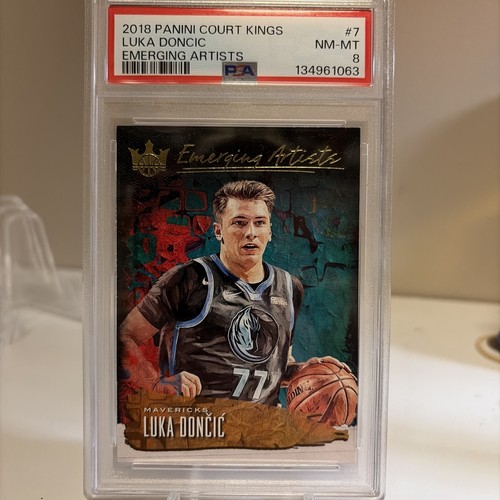
Then scarcity. Print runs and parallels decide how many copies exist. Take Luka Doncic's 2018 Panini Prizm rookie. The base #280 runs about $61 raw and roughly $160 in a PSA 10. The Silver parallel of the same card jumps to around $417 raw and over $1,500 in a PSA 10. Same player, same year, same design. The only difference is how many were printed. A numbered Gold parallel, where only ten exist, climbs further still. But scarcity alone is worthless. A 1/1 of a player riding the G-League bench is still a card nobody wants. Rarity only pays when the player carries demand behind it.
Last, condition. A raw card can look flawless to your eye and still come back a 9. A PSA 10 Gem Mint is the target. A PSA 9 is excellent but routinely sells for a fraction of the 10. Look at that Luka base again: the gap between a $61 raw copy and a $160 PSA 10 is the grade. Never pay 10 money for a raw card unless you can grade it yourself and you are certain it gems. Assume raw is a 9 until proven otherwise.
Smart Buys on a Budget
You do not need a chase card to start. You need a foundation of solid, gradeable cards you actually like owning. The move is to target good players whose parallels still sit cheap.
Mikal Bridges is the textbook example. His 2018 Prizm Silver #289 runs about $5 raw and around $40 in a PSA 10. That is a graded, sharp-looking parallel of a real rotation starter for the price of lunch. The base version is even cheaper at roughly $2 raw. It will not rocket like a Luka Silver, but it has a floor and room to move if his career keeps climbing.
Franz Wagner works the same way. His 2021 Prizm base #310 is about a dollar raw and $33 in a PSA 10. The Silver parallel of that card climbs to roughly $8 raw and near $177 in a PSA 10. He is a young, rising starter, and that Silver is a genuinely good-looking card. A raw base copy for a dollar is a low-risk entry point. The Silver is where the upside lives if he breaks out.
Do the Research First
Before you buy anything, look up the card. Check what a PSA 10 actually sold for. Check the PSA 9. Check raw. Compare real sold prices across eBay and the public auction houses. Patterns show up fast.
The biggest red flag is a raw card selling for nearly the same price as a graded PSA 9. That means someone is paying a guaranteed-grade price for a card that has not been graded. Do not be that buyer. Reading those price gaps is how you find value instead of paying for hope.
What to Do This Week
Pick one or two players whose careers you would follow anyway, not whoever is hot this month. Focus on their rookie-year cards, because that is where long-term value lives. On anything over $30, buy graded first. A PSA 9 removes the condition gamble for a small premium. If you are buying raw, keep it under $20 so a bad grade does not cost you much. And treat current-year retail wax as entertainment, not investment. Print runs are massive and the odds of pulling a card that covers the box are brutal.
Starting a collection should be fun, not stressful. Take your time, learn the market, and buy against real numbers instead of headlines. Do that and you build something with value instead of a stack of paperweights.