
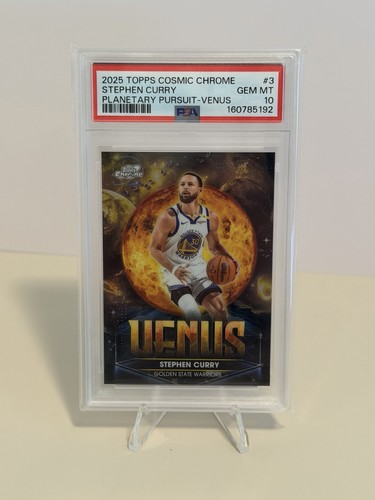
Stephen Curry is a modern blue chip. His cards trade like one. Four titles, two MVPs, and the all-time three-point record put him in a tier where demand does not fade between seasons. The comps back that up. His 2009 Topps Chrome rookie carries real weight, and the parallels stacked on top of it stretch the price ladder a long way. This is a market built on a finished resume, not a hot playoff run.
Start with the foundation. The base 2009 Topps Chrome #101 moves around $2,835 raw and clears $31,681 in a PSA 10. The floor is high. Now climb one rung, to the Refractor of that same card. It runs near $9,099 raw, and a PSA 10 has sold for $105,293. Same player. Same set. Same year. The only difference is the shiny parallel and the scarcity behind it, and the market pays six figures for that difference.
Chrome Is Where the Premium Lives
Compare the chrome rookie to the paper one and the gap teaches the whole lesson. The base 2009 Topps #321, his flagship paper rookie, sits around $1,143 raw with a PSA 10 near $13,171. Real card. Real price. But the chrome version commands more than double in a 10, and the Refractor doubles that again. Collectors pay up for the format and the lower print run. They always have.
Gold pushes it further. The 2009 Topps Gold #321 runs about $4,162 raw and $20,369 graded. The Gold Refractor from the chrome set is numbered to just 50. It is rarer still, and it trades in the low six figures graded. These are the cards that separate a casual Curry collection from a serious one. Scarcity is the engine. The gold-numbered parallels sit on top of it.
The Prizm Ladder
Prizm is where most collectors actually shop, and Curry's run there is a clean case study. His 2012 Panini Prizm base #72 is reachable at roughly $81 raw and $450 in a PSA 10. The Silver Prizm of that same card jumps to around $767 graded. The 2012 set was the first Prizm ever made. A Silver of an all-time great from year one holds well, even though it is not technically a rookie.
The 2013 Prizm tells a similar story for less money. The base #176 is cheap, about $13 raw and $126 in a 10. The Silver of that card clears $833 graded. The Green parallel sits near $322. The pattern repeats every year. Base card is the patient buy. The colored parallels carry the premium. Want exposure without overpaying? The base is fine. Want the ceiling? You pay for the parallel.
Grading and Scarcity
Pop counts decide a lot here. A base card with hundreds of PSA 10s behaves nothing like a Refractor with a handful. When the population is high, the grade matters less and the raw scarcity of the card does the heavy lifting. When the population is tiny, like on those gold-numbered parallels, a clean PSA 10 becomes its own asset. Check the pop report first. The label reads the same whether 30 copies exist or 3,000.
Raw grading upside is real on Curry too. A 2012 Prizm base sells around $81 raw and $450 in a 10. That spread means a clean copy with strong centering can turn a small buy into a four-figure slab. The math works best on the base and the lower parallels, where the raw price is modest and the graded jump is steep. Buy copies you can actually inspect. Sharp corners, centered surfaces, and let the grade do the work.
What the Comps Say to Do
Want a blue-chip hold? Target the 2009 Topps Chrome rookie and its Refractor. Those anchor the whole market and have the cleanest demand. Tighter budget? The 2012 Prizm Silver is historically significant and still sits well under the chrome rookies. Like grading? The base Prizm rookies offer cheap raw entry with real graded upside.
Do not chase every new parallel that drops. Focus on the cards that tell the story of his career, and let the sold prices make the call instead of the hype. Curry's resume is finished. The demand has proven durable. This is a long-term market for collectors who check the comps first.