10 Most Valuable Baseball Rookie Cards
Baseball is the hobby's deepest rookie card market, and also the one with the widest era spread. A collector chasing the top ten baseball rookies has to move across pre-war tobacco and strip cards, late-thirties Gum, Inc. sets, the Bowman and early Topps runs of the forties and fifties, the Topps monopoly years, and the premium inserts of the nineties. This list is built from publicly reported auction results, PSA and SGC population reports, and the sets the hobby treats as flagship for each player. We kept it to one card per player so the list captures the full arc rather than stacking multiple Mantles and Ruths. The historical anchors on this list are settled, but the next generation of baseball rookie cards is still being written; the 2026 MLB prospect cohort we are tracking covers the active draft and Bowman Chrome window where future entries on a list like this one start out.
A note on pricing. Every number below is a reference to a public sale, not a guarantee of what a copy will bring today. Vintage baseball has compressed less than modern cards did through 2022 and 2023, but premium nineties cards (Jeter SP, Griffey Upper Deck) did pull back from their 2021 peaks. Always check a dated sold comp before you act on any of this. When in doubt, our card valuation walkthrough covers the comp-pulling process end to end.
At a glance
| Rank | Card | Era | Why it leads |
|---|---|---|---|
| 1 | 1914 Baltimore News Ruth (pre-rookie) | Pre-war | Highest public baseball rookie sale ever recorded |
| 2 | 1951 Bowman #253 Mickey Mantle | Postwar | The canonical Mantle rookie and 1950s hobby anchor |
| 3 | 1968 Topps #177 Nolan Ryan | Late vintage | Scarce high-grade Topps rookie of the strikeout king |
| 4 | 1939 Play Ball #92 Ted Williams | Pre-war | Williams' only true rookie card, set-flagship condition-sensitive |
| 5 | 1955 Topps #164 Roberto Clemente | Postwar | Vanishingly rare at PSA 10, cultural weight compounds price |
| 6 | 1954 Topps #128 Hank Aaron | Postwar | Aaron's only Topps rookie, 1954 set's top card |
| 7 | 1951 Bowman #305 Willie Mays | Postwar | High-series Bowman rookie with pronounced grade compression |
| 8 | 1948 Leaf #79 Jackie Robinson | Postwar | Flagship 1948 Leaf card, off-register print runs |
| 9 | 1993 SP Foil #279 Derek Jeter | Modern vintage | The defining nineties foil rookie, surface-sensitive |
| 10 | 1989 Upper Deck #1 Ken Griffey Jr. | Modern vintage | Card that launched the modern premium-rookie era |
The ten cards, in detail
-
1914 Baltimore News Babe Ruth Pre-Rookie
The 1914 Baltimore News Ruth is a minor-league promotional card issued by a Baltimore newspaper during Ruth's single season with the Baltimore Orioles of the International League, before his sale to the Boston Red Sox. Fewer than ten graded copies are known to exist. A PSA 2 sold through Memory Lane Inc. for $7.2 million in , which remains the highest publicly reported baseball rookie card sale on record. A 1916 M101-5 Sporting News Ruth is sometimes treated as an alternate rookie for Ruth's first Major League card, but the Baltimore News issue predates every other Ruth card and is the one the hobby consensus ranks highest.
If you are looking for the ceiling on any baseball rookie, this is the card that sets it. Scarcity plus subject plus newspaper-issue context drive the price. For the broader definition of what counts as a rookie card across eras, see our what is a rookie card guide.
-
1951 Bowman #253 Mickey Mantle Rookie
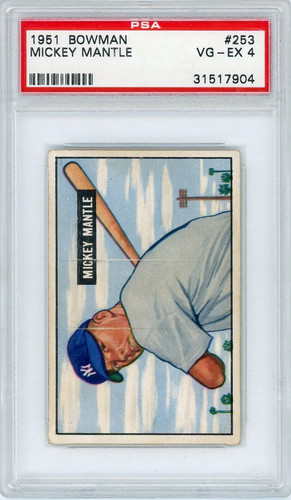
The 1951 Bowman #253 is Mantle's true rookie, not the more famous 1952 Topps #311 (which is a second-year card but carries greater cultural presence). A PSA 9 sold publicly through Heritage for $2.88 million in , and PSA 10 examples have changed hands in the low to mid seven figures since. Population is tight at PSA 9 and extremely thin at PSA 10 given 1951 print centering and the card's position in the high-series (#253) run, which was short-printed and distributed in fewer packs than the low series.
The 1952 Topps Mantle is a second-year card, not a rookie, which is why it sits out of this list despite its higher public-sale ceiling. A graded 1952 Topps Mantle SGC 9.5 sold for $12.6 million in , still the highest public sports-card sale on record, but that card belongs to the set that put Topps into the modern baseball card business rather than to Mantle's rookie year.
-
1968 Topps #177 Nolan Ryan Rookie
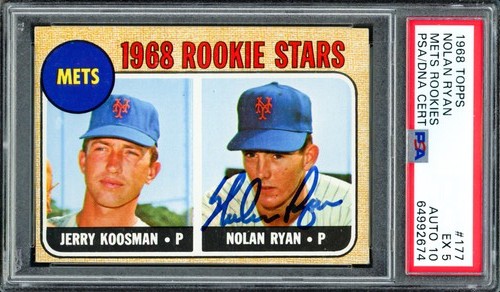
This is Ryan's only Topps rookie, shared with fellow Mets pitcher Jerry Koosman on a dual-player rookie cup card. A PSA 10 sold publicly through Goldin for $1.44 million in , setting the record for a 1968 Topps card and any Ryan rookie. PSA 9 copies trade in the low six figures, and PSA 8 copies sit in the high four to low five figures depending on eye appeal. 1968 Topps used a burlap border pattern that is notoriously hard to grade clean because chipping on the yellow team-name strip shows under any magnification.
Ryan's 27-season career and 5,714 strikeouts are the narrative driver. Koosman on the same card is a condition-scarce footnote for most collectors, but 1968 Topps checklist completists care because Koosman is otherwise only on his 1969 solo Topps card.
-
1939 Play Ball #92 Ted Williams Rookie
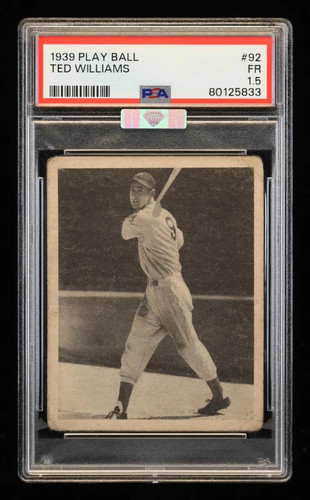
The 1939 Play Ball set from Gum, Inc. is one of the two pre-war flagship baseball sets (alongside 1933 Goudey), and Williams' rookie sits at the top of its checklist. The card is single-printed, black-and-white, and extremely sensitive to centering and surface condition. Public PSA 9 sales have reached the low seven figures, with a Heritage sale of a PSA 9 crossing $3 million in . Lower grades from PSA 4 through PSA 7 trade actively in the low five to low six figure range depending on eye appeal.
The 1939 Play Ball set also includes rookies for Joe DiMaggio (who also has earlier rookie cards), Bob Feller, and Enos Slaughter, which is part of why the set carries hobby weight beyond just the Williams card. For grade-sensitivity context on pre-war cards, our SGC grading guide covers how the major graders compare on black-and-white pre-war issues.
-
1955 Topps #164 Roberto Clemente Rookie
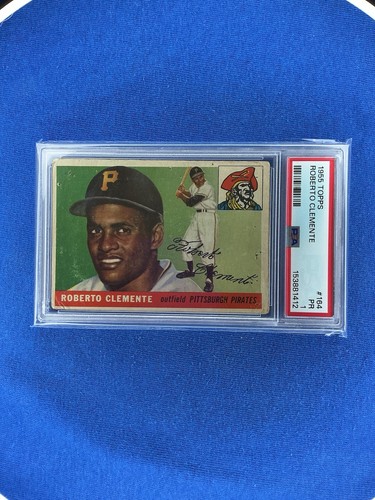
Clemente's rookie sits in the horizontal-format 1955 Topps set, which is the same year Sandy Koufax made his rookie appearance. PSA 10 copies are vanishingly rare (fewer than ten at the current pop count) and have crossed the low seven figures in private sales. PSA 9 copies trade publicly in the mid six figures, with a Goldin PSA 9 sale at $478,000 in . PSA 8 copies have settled into the five figure range post-2022, which is where most serious Clemente collectors operate.
Clemente's career-ending plane crash in 1972 while delivering relief supplies to Nicaragua gives the card cultural weight that compounds its scarcity. The 1955 Topps set also produced Harmon Killebrew and Al Kaline rookies, both of which are Hall of Fame cards trading a tier below Clemente and Koufax.
-
1954 Topps #128 Hank Aaron Rookie
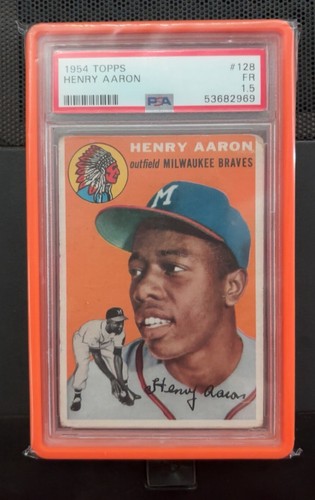
The 1954 Topps set was Topps' first set with Aaron, Banks, and Kaline rookies, and Aaron's card is the set's flagship. A Memory Lane PSA 10 sold for $1.1 million in , and the PSA 9 grade has changed hands in the low to mid six figures since. 1954 Topps used a two-photo design with a portrait and a small action shot, printed on high-contrast stock, which makes centering and print-line defects unusually visible at grading time.
Aaron's career home run total (755) and his sustained excellence across 23 seasons anchor the card's narrative. The 1954 Topps set as a whole is considered one of the cleanest sets for Hall of Fame rookie concentration, with Banks and Kaline as the secondary flagships.
-
1951 Bowman #305 Willie Mays Rookie
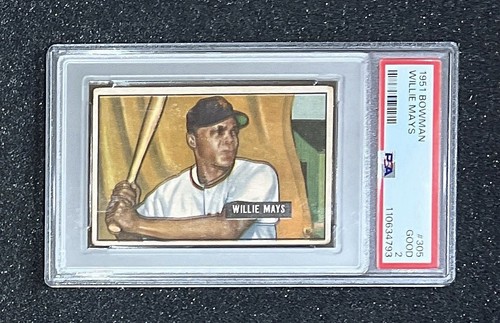
Mays' rookie shares the 1951 Bowman high-series block with Mickey Mantle at #253, which is the structural reason both cards are short-printed relative to the rest of the set. A PSA 9.5 (half-grade) sold through Heritage for $1.05 million in , and the straight PSA 9 has sold publicly in the mid to high six figures. PSA 10s have not surfaced at public auction. Lower grades from PSA 4 to 7 sell in the low five figures, which is where most Mays rookie activity actually happens.
Mays' 1952 Topps #261 and 1952 Bowman #218 are his second-year cards, both trading a tier below the 1951 Bowman rookie. If you are cross-shopping between the 1951 Bowman and the 1952 Topps at similar grades, our card valuation walkthrough breaks down the rookie-versus-second-year gap in detail.
-
1948 Leaf #79 Jackie Robinson Rookie
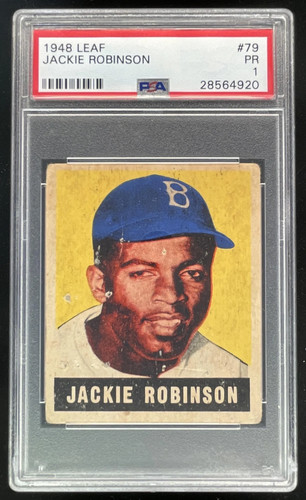
The 1948 Leaf set (issued over 1948 and 1949) is Robinson's rookie card, released in the year after he broke the color barrier with the Brooklyn Dodgers. Public PSA 9 sales land in the mid six figures, with a Memory Lane PSA 9 crossing $650,000 in . The 1948 Leaf print run was off-register and heavily miscut, which is why high-grade copies are so thin and low-grade copies (PSA 3 to PSA 5) still clear five figures routinely.
Robinson also has a 1948 Bowman #6 rookie card, which is generally considered the secondary rookie because the Leaf printing is more visually distinctive and the card has greater hobby heritage around it. Both cards trade as rookies and both routinely appear in Robinson-only sub-collections.
-
1993 SP Foil #279 Derek Jeter Rookie
The 1993 SP set from Upper Deck was a single-year premium release, and the Jeter rookie at #279 is the set's flagship card. A PSA 10 sold through Goldin for $600,000 in , still the peak for the card. PSA 9 copies compressed 40 to 60 percent off 2021 peaks through the next two years and sit in the low five figures in 2026. The card is surface-sensitive because the foil stock scratches and chips easily, which is why PSA 10 population is thin.
Jeter also has a 1993 Topps #98 rookie, 1993 Upper Deck #449 rookie, and 1993 Bowman #511 rookie, all of which trade as rookies and all of which sit well below the 1993 SP in market value. The SP Foil is the one the hobby treats as the Jeter rookie the same way the Jordan Fleer is the Jordan rookie in basketball.
-
1989 Upper Deck #1 Ken Griffey Jr. Rookie
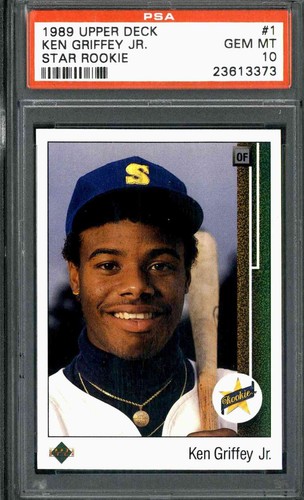
Upper Deck's 1989 debut set put Griffey's rookie at card #1, a deliberate choice that set the hobby's expectation for premium rookie placement going forward. The card is printed on Upper Deck's first-year heavier cardboard with a tamper-evident foil hologram on the back, and production was higher than any vintage card on this list. Population is therefore enormous, which caps the upside: even at BGS 10 Pristine the card holds only the low five figures, and PSA 10 copies settled into the low to mid four figures after 2021.
Griffey's 1989 Bowman #220 rookie and 1989 Fleer #548 rookie are the secondary Griffey rookies, both trading as rookies and both sitting a tier below the Upper Deck. The Upper Deck is on this list because it defined the modern premium-rookie era, not because it has the highest ceiling of the ten. If you are cross-shopping Griffey rookies, the Upper Deck carries the cultural weight and the Bowman offers the better condition-scarcity narrative.
What these ten cards have in common
Three patterns show up across the list. First, pre-war and early postwar placement carries more weight than raw career stats: Ruth's 1914 Baltimore News leads because of scarcity and subject, Williams' 1939 Play Ball leads its era because Play Ball was the pre-war flagship, and Mantle and Mays anchor the postwar decade because 1951 Bowman is the set the hobby treats as foundational. Second, grade compression matters more at the top than in the middle: one step from PSA 8 up to PSA 9 on these vintage cards often runs 4x to 10x the price, and the jump from PSA 9 to PSA 10 can reach 20x or more on condition-sensitive issues like 1955 Topps Clemente or 1968 Topps Ryan. Third, set context often matters as much as subject: the 1951 Bowman high-series short-print structure amplifies both the Mantle and Mays rookies, and the 1948 Leaf print-quality issues amplify the Robinson.
A fourth pattern worth calling out: serial-numbered premium parallels (the structure that dominates modern basketball and football rookie lists) barely appear on this list because baseball's top cards are largely pre-1990 base cards. Jeter's 1993 SP is the closest thing to a modern premium-insert equivalent, and even it is a foil base card rather than a numbered parallel. This is part of why baseball has compressed less than basketball through the 2022 to 2023 cycle: base vintage with thin pop reports holds its floor better than numbered modern parallels with full pop reports. Our what is a parallel guide explains how that numbering structure works in the modern era.
Cards that almost made the list
A handful of cards have a real case for the top ten that we did not include so the list could cover more eras and more players. The 1909-11 T206 Honus Wagner is often grouped with baseball rookies in mainstream coverage, but strict hobby convention does not treat it as a rookie (Wagner debuted in 1897 and has earlier cards), which is why it sits outside this list despite its status as the hobby's most famous card. The 2009 Bowman Chrome Draft Mike Trout Superfractor /1 sold for $3.93 million in , but that is a 1-of-1 parallel rather than a base rookie, and the base 2011 Topps Update Trout sits at a lower tier. The 2001 Bowman Chrome Draft Albert Pujols rookie and its refractor parallels were considered for the top ten, with Gold Refractor /50 copies trading in the mid five figures at peak. The 1955 Topps #123 Sandy Koufax rookie is a flagship 1955 Topps card alongside Clemente, with PSA 10 copies into the mid six figures. The 1957 Topps #35 Frank Robinson rookie, the 1975 Topps #228 George Brett rookie, and the 1975 Topps #616 Robin Yount rookie all anchor their respective decades a tier below the ten.
If you are building a Hall-of-Fame-focused baseball rookie collection from the ground up, the entry points outside this top ten are usually 1952 Topps high-number rookies (Eddie Mathews, Hoyt Wilhelm), 1954 Bowman rookies (Banks, Kaline in a second set), 1956 to 1958 Topps rookies (Luis Aparicio, Brooks Robinson, Orlando Cepeda), 1960s Topps rookie cups (Carlton Fisk 1972, Johnny Bench 1968), and 1980s Topps rookies (Ripken 1982, Gwynn 1983, Boggs 1983, Puckett 1985). Most of these trade from the low tens to low hundreds of dollars at PSA 8 to PSA 10 and form the practical middle of the vintage-and-junk-wax-border baseball market.
How to use this list
Treat the ten cards above as market anchors, not buy recommendations. The prices we cite are public references to specific sales. A copy you see listed today may be a different condition, a different grade, or a different moment in the market than the sale we cite. Before you buy, pull sold comps on the exact card and grade you are looking at, not the headline sale. Our how to value a card guide covers the process step by step, our spotting fake cards guide covers the counterfeit exposure on high-dollar vintage (which is real on pre-1970 cards), and our state of PSA 10 premiums report covers the grade-ladder math that drives the price spread on every card on this list.
If you are deciding between a higher-ticket pre-war card and a lower-ticket postwar or modern-vintage base, pre-war almost always holds grade better across cycles because supply cannot grow, but postwar Topps rookies carry more depth across the PSA 8 to PSA 9 band, which is where most collector money actually sits. That tradeoff is the one every serious baseball collector eventually has to make.
Frequently asked questions
What is the most valuable baseball rookie card?
The 1914 Baltimore News Babe Ruth pre-rookie. A PSA 2 sold for $7.2 million through Memory Lane in August 2021, the highest publicly reported baseball rookie card sale on record.
Is the 1952 Topps Mickey Mantle a rookie card?
No. The 1952 Topps #311 is Mantle's second-year card. His true rookie is the 1951 Bowman #253. The 1952 Topps holds the highest public sports-card sale on record at $12.6 million, but it is not a rookie card.
Why isn't the T206 Honus Wagner on this list?
The T206 Wagner is not a rookie card under hobby convention. Wagner debuted in 1897 and has earlier cards. It is the hobby's most famous card, but not a rookie, so it sits outside a rookie-card ranking.
Why are vintage baseball rookie cards so condition-sensitive?
The price gap between grades is steep. It often runs 4x to 10x between PSA 8 and PSA 9, and up to 20x between PSA 9 and PSA 10 on condition-sensitive cards like the 1955 Topps Clemente or the 1968 Topps Ryan.
Which modern baseball rookie cards could join this list?
The strongest modern candidates are the 2009 Bowman Chrome Mike Trout and the 2001 Bowman Chrome Albert Pujols. The current draft and Bowman Chrome class is where future entries on a list like this one start out.
How should I value a baseball rookie card before buying?
Pull a dated sold comp for the exact card and grade, not the headline sale. Premium cards have pulled back from their 2021 peaks, so a recent comp matters more than a record price. This page is reference information, not financial advice.