10 Most Valuable Football Rookie Cards
Football has a narrower top of market than baseball, but the top is stacked. One modern insert, the signed Brady Championship Ticket from 2000 Playoff Contenders, sits at the ceiling because of a print-run and serial-number structure the vintage base cards cannot match on scarcity. The pre-war and postwar vintage sets fill the rest of the list with flagship quarterback, running back, and defensive cards. This list is built from publicly reported auction results, PSA and SGC population reports, and the sets the hobby treats as flagship for each player. We kept it to one card per player so the list captures the full arc across the three football eras (pre-war, postwar Topps and Philadelphia, and modern inserts) rather than stacking multiple Brady or Mahomes cards.
A note on pricing. Every figure below references real sold comps and public auction results, not a guarantee of what a copy will bring today. Football modern rookie cards (Mahomes, Herbert, Allen) compressed heavily through 2022 and 2023, with Mahomes PSA 10 base Prizm copies giving back most of their 2021 peak. Vintage football held grade better than modern, but PSA 9 and PSA 10 vintage ceilings rest on a handful of sales and can move in either direction. Always pull a dated sold comp before you act on any of this. When in doubt, our how to value a card guide walks through the comp-pulling process end to end.
At a glance
| Rank | Card | Era | Why it leads |
|---|---|---|---|
| 1 | 2000 Playoff Contenders Championship Ticket #144 Tom Brady Auto /100 | Modern insert | Highest public football rookie sale ever recorded |
| 2 | 1935 National Chicle #34 Bronko Nagurski | Pre-war | Pre-war football flagship, thin high-grade pop |
| 3 | 1958 Topps #62 Jim Brown | Postwar | The Topps football flagship of the late fifties |
| 4 | 1957 Topps #138 Johnny Unitas | Postwar | First modern Topps football set, Unitas is the anchor |
| 5 | 1965 Topps #122 Joe Namath | Late vintage | Tall-boy format short-print, extreme condition sensitivity |
| 6 | 2017 Panini Prizm #269 Patrick Mahomes | Modern base | Modern era flagship, defines the Prizm-Mahomes tier |
| 7 | 1984 Topps #123 Dan Marino | Late vintage | Flagship of the 1984 QB-class set that also has Elway |
| 8 | 1981 Topps #216 Joe Montana | Late vintage | Montana's only base rookie, set also contains LT |
| 9 | 1986 Topps #161 Jerry Rice | Modern vintage | Greatest receiver of all time, print-sensitive 1986 stock |
| 10 | 1966 Philadelphia #38 Gale Sayers | Late vintage | Philadelphia Gum NFL era anchor rookie |
The ten cards, in detail
-
2000 Playoff Contenders Championship Ticket #144 Tom Brady Auto Rookie
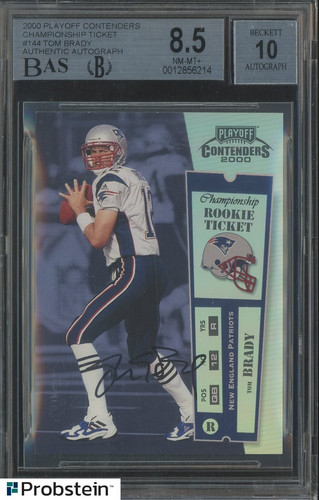
The 2000 Playoff Contenders football set contains three Brady rookie auto tiers. The base Rookie Ticket auto (/500) is the most common, the Playoff Ticket auto (/100) sits in the middle, and the Championship Ticket (numbered to just /100 and stamped with the Championship Ticket foil) sits at the top. A high-grade copy with a clean auto grade set the football record at Lelands in , the highest publicly reported sale for any football card. Goldin moved another Championship Ticket into seven figures across 2022 and 2023, and the Playoff Ticket auto /100 has changed hands in the six-figure range at PSA 10.
This card sits at the ceiling because the combination cannot be reproduced: Brady's seven Super Bowl wins, Contenders' standing as the rookie-auto franchise for football, the /100 serial number, and the on-card signature stock produced in 2000, before the sticker-auto era took hold in the sport. For more on how serial-numbered modern inserts price differently than vintage base cards, our what is a parallel guide covers the mechanics.
-
1935 National Chicle #34 Bronko Nagurski Rookie
The 1935 National Chicle set is football's pre-war flagship, a 36-card issue from a Massachusetts gum company that produced the first nationally distributed set with color artwork on NFL players. Nagurski at #34 is the set's most-chased card. A PSA 8 copy crossed the auction block at Goldin in for a six-figure result, and stronger copies have changed hands privately well above that. Population is very thin above PSA 7 because the 1935 print run was small, distribution was regional, and the artwork-heavy design is unforgiving on print registration and centering.
National Chicle also issued rookies for Ernie Nevers, Dutch Clark, and Knute Rockne in the same set, all of which command five figures in mid-grade. For pre-war grading context, our SGC grading guide covers how SGC handles vintage football versus PSA, since SGC has historically been the more common grader for pre-war football.
-
1958 Topps #62 Jim Brown Rookie
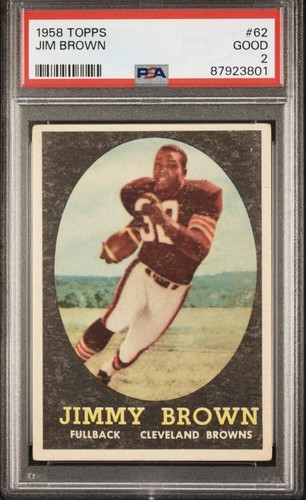
Jim Brown's rookie sits in the 1958 Topps set, the one the hobby treats as the first modern Topps football checklist with consistent design and nationwide distribution. A PSA 10 brought a six-figure result at Heritage in , and PSA 9 copies trade in the five-figure range on real sold comps. The card is condition-sensitive at the top because 1958 Topps used a print process that left visible print lines on the white jersey stock, and those show under any magnification at grading time.
Brown's 1957 season with the Cleveland Browns (the year that technically predates this 1958-issued card) was as a rookie out of Syracuse, and the card reflects his first NFL season. Brown's career (the all-time rushing record at retirement, nine Pro Bowls in nine seasons, 1964 NFL championship) anchors the card's hobby weight alongside the cultural context of his post-football career.
-
1957 Topps #138 Johnny Unitas Rookie
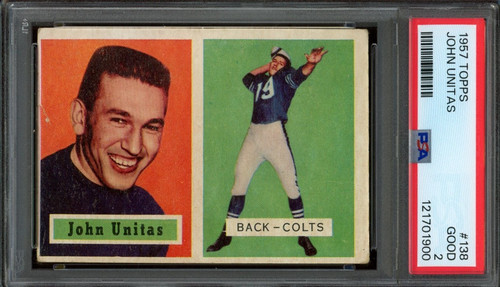
The 1957 Topps football set was Topps' first standard-size NFL-only release after the company split distribution between football and baseball. Unitas at #138 is the set's flagship card and the anchor of its long second series. A PSA 10 changed hands at Heritage in for a strong five-figure result, and PSA 9 examples settle into five figures as well. The 1957 design runs horizontal and chips on the bottom edge under grading, which is why high-grade copies are so thin despite the set being better distributed than the 1956 Topps issue (that one used Bowman-era rights and does not carry Unitas).
The 1957 Topps set also has rookies for Bart Starr (#119) and Paul Hornung (#151), both of which trade a tier below the Unitas and both of which are considered flagship cards in their own right. Starr's 1957 Topps is the most common secondary pickup for collectors who miss on Unitas, and the Hornung is the set's highest-numbered Hall of Fame rookie.
-
1965 Topps #122 Joe Namath Rookie
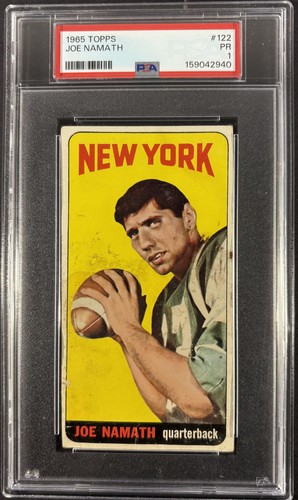
The 1965 Topps football set is the one the hobby calls the "tall boy" set because the cards measure 2.5 inches by 4.75 inches, noticeably taller than the standard 2.5 by 3.5 trading card format Topps used every other year. Namath's rookie at #122 is the set's flagship. A PSA 8 brought a six-figure result at Goldin in , and the card is so condition-sensitive that a clean PSA 10 commands six figures on the open market. The tall-boy format means centering and corner wear show more readily than on standard-size cards, which is why the PSA 10 population is in the single digits.
The 1965 Topps set covered only the American Football League, because Topps held the AFL license while Philadelphia Gum held the NFL license from 1964 to 1967. That licensing split is the structural reason a rookie of the era appears on either Topps (AFL) or Philadelphia (NFL) but not both, and it is why the Philadelphia Gum set at #10 on this list also anchors a separate part of the decade.
-
2017 Panini Prizm #269 Patrick Mahomes Rookie
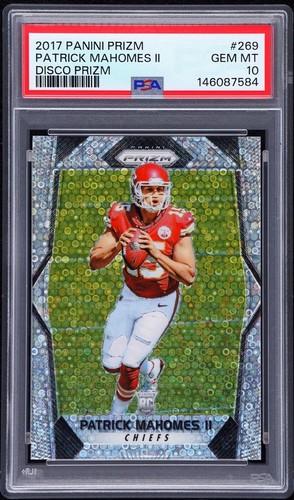
The 2017 Panini Prizm base rookie is the card the modern football market treats as the Mahomes flagship. A PSA 10 ran up to its peak in 2021, compressed hard through 2022 and 2023 alongside the broader modern-rookie market, and now trades in the low to mid four figures on real sold comps. Population at PSA 10 is high (five figures of graded copies) because the card shipped in retail blaster and hanger boxes as well as hobby, which is why the ceiling sits below the vintage single-sale anchors despite Mahomes' on-field resume of three Super Bowl wins, two MVPs, and a stack of passing records.
Mahomes has a deep rookie ladder beyond the base Prizm. The Silver Prizm is a no-serial parallel that carries a clear premium over the base at PSA 10, the colored Prizm parallels climb from there, the Gold Prizm /10 and Black Finite /1 reach six figures when they surface, and the 2017 Panini National Treasures RPA /99 is the auto-patch ceiling pickup. The base Prizm earns its spot here because it defines the Mahomes entry point, not because it tops his rookie ladder.
-
1984 Topps #123 Dan Marino Rookie
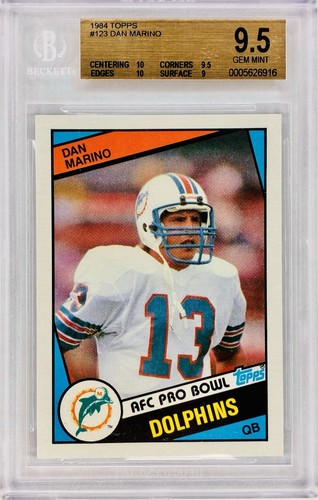
The 1984 Topps set is known as the QB-class set because it contains the rookies of Dan Marino (#123), John Elway (#63), and other names that matter, including Eric Dickerson (#280), Mike Richardson (#208), and Darrell Green (#389). Marino's rookie sits at the top of the set. A flawless PSA 10 brings solid four-figure money, with the gem-grade premium widening sharply over PSA 9 copies. The card is print-sensitive because 1984 Topps used a slightly brittle cardboard stock that shows edge wear readily.
Elway's 1984 Topps rookie at #63 sits a step below Marino at equivalent grades, which makes it a useful comp to work off when you are pricing a Marino copy. The 1984 Topps USFL set, a separate 1984 issue, also carries Steve Young's XRC (extended rookie card), which is not considered his true rookie but gets mentioned alongside the Marino-Elway set.
-
1981 Topps #216 Joe Montana Rookie
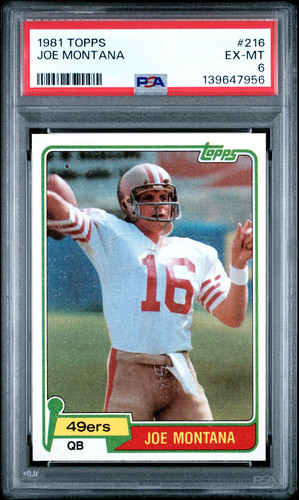
Joe Montana's only rookie sits at #216 in the 1981 Topps set, paired with Lawrence Taylor's rookie at #434 as the two flagship cards of that set. A PSA 10 Montana clears five figures on real sold comps, while PSA 9 copies land in the four-figure range. The card is condition-sensitive because 1981 Topps used a gray-back design that chips readily under grading, and the centering tolerance across the set runs tight.
Lawrence Taylor's 1981 Topps rookie at #434 trades at roughly 40 to 60 percent of the Montana at equivalent grades. The set also contains a rookie for Anthony Munoz (#354), a Hall of Fame offensive tackle whose card trades a tier below the other two. If you want to cross-reference the Montana against other quarterback rookies, our card valuation guide covers the comp-pulling process on era-specific vintage QB rookies.
-
1986 Topps #161 Jerry Rice Rookie
Jerry Rice's 1986 Topps rookie at #161 sits in what is usually called the "Sun Bowl" set because the background artwork on many cards leans on a dusk color palette. A gem PSA 10 sits firmly in five figures, while PSA 9 examples land in four figures. The card uses mid-1980s Topps cardboard stock, slightly more brittle than the 1987 and later sets, which is why PSA 10 copies are far thinner than you would expect for a card printed at the start of the junk-wax era.
Rice's career (the all-time receiving records, three Super Bowl wins, 22 Pro Bowls) anchors the card's narrative. The 1986 Topps set also contains rookies for Steve Young (#374) as a Tampa Bay Buccaneer, Reggie White (#275), and Bruce Smith (#389), all of which trade a tier or two below the Rice. The Young 1986 Topps is often discussed as his true rookie, though the 1984 Topps USFL XRC question complicates that designation for condition-focused collectors.
-
1966 Philadelphia #38 Gale Sayers Rookie
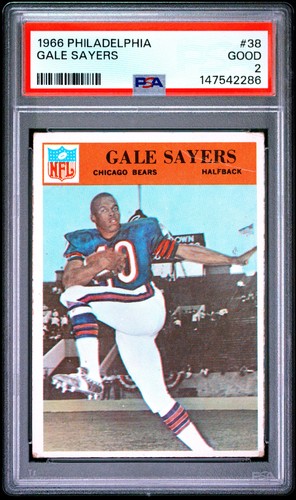
The 1966 Philadelphia set was one of four Philadelphia Gum-issued NFL sets produced between 1964 and 1967. Sayers at #38 is the set's flagship alongside Dick Butkus at #55 (Butkus was a separate team-logo-based card in the same set). A PSA 9 brought a five-figure result at Goldin in , and PSA 10 copies, with their very thin population, command a strong five-figure result when one surfaces. The Philadelphia cards used a consistent white border that shows wear clearly, which is why PSA 9 is the practical ceiling for most copies.
The 1966 Philadelphia set also contains the Butkus rookie at #55 (trading at roughly 50 to 70 percent of the Sayers at equivalent grades) and team-focused cards for every NFL franchise of the era. Sayers' shortened career (seven seasons cut short by knee injuries) does not reduce the card's hobby weight, because his peak years included a record-tying six touchdown game as a rookie and a five-time All-Pro selection span.
What these ten cards have in common
Four patterns show up across the list. First, football's top card is a modern insert rather than a vintage base, which is different from baseball (where 1914 Ruth leads) and different from basketball (where 1986 Fleer Jordan is the flagship but the 2003 LeBron Exquisite RPA sits near the top). The Brady Championship Ticket hits the ceiling because the combination of a low serial number, on-card auto, Brady's career, and the Contenders franchise cannot be reproduced. Second, the vintage block (cards 2 through 5 plus 10) follows the same era-weighting rules as baseball: pre-war scarcity (Nagurski) plus postwar flagship Topps and Philadelphia cards dominate because supply cannot grow. Third, the late-vintage block (cards 7 through 9) is heavily QB-dominated, which reflects the position's career-length premium and the structural reality that QBs produce the hobby's most durable cards.
A fourth pattern worth calling out: football modern compression ran deeper than baseball modern compression through 2022 and 2023. The 2017 Panini Prizm Mahomes PSA 10 gave back most of its 2021 peak, and the Justin Herbert and Josh Allen Prizm rookies from the same era took the same kind of hit. That compression is why only one modern base card (the Mahomes) appears on this list and why the Brady Championship Ticket earns a spot as a modern insert rather than a modern base. Our card market compression cycles report covers the modern-rookie compression dynamic in detail across sports.
Cards that almost made the list
A handful of cards have a real case for the top ten that we left off so the list could cover more eras and more players. The 1948 Leaf #1 Sid Luckman rookie and 1948 Leaf #29 Bob Waterfield rookie are two of the earliest postwar football rookies and pull strong five-figure money in PSA 8. The 1948 Bowman #22 Sammy Baugh rookie anchors the earlier Bowman era and trades in five figures at the same grade. The 1957 Topps #119 Bart Starr rookie, discussed under the Unitas entry, is a top-15 card with gem copies reaching well into five figures. The 1965 Philadelphia #15 Jim Brown, not a rookie but his most valuable non-rookie card, holds five figures at PSA 10. John Elway's 1984 Topps #63 rookie was considered for the top ten but sits a step below Marino at equivalent grades. Lawrence Taylor's 1981 Topps #434 rookie was also in the mix, then dropped to keep the 1981 set to one card (Montana). Eric Dickerson's 1984 Topps #280 rookie runs a tier below Marino and Elway but comes up in any 1984 Topps discussion.
On the modern side, the 2017 Panini National Treasures RPA /99 Patrick Mahomes is the ceiling pickup for collectors who want an auto-patch rookie, and it commands strong five-figure money at PSA 10. The 2020 Panini Prizm Justin Herbert rookie and the 2018 Panini Prizm Josh Allen rookie both run active top-grade ladders, with their colored Prizm parallels carrying four-figure prices at PSA 10. The 2020 Panini National Treasures Joe Burrow RPA /99 and the matching Justin Herbert RPA /99 sit at the top end of four figures into five figures in gem grade. None of these crack the vintage-plus-Brady top ten, but together they form the practical modern middle of the football rookie market.
How to use this list
Treat the ten cards above as market anchors, not buy recommendations. The figures we cite are public references to specific sales. A copy you see listed today may be a different condition, a different grade, or a different moment in the market than the sale we point to. Before you buy, pull sold comps on the exact card and grade in front of you, not the headline sale. Our grading and pricing walkthrough covers the process step by step, our spotting fake cards guide covers the counterfeit exposure on high-dollar football vintage and modern auto cards (both are common attack surfaces), and our state of PSA 10 premiums report covers the grade-ladder math that drives the price spread on every card on this list.
If you are deciding between a higher-ticket vintage card (Unitas, Brown, Namath) and a high-ticket modern insert (the Brady Championship Ticket or a Mahomes NT RPA), the tradeoff is the one every serious football collector faces. Vintage holds grade better across cycles because supply cannot grow, but condition-sensitive pre-1970 football cards have a much narrower pool of PSA 9 and PSA 10 copies than postwar baseball, which amplifies both the upside and the downside. Modern inserts (the Brady is the extreme case) concentrate the supply inside a known serial-numbered print run, which produces a cleaner value formula but ties the card's ceiling more tightly to the subject's continued cultural relevance.
Frequently asked questions
What is the most valuable football rookie card?
The signed Brady Championship Ticket from 2000 Playoff Contenders, numbered to 100. It is the highest public football rookie sale ever recorded.
Why is the Brady Championship Ticket worth so much more than his base rookie?
The Championship Ticket is an on-card auto numbered to 100, while the standard Contenders Brady is unsigned and far more common. The scarcity plus Brady’s resume is what separates them.
Is the 1958 Topps Jim Brown a rookie card?
Yes. The 1958 Topps #62 is Jim Brown’s only rookie card and the Topps football flagship of the late fifties.
Why isn’t the 2017 Prizm Patrick Mahomes ranked higher?
It is a modern base rookie with a large print run. It defines the Prizm-Mahomes tier, but a base card cannot match the ceiling of a serial-numbered vintage auto like the Brady.
Which modern rookies could join this list?
The on-card Contenders and Prizm autos of the current young-quarterback class are where future entries on a list like this one begin.
How should I value a football rookie before buying?
Pull a dated sold comp for the exact card and grade. The 1965 Topps tall boys and pre-war National Chicle are extremely condition-sensitive, so grade drives the price. This page is reference information, not financial advice.