
What a Grade Is Really Worth: Five Cards From $45 to $2 Million
Condition is the single biggest factor in what a card sells for, and on the right cards the difference is enormous. The same card can be worth a few hundred dollars raw and well into six or seven figures in a flawless graded holder. The five examples below, across baseball, basketball, football, and hockey, show how wide that spread can run. Every price is current and pulled from real sales. Each card makes the same point from a different angle: on scarce, condition-sensitive cardboard, you're not really paying for the card, you're paying for the grade.
1959 Topps Bob Gibson #514

The 1959 Topps Bob Gibson rookie sets the tone. This is the same Gibson who threw a 1.12 ERA in 1968, a season so dominant the league lowered the mound the next year to give hitters a chance. His rookie predates all of that. A presentable raw copy goes for about $600, already serious money for a card most casual fans couldn't name. Slab it at a PSA 9 and it clears thirty thousand dollars. The PSA 10 record sits around $124,000. That jump from $600 to six figures is condition and nothing else, plus the plain fact that almost no copies survived sixty-odd years clean enough to grade that high. The raw card is affordable history. The gem is an investment-grade asset.
2018 Panini Prizm Luka Doncic Silver #280
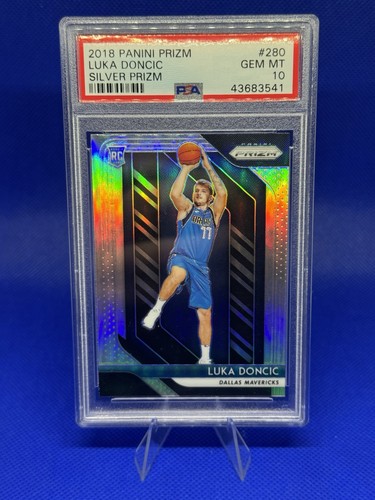
Modern cards hit the same extremes once scarcity shows up. Luka Doncic's 2018 Prizm rookie comes in a full rainbow of parallels, and the Silver Prizm sits well above the base. A plain base rookie is about sixty bucks raw. The Silver, still raw, already clears $400, and gem it in a PSA 10 and you're near $1,500. Same photo, same player, same year. The only variables are scarcity and surface, and the market pays heavily for both. That's the trap with modern cards. The base and the parallel look nearly identical in hand, but they live in different price tiers, and grading only widens the gap.
1989 Score Barry Sanders #257
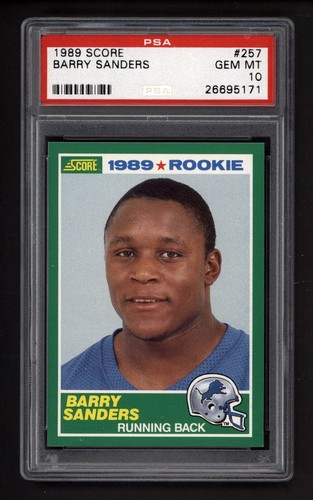
The 1989 Score Barry Sanders rookie works the opposite way. It dropped the year Score, Topps, Fleer, Donruss, and a brand-new Upper Deck were all flooding the market, so raw copies turn up everywhere at about sixty dollars. A PSA 9 only gets to roughly $180, which tells you how common a near-mint copy is. The 10, though, has been changing hands near $2,000. More than ten times the price of the 9, on a mass-produced card. When millions get printed but almost none are flawless, the money concentrates on the handful that are. It looks irrational until condition scarcity clicks, and then it makes perfect sense.
2022 Topps Chrome Update Julio Rodriguez #USC150
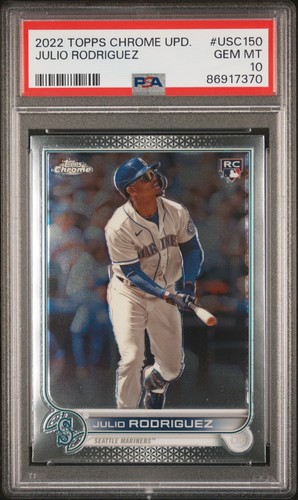
The same pattern holds at the cheap end. Julio Rodriguez took American League Rookie of the Year in 2022, and his Topps Chrome Update rookie changes hands for about three dollars raw. Graded a PSA 10, it's around $45. Roughly fifteen times the raw price, the very same multiplier the five-figure cards show, just with far less money on the line. It's the card we point new collectors to when they want to learn grading, because a misread costs a few dollars instead of a few thousand.
1979 O-Pee-Chee Wayne Gretzky #18
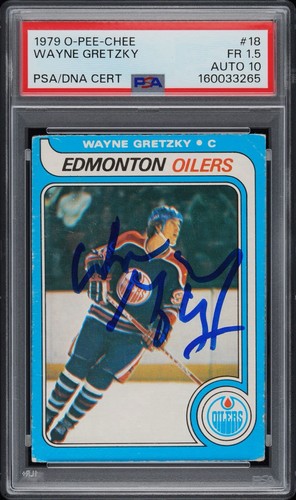
Gretzky's 1979 O-Pee-Chee rookie is the extreme case. It's the most important hockey card in the hobby, his true first card, printed in Canada on cheap stock with famously rough centering, which is exactly why a clean one is so hard to find. A raw example is around $830, fair for what it is. A PSA 9 clears $100,000. And a PSA 10, on the rare day one trades, has hit roughly two million dollars. Eight hundred bucks to two million, the same card, on condition alone. Only a handful of true gems exist, and collectors pay whatever it takes. At the very top, condition isn't a factor in the price. It's the price.
The lesson across all five is the same. On scarce, condition-sensitive cards, the distance between a beat-up raw and a flawless slab isn't a modest premium. It's often the entire value, and it stretches wider the older and rarer the card gets. None of this is a push to chase gem-grade vintage, which is out of reach for most of us. The point is to understand why the numbers look the way they do, so a slab priced at fifty times the raw reads as a rational outcome instead of a mistake.
Track Card Prices in Real Time
Join thousands of collectors using HobbyCardIndex to monitor prices, find grading opportunities, and build smarter portfolios.
Start Free — No Credit Card