
The Grade Divide: 5 Modern Rookies Where PSA 9 vs. PSA 10 Is Everything
Here's a number that still gets me. The same Mahomes rookie can be worth about $1,200 in a PSA 9 and over six grand in a PSA 10. Identical card, one grade apart. People at shows love to wave that off, holding up a 9 and going 'eh, basically a 10,' and on a lot of cards they're right, who cares. But on modern rookies that attitude will quietly cost you. Here's why. These cards were printed in enormous numbers, so near-mint copies are everywhere, but a truly perfect one, dead-centered with sharp corners and no print lines, is genuinely hard to pull. A card grades a 9 instead of a 10 over one slightly soft corner, or a sliver of off-centering you'd need a loupe to catch, or a faint print line near the border. That's all it takes to lop off most of the value. So the market quits paying for 'really nice' and starts paying a fortune for 'flawless.' Here are five modern rookies where that gap isn't a rounding error, it's a multiple, with the real numbers on each.
Patrick Mahomes 2017 Panini Prizm Silver #269
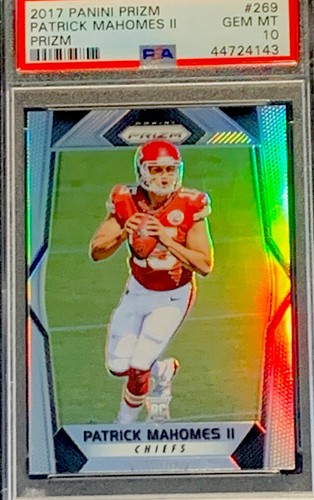
Start with the big one. Back in 2017 most teams reached for Mitchell Trubisky and let Mahomes slide all the way to the tenth pick, which looks insane now. He's since dragged the Chiefs to the Super Bowl over and over and stacked up MVPs, and his Prizm rookie is the card the whole hobby measures football against. Here's the grade thing. A PSA 9 of the Silver parallel runs around $1,260. The PSA 10 has been hitting near $6,375. Five times. For one grade, on the identical card. The 9 is gorgeous, but perfect copies are rare enough that the market basically files the 10 as a separate asset.
Anthony Edwards 2020 Panini Prizm #258
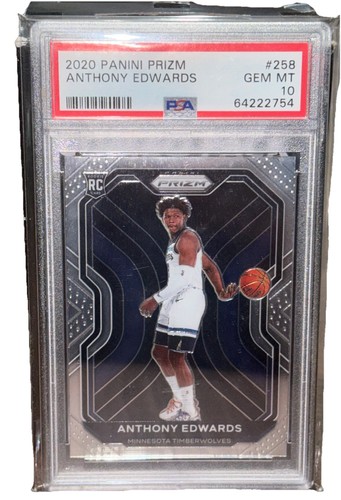
Anthony Edwards went first overall to Minnesota in 2020 and plays like he's personally offended by the rim. His base Prizm runs the same play, just cheaper. A 9 is about $25, a 10 closer to $105. Four to one. I like this as the card you learn on, honestly, because twenty-five dollars is small enough to think clearly about. No sticker shock fogging up the decision. And once that four-to-one ratio clicks on a hundred-dollar card, you understand exactly what's happening on the ones with two extra zeros.
LaMelo Ball 2020-21 Panini Prizm #278
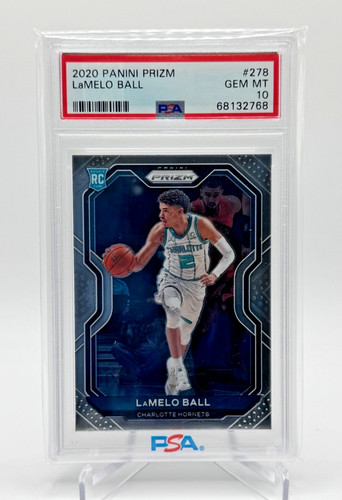
LaMelo was the youngest of the three Ball brothers and the one who actually became a star, winning Rookie of the Year for Charlotte out of that 2020 class. Prizm basketball has a reputation, and it isn't a good one. The factory centering is all over the place. That's the whole engine behind the gap. His base rookie in a 9 sits around $11, but a dead-centered 10 jumps to roughly $40. Almost four times, on a card that's pocket change either way. The card isn't rare. A flawless one is. That's the core of it on modern Prizm.
Shohei Ohtani 2018 Topps Chrome #150
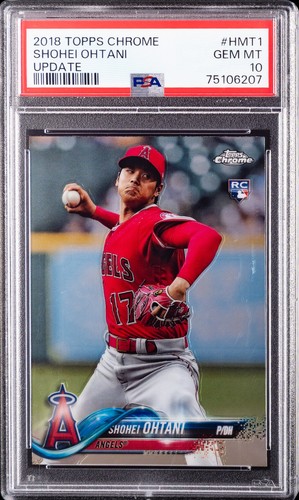
Ohtani breaks the pattern, because even his 'cheap' grade isn't cheap. He's hitting and pitching at a level the sport hasn't seen since Babe Ruth, and the Dodgers handed him $700 million to keep doing it, so his 2018 Topps Chrome rookie is wanted at every grade. A 9 sits near $512. The 10 lands around $1,040. That's barely double, not the four or five times the others pull, and that smaller gap actually tells you something. When demand runs this deep, the 9 holds its ground, because most buyers just want the card and won't go to war over the last tenth of a point.
Ja'Marr Chase 2021 Panini Prizm #337
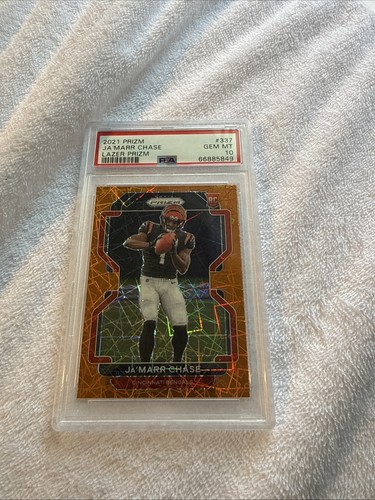
Ja'Marr Chase closes it out, and he's a fun one. He sat out the entire 2020 college season to stay ready for the draft, then walked into Cincinnati, reunited with his LSU quarterback Joe Burrow, and won Offensive Rookie of the Year in 2021. His base Prizm is the gentle example. Raw, a couple of bucks. A 9 around $20, a 10 near $51. Two and a half times for the gem, the smallest split on the list, and that's why I saved it for last. Even on a cheap, common rookie, perfection still gets paid. The pattern never breaks. Only the number of zeros does.
So that's the divide. On modern rookies, a PSA 9 and a PSA 10 aren't the same card with a different sticker, they're often two different price tiers, sometimes by a factor of four or five. The thing to take from it isn't 'only buy 10s.' Plenty of those 9s are smart buys, especially when the gap is small like the Ohtani. It's that you should always know which side of the divide you're paying for before you click buy, because assuming a 9 is 'basically a 10' is how people quietly overpay. Picture two copies of that Mahomes Silver in a case at a show, one a 9 and one a 10, identical to your naked eye, with five grand sitting between them. That's not a ripoff or a typo. It's the market pricing the half-millimeter you can't see. Know the gap, then decide.
Track Card Prices in Real Time
Join thousands of collectors using HobbyCardIndex to monitor prices, find grading opportunities, and build smarter portfolios.
Start Free — No Credit Card