The 10 Most Valuable Modern Hockey Rookie Cards
The top of the modern hockey market belongs to Connor McDavid, Auston Matthews, and Connor Bedard. Their flagship 2015-16, 2016-17, and 2023-24 Young Guns base rookies trade from the mid three figures into the four figures in PSA 10, with McDavid at the top of that range. Canvas parallels and Young Guns auto rookies reach much higher.
Two quick pointers before the list. If you have a modern hockey rookie card and you're weighing whether to slab it, our grading decision framework runs the numbers. And if you're price-checking across tools, here is how HCI compares as a CardLadder alternative on our alternatives to CardLadder page.
How this modern hockey list is different from the all-time list
A modern hockey rookie card and a vintage one do not trade by the same rules, so this list is scoped on purpose. Every card here belongs to a player who debuted in the 2015-16 NHL season or later. You won't find a 1979-80 OPC Wayne Gretzky, a 1951 Parkhurst Gordie Howe, a 1986-87 Topps Patrick Roy, or any of the Young Guns Crosby and Ovechkin era on it. Those belong on the all-time list, and we keep that separate at our 10 most valuable hockey rookie cards page. Mixing eras just buries the modern cards under vintage that a modern hockey collector isn't shopping for.
One brand note up front. Upper Deck has held the exclusive NHL trading-card license since the 2004-05 season, and that exclusivity is still in place in 2026, so the canonical modern hockey rookie is the Upper Deck Series 1 or Series 2 Young Guns base. Background on the brand is on the Upper Deck Company Wikipedia entry. Every card on this list is a Young Guns rookie. SP Authentic and The Cup carry the higher-end auto and patch rookies of the same players at much higher price tiers, and we'll mention them where the chase market on a given player runs through those products.
At a glance: the ranking by debut wave
The table sorts the ten cards by rough current value, and it adds a debut-wave column, because hockey is a sport where the debut cohort tells you a lot about the supply and the surrounding demand for a given rookie. We split the modern era into six debut waves from 2015-16 through 2023-24, and the wave is the unique axis on this table, the thing this list adds that the all-era list does not.
| Rank | Card | Set (year) | Debut wave | Rough PSA 10 range |
|---|---|---|---|---|
| 1 | Connor McDavid | Young Guns (2015-16) | 2015-16 wave | Low to mid 4 figures |
| 2 | Auston Matthews | Young Guns (2016-17) | 2016-17 wave | Mid to high 3 figures |
| 3 | Connor Bedard | Young Guns (2023-24) | 2023-24 wave | Mid to high 3 figures |
| 4 | Cale Makar | Young Guns (2019-20) | 2019-20 wave | Mid to high 3 figures |
| 5 | Elias Pettersson | Young Guns (2018-19) | 2018-19 wave | Two figures into low 3 figures |
| 6 | Mitch Marner | Young Guns (2016-17) | 2016-17 wave | Low to mid 3 figures |
| 7 | Mikko Rantanen | Young Guns (2015-16) | 2015-16 wave | Low 3 figures |
| 8 | Jack Hughes | Young Guns (2019-20) | 2019-20 wave | Low 3 figures |
| 9 | Quinn Hughes rookie | Young Guns (2018-19) | 2018-19 wave | Low to mid 3 figures |
| 10 | Matthew Tkachuk rookie | Young Guns (2016-17) | 2016-17 wave | Low 3 figures |
Three of the ten cards belong to the 2016-17 debut wave, which says something about how unusually deep that draft and signing year was for the modern hockey market. Two come from 2015-16, and two from 2018-19 and 2019-20 each. The 2023-24 wave is represented by a single card, Bedard, and the cohort beyond him is still developing.
The 10 cards in detail
-
Connor McDavid, 2015-16 Young Guns RC
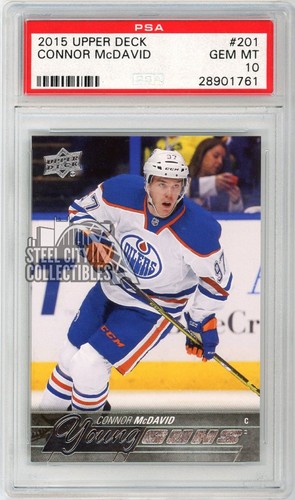
McDavid is the most valuable name in modern hockey cards, and the gap to second place is meaningful. Edmonton took him first overall in 2015 after the most-hyped junior career since Crosby, he won the Calder as a rookie despite a collarbone injury, then he won the Art Ross in his first full healthy season and added two MVP trophies before turning 22. His 2015-16 Young Guns rookie, card number 201, is the card every modern hockey collector points to first. A base copy in PSA 10 trades comfortably into the four figures, raw copies sit in the high three figures, and even that understates the card. The Canvas parallel, the Young Guns Exclusives numbered to 100, and the SP Authentic and The Cup auto rookies of McDavid run into the thousands and well beyond. McDavid is the rare modern hockey player whose card demand pulls in collectors from outside the sport.
-
Auston Matthews Rookie Card, 2016-17 Young Guns
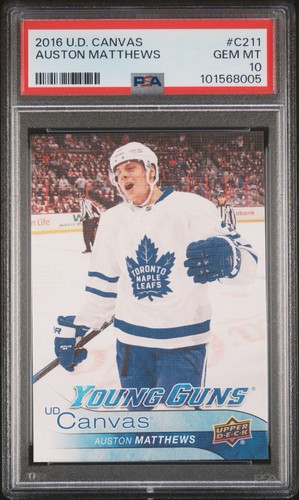
Matthews was the first overall pick in 2016, scored four goals in his first NHL game, won the Calder, and has been the most productive pure goal-scorer of the modern era, with a 60-goal season and multiple Rocket Richard trophies on the wall. The 2016-17 Young Guns is his flagship rookie. In PSA 10 the base lands in the mid to high three figures. Matthews is the Toronto premium in card form, with a deep collector base that pushes his card harder than the on-ice case alone would predict. The Canvas, the Exclusives, and the high-end auto rookies run well into the thousands, and his Cup rookie patch autos have produced some of the biggest non-McDavid hockey card prints of the era.
-
Connor Bedard, 2023-24 Young Guns Rookie
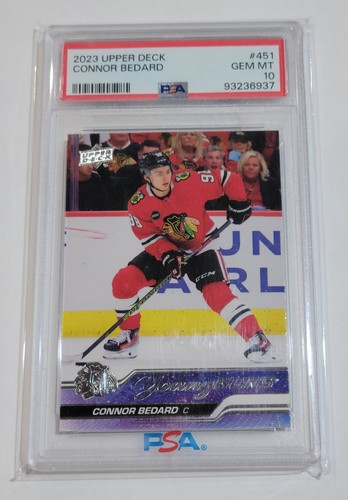
Chicago took Bedard at number one in 2023, and he arrived with the most pre-draft hype the sport had generated since McDavid, and won the Calder in his rookie year on a roster that was otherwise rebuilding. His 2023-24 Young Guns rookie is the newest card on this list, with a PSA 10 base in the mid to high three figures, unusually high for a card this recent. The price is mostly a bet on the player, carried by the largest first-year collector base hockey has seen since McDavid. Treat the number as not yet settled, because a card this new has not been through a full market cycle.
-
Cale Makar, 2019-20 Young Guns RC
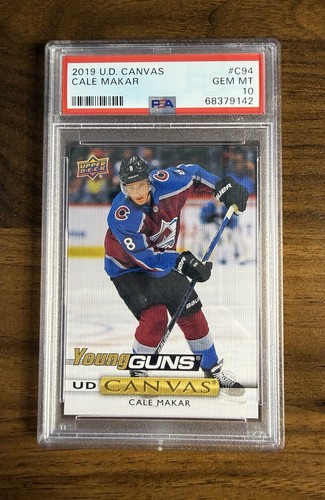
Makar was the fourth pick in 2017 but did not debut in the NHL until the 2019-20 playoffs, so his rookie card year is 2019-20. He won the Calder, then won a Conn Smythe and a Stanley Cup in 2022, and is the consensus best defenseman of his generation. His 2019-20 Young Guns is the flagship rookie for the position, and a base PSA 10 trades in the mid to high three figures, the strongest defenseman card on this list by a clear margin. Makar is the top defenseman here and the only one in the top five, which says something about how heavily the modern hockey market weights forwards. His Canvas and his Cup rookie patch auto carry deep premiums.
-
Elias Pettersson Rookie Card, 2018-19 Young Guns
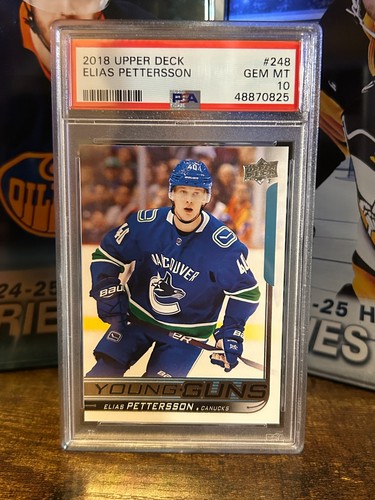
Pettersson was the fifth pick in 2017, came over to Vancouver from the SHL, and won the Calder with one of the most productive offensive rookie years of the modern era. He has been a true first-line center for the Canucks ever since, with a long-term contract that anchors the franchise. His 2018-19 Young Guns rookie is the flagship. A PSA 10 base trades from the high two figures into the low three figures. Pettersson's card market is sensitive to team results because Vancouver is a market that swings, and the base rookie sits below the forward names above him on this list. The volume is real and the card moves, but it has not commanded the premium of the McDavid or Matthews cohort. The Canvas and the SP Authentic auto rookies run into the thousands.
-
Mitch Marner, 2016-17 Young Guns RC
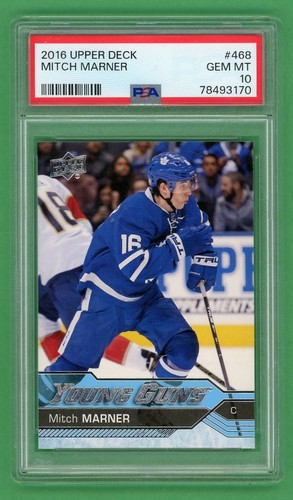
Marner was the fourth pick in 2015 but he played a full junior year before debuting, so his rookie card landed in the 2016-17 Young Guns class alongside Matthews. He has been a point-per-game playmaker in Toronto for years, and the city's collector base props up the card. His 2016-17 Young Guns rookie sits in the low to mid three figures in PSA 10. Marner's card behaves like the second pillar of the Toronto rookie pair, riding the Matthews market without fully tracking it. The Canvas and the higher-end parallels carry a clean premium over the base.
-
Mikko Rantanen, 2015-16 Young Guns RC
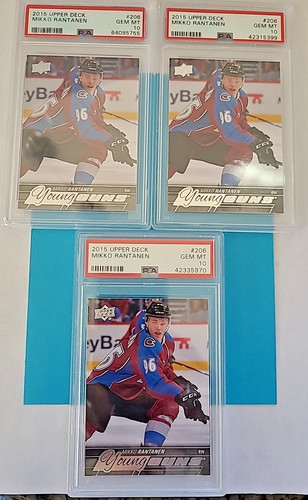
Rantanen was the tenth pick in 2015, debuted in 2015-16 and qualified for the same rookie-card year as McDavid, and has been a perennial point-per-game scorer on Colorado contender teams ever since. His Young Guns rookie from that same class settles in the low three figures graded. Rantanen is the case study for a debut-wave card that is not McDavid: a strong card with real liquidity but priced as the secondary name of the cohort. His Cup rookie patch auto is the higher-end version that drives chase money.
-
Jack Hughes Rookie Card, 2019-20 Young Guns
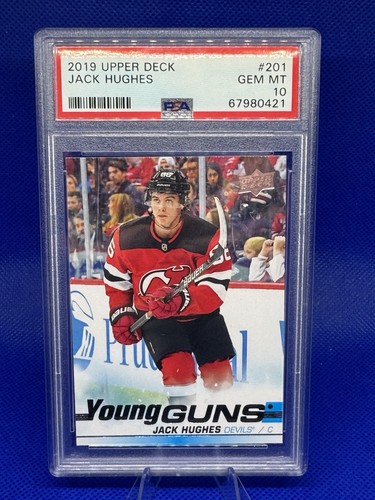
New Jersey took Jack Hughes at the top of the 2019 draft, and he struggled through the early COVID-shortened years, then turned into one of the most productive offensive forwards in the league, with point totals that put him squarely in the top tier of his cohort. The 2019-20 Young Guns is his flagship rookie, and a graded copy sits in the low three figures. Hughes is also useful as a reminder that a top draft slot is the start of the story, not the end. His card trades below Makar's despite sharing the same rookie-card year, a gap the market has been slow to close even as his point totals climbed.
-
Quinn Hughes, 2018-19 Young Guns RC
Quinn Hughes was the seventh pick in 2018, debuted late in the 2018-19 season, and has become the offensive engine in Vancouver, with a Norris trophy in 2024 to anchor the case. His 2018-19 Young Guns rookie carries a base PSA 10 in the low to mid three figures. He is the second defenseman on this list after Makar, and the two together show how the market handles top blueliners, with real but capped premiums relative to top forwards from the same cohort. The Canvas parallel carries a clean premium against the base.
-
Matthew Tkachuk, 2016-17 Young Guns Rookie
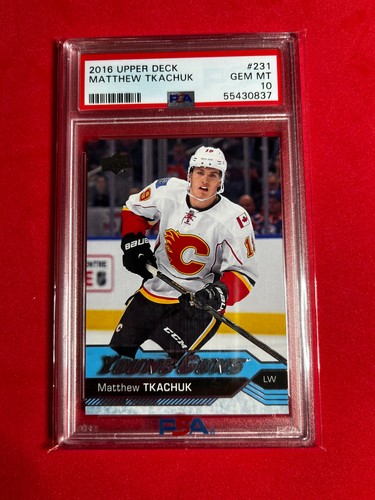
Matthew Tkachuk was the sixth pick in 2016, played a full rookie year in Calgary, and has been a top-line winger ever since, with a Stanley Cup run in Florida that has kept his market warm. His 2016-17 Young Guns is the third card on this list from that wave, with a graded PSA 10 in the low three figures. Tkachuk's card got a clear price bump after the Florida trade, and the Sunrise crowd has built a local collector base that supports the floor. The Canvas and the auto rookies carry the usual premium against the base.
Reading the debut-wave column: cohort context on the table
The debut-wave column on the table is the unique axis we are offering on top of the all-era list, and it is worth saying clearly what we think it tells you. A debut wave clusters the rookies whose Upper Deck Young Guns cards landed in the same release window, because cards from the same Series 1 and Series 2 print run share a supply story. The 2015-16 wave (McDavid, Rantanen) carries an older supply of graded copies, with a long PSA 10 population built up over a decade. The 2016-17 wave (Matthews, Marner, Tkachuk) is the deepest single wave on this list, and that depth has visible effects on dealer behavior and on parallel pricing in that year's product. The 2018-19 (Pettersson, Quinn Hughes) and 2019-20 (Makar, Jack Hughes) waves landed during the boom-era submission window, so their pop counts grew faster than older waves at the same career stage.
The 2023-24 wave is the live one. Bedard is the only card on this list from it, and the supply story for that year's Young Guns is still being written. The Bedard rookie has held a higher price than the average two-year-old card in this cohort would suggest, driven mostly by the size of the collector base that came in chasing him rather than by anything unusual in the print run.
None of this is meant as a buy signal. The debut wave is a framework for understanding why two cards at similar career stages might trade differently, not a forecast. For more on the supply-curve mechanic that compounds across cohorts, our graded population problem report covers the broader version of the story, and our modern rookie curve report covers how rookie cards behave through the post-debut price cycle.
What makes a modern hockey rookie card valuable?
A few things, and they are worth separating. First, the player. A rookie card is a bet on a career, and the cards that hold value belong to players who became stars and stayed productive. McDavid, Matthews, and Makar anchor this list because the players delivered. A clean-looking rookie card of a hockey player who didn't develop is worth very little, and the modern hockey market is full of those.
Second, the card itself, meaning the set and the parallel. A base Upper Deck Young Guns rookie is a different market from a Canvas parallel, a Young Guns Exclusives numbered card, an SP Authentic auto, or a Cup rookie patch auto of the same player. The base prints at a meaningful but limited volume because Young Guns is a short-print subset, so even a superstar's base in PSA 10 usually settles in the three figures rather than higher. The scarcity, and the real money, lives in the parallels and the autographs. Don't average a base card and an auto together.
Third, the grade. Upper Deck Young Guns comes out of the pack with centering issues and the occasional surface mark, so the PSA 10 population is a fraction of cards submitted. The gap between a PSA 9 and a PSA 10 on a top forward can be wide. If you're weighing whether to grade, our grading decision framework runs the math, and our graded population problem report covers the broader pop-count context.
Fourth, the team market. Hockey card prices respond to local collector markets in a way that is stronger than basketball or baseball. Toronto, Boston, Montreal, and Edmonton have deeper collector bases that hold prices on their teams' rookies, while smaller-market rookies can trade flatter even with similar on-ice production. That is part of why Matthews and Marner sit where they do on this list, and part of why Pettersson's market is sensitive to Vancouver results.
Last, the off-ice story. A Stanley Cup run, a Calder, an Art Ross, a trade to a contender, all of it moves modern hockey cards in real time. A rookie card is a live asset tied to a living career, and that is the part that makes it interesting and the part that makes it risky.
Are modern hockey rookie cards a good buy in 2026?
The honest answer is that it depends, and we are careful with that question. Modern hockey cards trade with less volatility than modern football, because hockey careers are longer on average and the playoff swing has less of a season-by-season effect on a single card price. But the supply context still matters.
The rough version is this. The top of this list, the McDavid, Matthews, and Bedard rookies, behaves like the blue-chip end of the modern hockey market. Those cards compress in a soft market but they don't vanish, because the demand is real and the supply is anchored by the Young Guns short-print structure. The middle of the list, the 2018-19 and 2019-20 wave, is more sensitive to pop growth from the boom-era submission window. And the newest card here, the Bedard rookie, is the hardest to call, because it hasn't been through a full market cycle and the Series 1 supply story is still being read.
There's also the broader cohort question. The 2018-19 and 2019-20 waves landed during the boom-era grading window, so their PSA 10 pop counts grew faster than older cards at the same career stage. That compounds against the cards in the middle of this list, in the same shape we cover in our graded population problem report. The McDavid and Matthews cards are far enough into their submission curve that most of the pop growth is behind them; the Pettersson, Hughes, and Tkachuk cards have more pop story still ahead.
Treat this list as a map of the modern hockey high end, not a buy list. We don't give buy and sell calls. If you want to understand how the wider card market has split between cards that hold and cards that drift, our modern rookie curve report covers that pattern, and the framework applies to hockey as much as to any other sport.
How do you check what a hockey rookie card is worth?
Same process every time. Identify the exact card first: player, year, set, card number, and parallel. A base Young Guns rookie and a Canvas parallel of the same player are different cards in different markets, so don't price one off the other. Then pull a dated sold comp on that exact card at the exact grade you have, raw or graded. Active listings are asking prices, not the market. Keep the comp window under 90 days, because modern prices move.
HCI card pages show the last public sale, the date of that sale, and the grade split for a card. For a wider modern listing of comparable rookies, our modern baseball rookies and modern football rookies lists show the same shape for the other major sports, and the cross-sport comparison is useful for understanding why hockey rookie prices sit where they do.
Common questions
What is the most valuable modern hockey rookie card?
Connor McDavid's 2015-16 Young Guns rookie card, number 201, leads the modern era. In PSA 10 it trades into the four figures, with raw copies in the high three figures, and McDavid's Canvas, Exclusives, and high-end auto rookies run substantially higher. He is the modern hockey GOAT card.
How much is a Connor McDavid rookie card worth in 2026?
A Connor McDavid 2015-16 Young Guns base rookie in PSA 10 trades into the four figures, with raw copies in the high three figures. The Canvas parallel, the Exclusives, and the auto rookies run into the thousands and well higher. Pull a dated sold comp on the exact card and grade.
What is an Upper Deck Young Guns card?
Young Guns is the rookie subset in the Upper Deck Series 1 and Series 2 base hockey product. Young Guns cards are short-printed, carry an iconic Young Guns logo on the front, and serve as the canonical NHL rookie card. The base Young Guns is the card most modern hockey collectors quote as the rookie.
Why is Connor Bedard's rookie card so expensive?
Bedard was the first overall pick in 2023, won the Calder as the youngest player on his team, and arrived with the most hype since McDavid. His 2023-24 Upper Deck Young Guns is the rookie that anchors the newest debut wave. Strong rookie-year hype and a deep base of new collectors push the price higher than the typical first-year card.
Is Upper Deck the only modern hockey rookie set worth owning?
For NHL rookies, more or less yes. Upper Deck has held the exclusive NHL trading-card license since 2004-05, so the canonical rookie product is Upper Deck Series 1 and Series 2 base, with Young Guns as the rookie subset. SP Authentic and The Cup carry high-end rookie autos and patches at much higher price tiers.
Do modern hockey rookie cards hold their value?
The top of the list does. McDavid, Matthews, and Makar rookie cards have held value through several market swings because the players have stayed productive. Cards of role players, depth scorers, and rookies who plateau tend to drift lower over time. A hockey rookie card holds value when the player does.
How do I check what a hockey rookie card is worth?
Identify the exact card first: player, year, set, card number, and parallel. Then pull a dated sold comp at your card's grade, not an active asking price. Use a comp window under 90 days. HCI card pages show the last public sale and its date for any catalogued hockey card.