10 Most Valuable Hockey Rookie Cards
Hockey's rookie card market has a tighter shape than baseball or basketball. The value stacks into three eras, the Parkhurst and early Topps vintage window from 1951 through the 1970s, the O-Pee-Chee and Topps pre-Young-Guns era from the late 1970s through 2004, and the Upper Deck Young Guns run from 2005-06 forward. Most of the sport's history outside those three tracks is affordable in raw condition. A very small group of cards opens the gap that starts in five figures and runs past seven. This list is built from publicly reported auction results, PSA and BGS pop reports, and the sets the hobby treats as flagship in each era.
A note on pricing. Every number below is a reference to a public sale, not a guarantee of what a copy will bring today. Hockey tracked the broader hobby compression from 2022 through 2023, and the Young Guns era names took the bigger hit while vintage Parkhurst, Topps, and O-Pee-Chee held better. Modern Young Guns sealed box prices stayed firm through the cycle because the print window stays narrow. Check a dated sold comp before you act on any number on this page. If you are new to the process, our how to value a card guide walks through the comp-pulling workflow end to end.
At a glance
| Rank | Card | Era | Why it leads |
|---|---|---|---|
| 1 | 1979-80 O-Pee-Chee #18 Wayne Gretzky | Modern vintage | Hockey's all-time public sale record holder |
| 2 | 1951 Parkhurst #66 Gordie Howe | Vintage | First Parkhurst set, Mr. Hockey anchor |
| 3 | 1966-67 Topps #35 Bobby Orr | Vintage | Short-printed tall-boy, defense-redefining rookie |
| 4 | 1985-86 O-Pee-Chee #9 Mario Lemieux | Modern vintage | Franchise-defining Penguins RC with OPC scarcity |
| 5 | 2005-06 Upper Deck Young Guns #201 Sidney Crosby | Modern | Young Guns flagship that defines the modern era |
| 6 | 1986-87 O-Pee-Chee #53 Patrick Roy | Modern vintage | Best goaltender rookie on the list, OPC run |
| 7 | 2015-16 Upper Deck Young Guns #201 Connor McDavid | Modern | Post-Crosby generational Oiler with the tightest SP |
| 8 | 2005-06 Upper Deck Young Guns #443 Alex Ovechkin | Modern | Series 2 Young Gun with goals-record upside |
| 9 | 2016-17 Upper Deck Young Guns #201 Auston Matthews | Modern | Four-goal debut and a Toronto tax on every Leaf RC |
| 10 | 1990-91 Score #440 Eric Lindros | Junk wax | Pre-rookie from the one hockey set that age-graded well |
The ten cards, in detail
-
1979-80 O-Pee-Chee #18 Wayne Gretzky
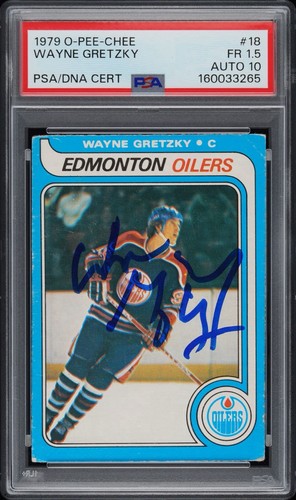
The OPC Gretzky is the anchor card of the sport. It is the Canadian print version of the 1979-80 Topps #18, and collectors treat the O-Pee-Chee version as the true rookie because the print run was smaller and the card stock was different. PSA 10 copies are genuinely rare, with the pop report running in the low single digits through 2026. Real sold comps put a clean PSA 10 in the seven figures, the highest tier any hockey card reaches. PSA 9 copies trade into the low six figures, and PSA 8 copies in the high five figures.
Centering is the reason this rookie grades so poorly at the top. The set used rough-cut edges and a tight centering tolerance, so most copies that look clean to the eye still fail at PSA 9. The Topps version of the same card, same photo, same #18, trades at a fraction of the OPC comp at equivalent grade because the Topps print was the U.S. distribution and the population is several multiples larger. Our PSA grading guide covers why centering eats the top half of a PSA 10 population on cards from this era.
-
1951 Parkhurst #66 Gordie Howe
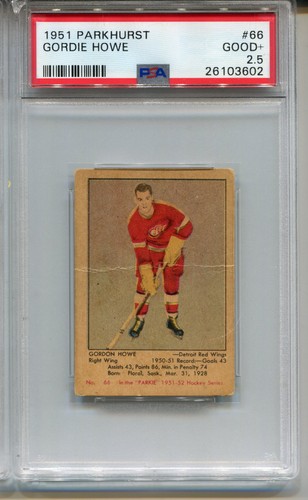
The 1951 Parkhurst set was the first nationally distributed hockey card set after the 1940s gap, and the Howe #66 is its flagship. Howe's career bridges Detroit's mid-century dynasty and his return in the WHA, which is why the card carries more cultural weight than its population numbers alone. PSA 9 copies have sold into the low six figures through the 2020 to 2022 window, and PSA 8 copies trade in the five figures consistently. Lower-grade authentic copies in PSA 3 to 5 still clear four figures routinely because the 1951 Parkhurst print is seventy-five years old and the survival rate is what it is.
The 1951-52 Parkhurst set also contains the Maurice Richard and Terry Sawchuk rookies, which is part of why the set is the vintage starting point for every serious hockey collection. If you are evaluating raw 1951 Parkhurst, get the card in hand and check the back. Reprinted versions of this set have circulated since the 1990s. Our spotting fake cards guide covers the tells for early-1950s vintage, where stock thickness, print-dot pattern, and the way the edges knife are the most reliable authenticity signals.
-
1966-67 Topps #35 Bobby Orr
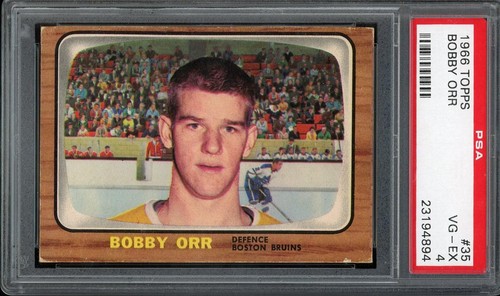
Orr's 1966-67 Topps rookie is the card that defines the late-1960s Topps hockey run. It is a tall-boy, printed in a 2.5 by 4.75 inch format that Topps used for hockey from 1964-65 through 1967-68. The format matters because the taller card is harder to preserve in high grade. Corner wear is the standard degradation mode. A PSA 10 reaches six-figure territory, and PSA 9 copies land in the low six figures. PSA 8 copies trade in the five figures, and PSA 7 copies in the mid five figures.
The 1966-67 Topps set is also short-printed in a way that is unusual for Topps hockey. The series that contains the Orr card is believed to have been printed in smaller quantities than the rest of the set, and the tall-boy format means the population that survived in collectible condition is thinner than the raw print run suggests. Orr re-wrote the job description for defensemen, which is the kind of hobby-anchoring story that holds price through the full compression cycles the rest of the 1960s Topps hockey run has seen.
-
1985-86 O-Pee-Chee #9 Mario Lemieux
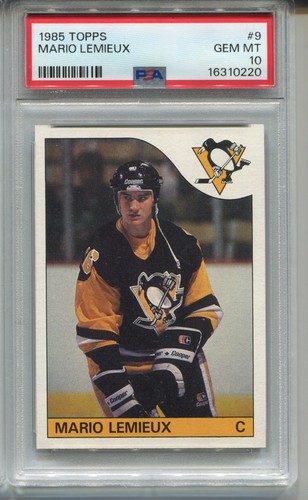
Lemieux's 1985-86 OPC #9 is the Penguins franchise rookie card. The 1985-86 Topps #9 exists as the U.S. print parallel, and like the Gretzky pair, the O-Pee-Chee version trades at a meaningful premium. PSA 10 OPC copies have reached the mid five figures. PSA 9 copies trade in the low four figures, and raw clean copies in the low hundreds. The Topps #9 equivalent at PSA 10 typically trades at roughly 35 to 50 percent of the OPC PSA 10.
Two Stanley Cup rings and two cancer comebacks gave Lemieux a career arc that hobby memory treats as unique, and the 1985-86 OPC is the card the market attaches to that arc. If you are comparing OPC to Topps on this card, the differences to look for are the OPC logo in the upper right of the back, the French on the back, and the subtle color-tone difference on the front that comes from the different print run. Our what is a rookie card guide covers how the two Canadian and U.S. prints parallel each other across the modern-vintage era.
-
2005-06 Upper Deck Young Guns #201 Sidney Crosby
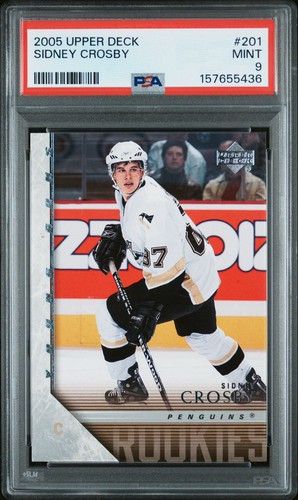
Crosby's rookie is the card that made the Young Guns line the defining modern hockey series. The inserts are short-printed across Series 1 and Series 2, with a reported rate of roughly one per four packs, which gives them a real scarcity constraint inside a mainstream product. The Crosby Young Gun is the most valuable modern hockey rookie by a wide margin, with PSA 10 copies sitting at the top of the post-2005 market and lower grades stepping down from there. Pull a dated sold comp for the exact grade before you act on any listed price.
That same checklist also contains Ovechkin and Carey Price Young Guns, which is why the set anchors the entire post-lockout modern hockey era. Sidney Crosby's 2026 career arc with 500-plus goals and three Stanley Cup rings has held the card's hobby identity through the post-2021 compression. Our what is a parallel guide explains how Young Guns fits into the broader Upper Deck parallel structure, with Young Guns Canvas, High Gloss, Exclusives, and 1-of-1 Printing Plates pulling the ceiling higher.
-
1986-87 O-Pee-Chee #53 Patrick Roy
Roy's 1986-87 OPC #53 is the best goaltender rookie on the list and arguably the best goaltender rookie card the hobby has. The 1986-87 Topps #53 is the U.S. print parallel, and the OPC carries the usual modern-vintage premium. PSA 10 OPC copies trade in the four figures, near the top of the goaltender market. PSA 9 copies sit in the high hundreds, and the base raw card is available at every card show in clean condition for under a few hundred dollars.
Roy's career arc delivered four Stanley Cup rings and three Conn Smythe trophies across Montreal and Colorado, and the goaltender position anchors the series in a way no other skater rookie does because the supply of Hall of Fame goaltenders is genuinely thin. The 1986-87 OPC set also contains rookies for Luc Robitaille and Vincent Damphousse, so it is a complete Hall of Fame rookie class. If you are assessing Roy rookies, the Topps version is worth owning at PSA 9 for collectors who want the player without the OPC premium.
-
2015-16 Upper Deck Young Guns #201 Connor McDavid
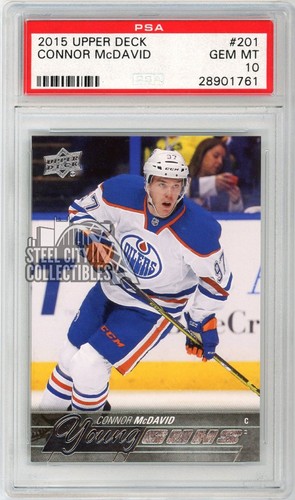
McDavid's 2015-16 Young Guns is the post-Crosby generational Young Gun. He was the consensus #1 overall pick in 2015, the pre-draft coverage compared him to Crosby for two full seasons, and the card has carried that expectation through ten years of production that has not disappointed. A clean PSA 10 sits in the low four figures, with PSA 9 copies around the four-figure line and lower grades stepping down to the high hundreds. The base Young Gun is the one most collectors chase, but the parallels run far higher.
The 2015-16 Upper Deck set is worth understanding as a whole. The Young Guns run in Series 1 at #201 through #250 and in Series 2 at #451 through #500 is where the modern hockey RC market lives, and McDavid is the hobby-anchoring card in that run. The same set includes Jack Eichel, Mitch Marner, and David Pastrnak Young Guns, which makes the 2015-16 class the deepest Young Guns year since 2005-06 Crosby. Our hockey cards hub covers the Young Guns era in depth, including the Canvas and High Gloss parallel layers.
-
2005-06 Upper Deck Young Guns #443 Alex Ovechkin
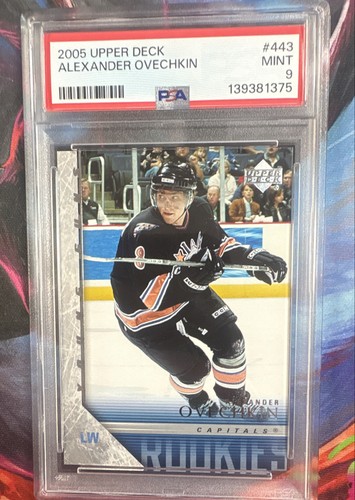
Ovechkin's 2005-06 Young Guns is the Series 2 companion to the Crosby Series 1 card, and the hobby has always treated the pair as the defining rookies of the post-lockout era. Series 2 Young Guns have the same short-print rate as Series 1, but distribution matters for Ovechkin specifically because Upper Deck Series 2 for 2005-06 shipped into a market that was already pricing Crosby ahead of Ovechkin. Graded gem copies trade in the four figures, with PSA 9 copies around the four-figure line and raw copies in the high hundreds.
What is different about this Ovechkin card in 2026 is the Wayne Gretzky goals record. Ovechkin passed Gretzky's career regular-season goals record in , a record the hobby had treated as untouchable since 1999. That passage changed the ceiling on the card's hobby identity. The YG is still priced well below Crosby's YG at equivalent grade, which creates a live question for any collector debating the pair. If you are considering the Ovechkin as the higher-ceiling name for the next ten years, the gap to Crosby is the trade you are paying to make.
-
2016-17 Upper Deck Young Guns #201 Auston Matthews
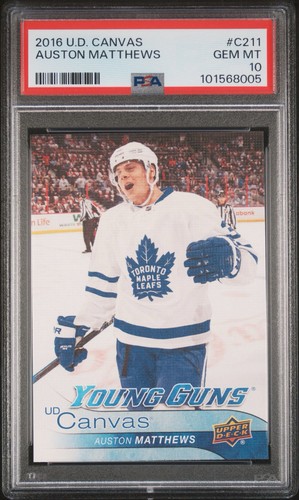
Matthews scored four goals in his NHL debut on , the first player in the modern era to do that, and his Young Gun is the rookie card the hobby attached to that debut. Graded gem copies bring the high hundreds, a step below the Crosby and McDavid Young Guns. PSA 9 copies sit in the mid hundreds, and lower grades run lower still. The base Young Gun is the chase, with the parallels carrying the higher numbers.
The Toronto Maple Leafs market adds a premium that shows up on every Leaf rookie back to the 1960s, and Matthews is the first post-lockout Leafs anchor to carry that tax. The card's 2026 hobby identity hinges on whether Matthews breaks through past the first round of the Stanley Cup playoffs, which the Leafs franchise has not done in decades. If that story closes, the card has real upside inside the Young Guns series. If it does not, the comp range stays where it is.
-
1990-91 Score #440 Eric Lindros
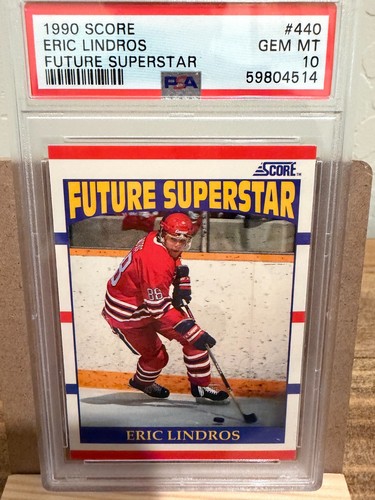
Lindros is the exception on this list. He never played for the Quebec Nordiques that drafted him first overall in 1991, and his NHL rookie season was 1992-93 with the Philadelphia Flyers. That means the 1990-91 Score #440 is a pre-rookie draft-pick card rather than an NHL rookie, but the hobby has treated it as the Lindros rookie since the junk wax era because it is the earliest widely distributed card that names him. The 1990-91 Score set is the only junk wax hockey set that age-graded well, so PSA 10 copies exist in volume but stay inexpensive, with PSA 9 copies at $50 or under and raw copies in pocket change.
This entry is on the list to represent the junk wax era and the pre-rookie category. Lindros was the most hyped North American hockey prospect since Gretzky and Lemieux, with a career shortened by concussions that kept the hobby story from closing the way the pre-draft hype promised. The card is a reminder that the top of the rookie market is not always about the highest-grade card from the most prestigious set. Sometimes it is about which rookie the hobby happened to settle on during a particular window.
What these ten cards have in common
Four patterns show up across the list. First, hockey's vintage anchor is a Canadian print. The OPC Gretzky and the OPC Lemieux both sit above their Topps twins because that print was the smaller run, from a different country with a different card stock. That is the opposite pattern of baseball, where Topps is the hobby's anchor brand across every era. Second, goaltender supply is thin. Roy is the only true goaltender on this list at #6, and that scarcity is why the card holds premium even though raw copies are plentiful. Martin Brodeur, Dominik Hasek, and Carey Price rookies all have cases for the long list, but none of them trade at Roy's multiples at the top.
Third, Upper Deck Young Guns is the defining modern hockey RC format. Every hockey rookie from 2005-06 forward competes inside the Young Guns framework, and the series has been remarkably stable for twenty years. That stability is unusual in modern sports cards. Basketball has shifted from Topps Chrome in the 1990s to National Treasures in the 2010s to Panini Prizm as the base anchor in 2012-13 forward. Hockey has just kept Young Guns. Fourth, the 1990s hockey junk-wax overhang still weighs on every rookie from 1989-90 Topps through 1997-98. Brett Hull, Joe Sakic, Jaromir Jagr, and Joe Thornton are all Hall of Famers whose flagship rookies sit outside this top ten because the print runs were too large and the 1990s set design was too uniform for any one rookie to break out of the era.
Cards that almost made the list
A handful of cards have a case for the top ten that we did not include so the list could cover more eras and more positions. The 1971-72 Topps #45 Ken Dryden rookie is a Hall of Fame goaltender rookie that reaches the four figures at PSA 10 and has short-printed-series claims similar to the Orr. The late-1980s O-Pee-Chee Brett Hull rookie is the best of the OPC rookies from that window and reaches the four figures at PSA 10. The 1990-91 Upper Deck Jaromir Jagr rookie anchors the first Upper Deck hockey set. The 2010-11 Upper Deck Young Guns Jeff Skinner and the 2010-11 Young Guns Taylor Hall are era-specific post-Crosby names worth tracking. The 1966-67 Topps Orr-adjacent cards for Serge Savard and Bernie Parent round out the 1960s tall-boy run.
If you are building a Hall-of-Fame-focused hockey rookie collection from the ground up, the entry points outside this top ten are 1970s O-Pee-Chee base rookies (Guy Lafleur, Bryan Trottier, Mike Bossy, Denis Potvin), 1990s Upper Deck and Pinnacle base rookies (Steve Yzerman era is technically late-1980s but the affordable Yzerman rookies live in this window), and 2005-06 forward Young Guns outside the top six or seven names (Evgeni Malkin, Jonathan Toews, Patrick Kane, Carey Price, Phil Kessel). These cards trade from tens to a few hundred dollars at PSA 9 and PSA 10 and form the practical middle of the hockey market.
How to use this list
Treat the ten cards above as market anchors, not buy recommendations. The prices we cite are public references to specific sales. A copy you see listed today may be a different condition, a different grade, or a different era of the market than the sale we cite. Before you buy, pull sold comps on the exact card, print run (O-Pee-Chee or Topps), and grade you are looking at. The OPC premium on Gretzky, Lemieux, and Roy means the card you think you are buying may actually be the Topps parallel, and the price should reflect that. Our card valuation walkthrough covers the process step by step.
If you are deciding between a higher-ticket vintage card and a Young Guns flagship, the vintage card will almost always hold grade better across cycles but the Young Guns flagship carries more upside if the player's career story keeps delivering. That tradeoff is the one every serious hockey collector eventually has to make. Our state of PSA 10 premiums report covers the grade-ladder math that drives the price spread on every card on this list, and our card market compression cycles report covers how the 2022 to 2023 compression hit hockey specifically.
Frequently asked questions
What is the most valuable hockey rookie card?
The 1979-80 OPC Wayne Gretzky. It sets the sport’s public ceiling, with the top graded copies trading in the seven figures on real sold comps.
What is the difference between the O-Pee-Chee and Topps Gretzky rookies?
They share the 1979-80 design, but O-Pee-Chee was the Canadian print with a smaller run and rougher cuts. High-grade O-Pee-Chee copies are far scarcer and far pricier than the Topps version.
Is the 2005-06 Upper Deck Young Guns Sidney Crosby his rookie card?
Yes. Young Guns is the modern flagship rookie format, and the Crosby Young Gun defines the post-2005 era of the hobby.
Why is the 1990-91 Score Eric Lindros called a pre-rookie?
It pictures Lindros after the draft but before his NHL debut, so it predates his on-ice rookie. It comes from the one junk-wax-era set that held up well in high grade.
Which modern rookies could join this list?
McDavid, Matthews, and Ovechkin Young Guns are already here. The strongest new candidate is the 2023-24 Upper Deck Young Guns Connor Bedard.
How should I value a hockey rookie before buying?
Pull a dated sold comp for the exact card and grade. O-Pee-Chee and tall-boy issues are condition-sensitive, so the grade tier decides the number. This page is reference information, not financial advice.