10 Most Valuable Vintage Basketball Cards
The hobby's top vintage hoops cardboard runs from the 1948 Bowman George Mikan rookie through the 1986-87 Fleer Michael Jordan, with anchor cards in 1957-58 Topps, the one-and-done 1961-62 Fleer set, and the 1969-70 Topps tall-boy run. Top-grade copies span from the low five figures up into six-figure territory.
How to read this list
This is a pre-1986 list. The Jordan rookie earns its spot because hobby convention treats the 1986-87 Fleer #57 as the bridge card between vintage and modern basketball, and a vintage list without Jordan reads incomplete. Every other card on the list ships from 1948 through 1981. Modern-era rookies (Magic Johnson 1980-81 Topps notwithstanding) are not in scope here; we cover them in our ranking of the priciest modern basketball rookies.
We work in descriptive price bands, not specific sold comps. The bands reflect public auction-house results and population-adjusted private sales through early 2026. PSA 10 is the reference grade where supply exists; for the 1940s and 1950s anchors PSA 8 or 9 is the practical ceiling because PSA 10 populations are sometimes zero or single-digit.
Why vintage basketball is so much rarer than vintage baseball
Basketball has roughly 25 years of widely produced vintage cards. Baseball has 100. That's the structural read.
The basketball card timeline starts with the 1948 Bowman set, which is the first major basketball release. Topps issued one set in 1957-58 then went silent. Fleer issued one set in 1961-62 then went silent. Topps returned in 1969-70 with the tall-boy format and ran annually through 1981-82, when it left the sport again. Fleer returned in 1986-87, and that is the bridge into the modern era. From 1948 through 1985 there are roughly 16 flagship releases across all manufacturers. By comparison, baseball had at least one major flagship every year from 1948 through 1985, often three or four manufacturers running in parallel.
That print history is why every flagship vintage basketball release matters. There are no second chances on rookie cards from the 1957-1968 window because the only flagship was the 1957-58 Topps set. There are no second chances on rookies from 1962 through 1968 because no flagship existed. The structural scarcity stacks; it's the load-bearing fact behind every price band on this list.
The vintage basketball print eras at a glance
| Era | Flagship | Coverage | Why it matters |
|---|---|---|---|
| 1948 | Bowman | 72 cards | First major basketball release. George Mikan rookie. No follow-up for nine years. |
| 1957-58 | Topps | 80 cards | Bill Russell, Bob Cousy, Bob Pettit rookies. No follow-up for four years. |
| 1961-62 | Fleer | 66 cards | Wilt Chamberlain, Oscar Robertson, Jerry West, Elgin Baylor rookies. Single set. |
| 1962 to 1969 | None | Effectively zero | No basketball flagship at all. Rookie cards of this era do not exist. |
| 1969-70 to 1980-81 | Topps | Annual | Tall-boy era 1969-70, then standard format. Alcindor, Maravich, Dr. J, Bird/Magic rookie all here. |
| 1981-82 to 1985-86 | None | Zero | Topps left the sport. No flagship. Olajuwon, Drexler, Stockton, Barkley have no period rookie cards. |
| 1986-87 | Fleer | 132 cards | Jordan, Olajuwon, Barkley rookie. Bridge to modern era. |
The ranking, card by card
-
1986-87 Fleer Michael Jordan #57
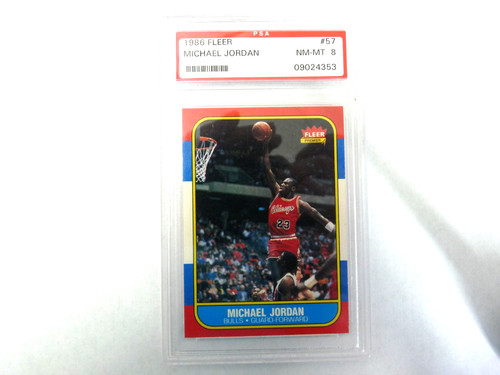
The bridge card. The rookie card of the most globally recognized basketball player in history, from the first widely produced basketball set after a five-year gap. It's the most submitted, most graded, and most traded card on this list by a wide margin. In 2026 a PSA 10 changes hands in the low six figures, with the exact number swinging on cohort and eye appeal. Anything below PSA 9 trades meaningfully cheaper but is still a four-figure card raw.
Bull case: Jordan's cultural footprint keeps expanding, the population gap between PSA 9 and PSA 10 stays wide, and the card is on every collector's want list.
Bear case: PSA 10 population has grown over time as more raw copies surface. Soft macro conditions hit this card harder than less-traded vintage because it has a deeper retail buyer pool.
-
1948 Bowman George Mikan #69
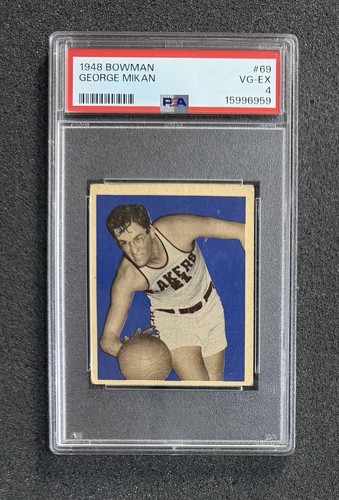
The rookie card of the original NBA superstar and the first basketball card flagship of any commercial significance. Mikan was the first five-time champion and the first dominant big man in pro basketball. The 1948 Bowman set is small (72 cards) and centering and color register are notoriously inconsistent. In 2026 a PSA 7 brings five figures, a PSA 8 steps up to the low six figures, and the rare PSA 9 that surfaces clears six figures comfortably.
Bull case: Genuine pre-NBA-merger basketball rarity. Population caps are durable and Mikan's first-superstar narrative is unassailable.
Bear case: The collector pool for pre-1957 basketball is small. Liquidity is thin and price discovery happens in discrete auction events, not continuous trade.
-
1957-58 Topps Bill Russell #77
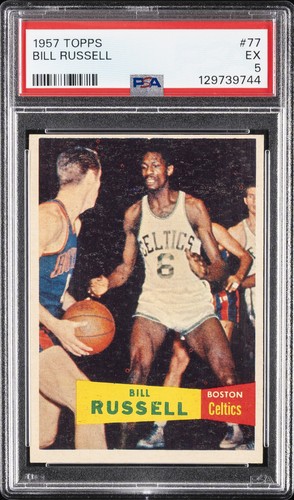
Russell's rookie card from the first Topps basketball set. The set produced the rookies of Russell, Bob Cousy, and Bob Pettit, and it was Topps' only basketball set until 1969-70. The card is centered notoriously poorly and high grades are rare. Expect mid to high five figures at PSA 8, with PSA 9 examples climbing well into six-figure territory.
Bull case: Eleven-time NBA champion, the most decorated player in any major sport. The 1957-58 Topps set is the only Russell-era flagship and the rookie population is fixed.
Bear case: The set's centering issues mean grading submissions are a coin flip even on visually clean copies. PSA 10 examples are essentially nonexistent, which caps the upper tail.
-
1961-62 Fleer Wilt Chamberlain #8
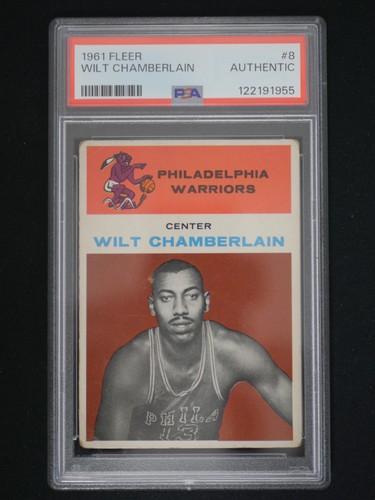
The most valuable card from the one-and-done 1961-62 Fleer set. Chamberlain's only contemporary rookie card. The set is small (66 cards) and Fleer did not produce a basketball flagship again until 1986-87, so the Chamberlain rookie has no sibling cards in the same product family for the rest of his career. A PSA 8 sits in the mid five figures; a PSA 9 crosses into the low six figures.
Bull case: 100-point game, four MVPs, and the structural rarity of that single Fleer release. The card has been a vintage anchor for forty years.
Bear case: The 1961-62 Fleer print quality is uneven and PSA 9 examples trade in a narrow band. Soft macro conditions compress the band.
-
1969-70 Topps Lew Alcindor #25
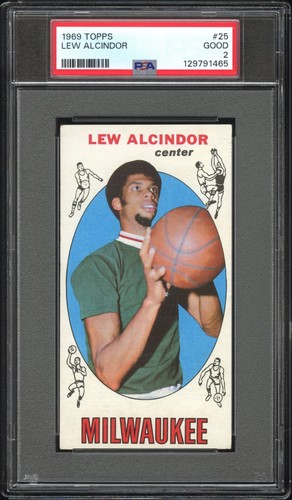
The rookie card of Kareem Abdul-Jabbar (still credited as Lew Alcindor on the card), from the first year of the Topps tall-boy era. The tall-boy format (roughly 2.5 by 4.75 inches) makes the card more vulnerable to corner and edge wear, which suppresses the PSA 10 population. A PSA 9 lands in the low five figures, and a clean PSA 10 pushes toward the middle of that range.
Bull case: All-time leading scorer for almost forty years, six rings, six MVPs. The Alcindor rookie is the cornerstone of any tall-boy collection.
Bear case: The card's tall-boy format and the Alcindor-vs-Kareem name change confuses casual buyers. The population of high grades is growing slowly as more raw copies are submitted.
-
1980-81 Topps Larry Bird / Julius Erving / Magic Johnson #6
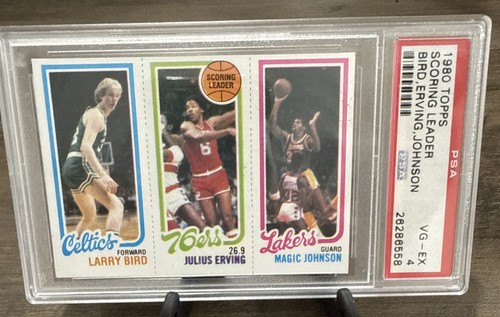
The three-panel rookie card carrying Bird and Magic together (with Dr. J as the third panel) from the last Topps basketball set before the five-year gap. The card is unusual because it requires three panels intact and well-centered; if any panel is cut or off-center, the grade drops sharply. A PSA 10 with all three panels well-centered changes hands in the high four figures, brushing low five for the cleanest examples.
Bull case: The most famous rivalry in basketball history on a single card. Bird and Magic together is a once-only piece of basketball cardboard.
Bear case: The three-panel format produces wide grade-by-grade pricing dispersion. Cut copies (where collectors separated the panels) are common and they trade as damaged.
-
1957-58 Topps Bob Cousy #17
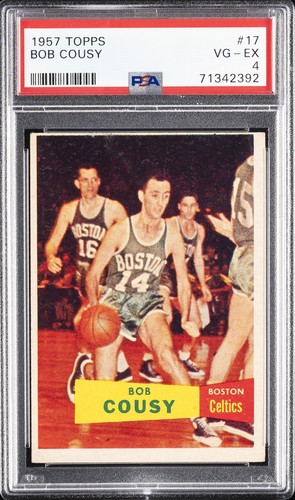
Cousy's rookie from the same 1957-58 Topps set as Russell. Cousy retired with six rings and is the prototype point guard of pro basketball. A PSA 8 brings mid four figures up toward low five, while the scarce PSA 9 population carries the card into six-figure territory.
Bull case: The first great pass-first point guard and a fixture of Boston Celtics history. Sibling to the Russell rookie in the same set.
Bear case: Cousy's cultural footprint is smaller than Russell's, so the demand band is narrower. Centering issues identical to the rest of the set.
-
1961-62 Fleer Oscar Robertson #36
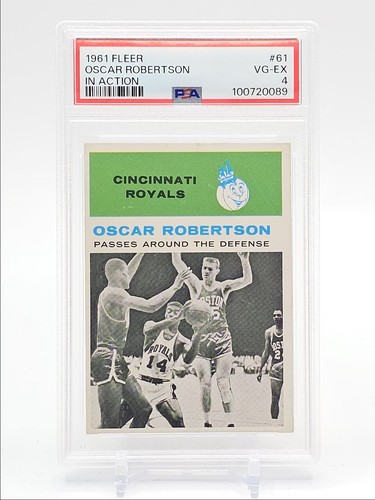
The Big O's only contemporary rookie card. Triple-double pioneer, the player whose name attaches to the modern triple-double conversation. The 1961-62 Fleer print quality issues apply to this card too. Figure on high four figures into low five for a PSA 8, with PSA 9 copies settling into the mid five figures.
Bull case: The original triple-double machine, MVP, NBA champion. The card sits in the same scarce 1961-62 Fleer flagship as Chamberlain and West.
Bear case: Oscar Robertson's name recognition with younger collectors trails Chamberlain and West, even though his on-court record is comparable.
-
1961-62 Fleer Jerry West #43
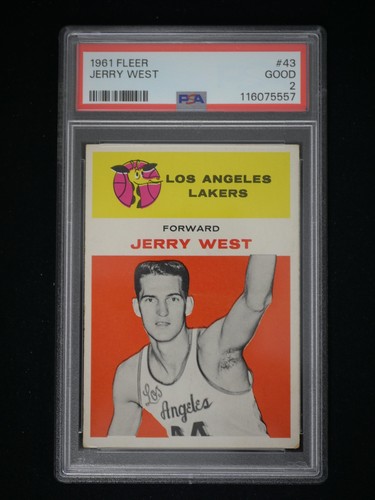
West's rookie. The man on the NBA logo (although officially uncredited). His on-court record (NBA champion, 14-time All-Star, Hall of Fame as a player and a builder) plus the logo connection makes the card a vintage staple. A PSA 8 occupies the mid four to low five figures; a PSA 9 sits comfortably in the mid five figures.
Bull case: The NBA logo association is a permanent demand floor. The 1961-62 Fleer single-set rarity is durable.
Bear case: The logo association is informal (Jerry West is not officially the silhouette), and that lessens the marketing-grade pull over time.
-
1970-71 Topps Pete Maravich #123
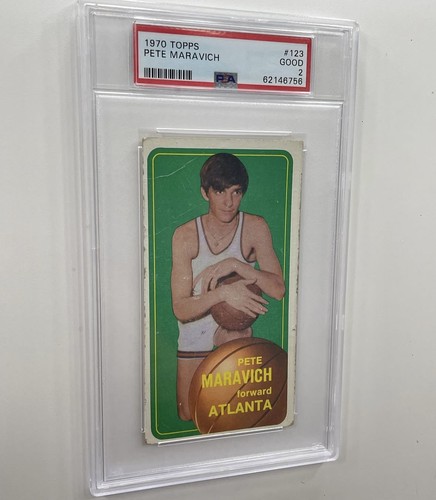
Pistol Pete's rookie from the second year of the Topps tall-boy era. Maravich's career was cut short by injury and he died young, but his on-court game and cultural footprint are outsized. The card is sensitive to tall-boy corner wear and high grades are rare. A PSA 8 brings low to mid four figures, and a PSA 9 steps up into the low five figures.
Bull case: One-of-a-kind playing style, durable nostalgia draw, mythologized career. Tall-boy population caps are tight.
Bear case: The collector base skews older and is not being replenished at the same rate as the Jordan or Bird/Magic cards. Generational handoff risk.
What about the modern era?
Modern-era rookies sit outside this list by design. The Jordan rookie is included because the hobby treats it as a bridge, but post-1986 rookie cards belong on the modern list. If you came here looking for Kobe, LeBron, Wembanyama, or any post-1986 anchor, our guide to the priciest modern basketball rookies covers that scope. The structural read is different: the modern era has unlimited supply expansion across parallels and inserts; the vintage era does not. We cover the supply-side mechanics of the modern hobby in our graded population problem report. For the cross-sport vintage build, the 10 most valuable vintage hockey cards listicle uses the same pre-1990 framing on the hockey side, with the OPC versus Topps split anchored by the 1979-80 Gretzky rookie.
Frequently asked questions
What is the most valuable vintage basketball card?
The 1986-87 Fleer Jordan rookie #57 holds the top spot in 2026. In PSA 10 grade it trades in the low six figures depending on cohort and population. The 1948 Bowman Mikan rookie follows as the second anchor card in PSA 8 and above.
How much is a 1948 Bowman Mikan rookie card worth?
The Mikan #69, the first true basketball rookie card of the original NBA superstar, trades in the low to mid five figures in PSA 7 grade. PSA 8 examples push into the low six figures. PSA 9 copies are exceedingly rare and clear well into six-figure territory at public auction.
Why is the 1986 Fleer Jordan the bridge card between vintage and modern?
The 1986-87 Fleer set is the first widely produced basketball release after a five-year Topps gap. It carries the rookie cards of Michael Jordan, Hakeem Olajuwon, and Charles Barkley, and it marks the start of the modern basketball card era. Hobby convention treats 1986 Fleer as the dividing line.
How long did Topps stay out of basketball after 1981?
Topps left basketball after 1980-81 and stayed out until 1992-93. That five-season gap (1981-82 through 1985-86) is one reason 1986-87 Fleer carries so much weight. There was effectively no major basketball card release during those years, so the rookie classes of that era have no widely circulated rookie cards.
What is the 1961-62 Fleer set and why does it matter?
It is a one-and-done 66-card release that produced the rookie cards of Wilt Chamberlain, Oscar Robertson, and Jerry West, plus a Bill Russell base. Fleer did not produce another basketball flagship until 1986-87. The set is structurally rare because no follow-up cards exist for that era's stars.
Are vintage basketball cards a good investment?
We do not give buy or sell calls. Vintage basketball is structurally rarer than vintage baseball because the print era is shorter (1948 through 1985 is the working window) and many years have no flagship release. That scarcity is durable. Whether prices keep pace with collector demand is a separate question and changes with macro conditions.
Price bands are descriptive ranges from public auction results and population-adjusted private sales through early 2026, not buy or sell calls. Specific sold comps live on the HCI card-detail pages. Methodology at /about/methodology/.