10 Most Valuable Vintage Baseball Cards
Quick answer. The ten vintage baseball cards that lead the hobby on attention and high-grade sold-comp ceiling, ranked, are the T206 Wagner, the 1952 Topps Mantle, the 1933 Goudey Ruth and Gehrig, the 1939 Play Ball Williams rookie, the 1951 Bowman Mantle rookie, the 1948 Leaf Robinson rookie, the 1948 Bowman Musial rookie, the 1955 Topps Clemente rookie, and the 1957 Topps Aaron.
At a glance: the ten vintage cards
| Rank | Card | Set / Year | Why it leads |
|---|---|---|---|
| 1 | Honus Wagner | T206 (1909-1911) | The holy grail of vintage; ~60 known copies |
| 2 | Mickey Mantle | 1952 Topps #311 | Tentpole of modern Topps; high-series scarcity |
| 3 | Babe Ruth | 1933 Goudey #53 | Set-anchor Ruth card; pre-war collector core |
| 4 | Lou Gehrig | 1933 Goudey #92 | Pre-war companion to Ruth; single-set tentpole |
| 5 | Ted Williams rookie | 1939 Play Ball #92 | 1940s-era HOF rookie, pre-war finale |
| 6 | Mickey Mantle rookie | 1951 Bowman #253 | True Mantle rookie; Mantle-x2 pair anchor |
| 7 | Jackie Robinson rookie | 1948 Leaf #79 | Color-line-breaking cultural card, 1947 MLB debut |
| 8 | Stan Musial rookie | 1948 Bowman #36 | Career-Cardinal HOF rookie, 475 HR, .331 lifetime |
| 9 | Roberto Clemente rookie | 1955 Topps #164 | 2,000-hit Pirate HOF, 1972 plane-crash legacy |
| 10 | Hank Aaron | 1957 Topps #20 | Second-year card; 755-HR franchise anchor |
Card-by-card walkthrough
1. T206 Honus Wagner (1909-1911)
The T206 Honus Wagner is the single most culturally loaded vintage baseball card and the card most hobbyists call the holy grail. The set was produced by the American Tobacco Company from 1909 through 1911 as a set of 524 players distributed across a dozen cigarette brands, and the Wagner card is known to have been pulled from production at the player's request (the commonly-cited reasons range from Wagner's opposition to tobacco marketing to a compensation dispute). Roughly 60 copies are known to exist across all grades. High-grade examples sit in eight figures at the top auction houses, and even heavily worn low-grade copies with strong eye appeal clear seven figures. The card is the only card on this list whose scarcity is driven by a decision to stop production, not by an age-and-attrition-only pattern.
The card is a tentpole on every vintage list and does not need a bull or bear case. The one nuance collectors should track is provenance: several famous copies (the Gretzky-McNall T206 Wagner, the Jumbo Wagner) have auction histories that trade at premiums above the condition-tier band because of the specific chain of custody. A T206 Wagner without a famous-copy provenance still trades at the condition-tier band, and collectors who are not pursuing a famous copy can reasonably focus on grade, eye appeal and corner sharpness.
2. 1952 Topps #311 Mickey Mantle
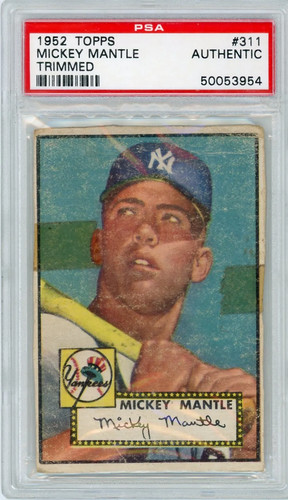
The 1952 Topps Mickey Mantle is the tentpole of modern Topps and the most widely-owned holy-grail-tier card outside the T206 Wagner. The 1952 Topps set was the first Topps set to ship in the gum-and-wax-pack format that became the industry standard, and the Mantle is in the high-number series (#311), which means it trades at high-number-scarcity premiums. A PSA 10 Gem Mint copy is one of the most valuable trading cards ever sold, with real sold comps running into eight figures, and even a PSA 9 Mint copy clears seven figures by a wide margin. High-grade copies are thin because 1952 Topps cardboard has known centering and corner-wear issues.
The card is the tentpole Mantle card and the first half of the Mantle two-slot pair that every serious vintage collector tracks (the 1951 Bowman Mantle rookie below is the second half). A purist might argue that the 1951 Bowman rookie is the correct tentpole because it is the true rookie, but the 1952 Topps is the card the hobby treats as the Mantle tentpole because of the high-number scarcity, the larger and more iconic card design, and the first-year-of-Topps premium.
3. 1933 Goudey #53 Babe Ruth
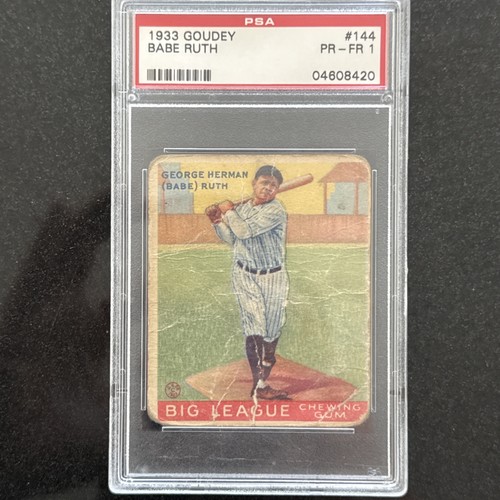
The 1933 Goudey Babe Ruth #53 is the set-anchor Ruth card and the first of four Ruth cards in the 1933 Goudey set (#53, #144, #149, #181). The set is a 240-card pre-war issue with tall cardboard and hand-colored photography, and the Ruth cards collectively carry the set's tentpole weight. At PSA 9 the #53 is a seven-figure card at the top auction houses, while a PSA 8 NM-MT copy typically trades in the high six figures. The set is known for centering and corner challenges, and PSA 8 and above is thin across all four Ruth variations.
The #53 card is the most widely-cited of the four Ruth variations because it is the lowest-numbered and because it carries the most iconic pose. A collector building a 1933 Goudey Ruth set rather than a single tentpole should prioritize condition over numbered-sequence preferences. The bear case on the Ruth cards collectively is that the pre-war-collector base has been thinning as collectors age, and the condition premium has expanded as the market narrows toward the very-high-grade tier.
4. 1933 Goudey #92 Lou Gehrig
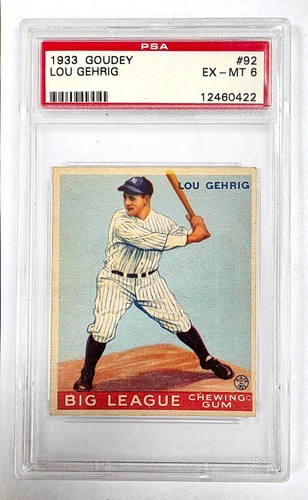
The 1933 Goudey Lou Gehrig #92 is the pre-war companion to the Ruth and the single tentpole Gehrig card. Gehrig appears twice in the 1933 Goudey checklist (#92 and #160), and the #92 is the more widely-cited tentpole. At PSA 9 it is a strong seven-figure card, and a PSA 8 NM-MT copy lands in the upper six figures. The condition challenges are the same as the Ruth cards: centering and corner wear keep high-grade copies thin.
Gehrig's cultural weight is the compound of the 2,130-consecutive-games streak, the 1939 ALS diagnosis and the "luckiest man on the face of the earth" farewell at Yankee Stadium on July 4, 1939. The single-franchise Yankees arc and the 1939 retirement year give the card a narrower narrative than Ruth, but the tentpole weight is comparable because Gehrig's plaque carries the same pre-war first-tier-HOF status. The card is a tentpole on a standalone basis and earns the fourth rank on this list independent of its pairing with the Ruth cards.
5. 1939 Play Ball #92 Ted Williams rookie
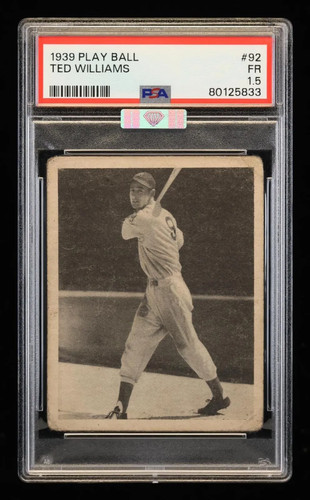
The 1939 Play Ball Ted Williams rookie is the 1940s-era HOF rookie tentpole and the pre-war-set finale. The 1939 Play Ball set is the first of three Play Ball issues (1939, 1940, 1941) and is a 161-card set that ships the Williams rookie at #92. At PSA 9 the Williams rookie is a seven-figure card when one surfaces at auction, and the grade is genuinely scarce. The 1939 Play Ball set carries the pre-war narrative transition: the last baseball-card set before World War II disrupted the hobby's production pipeline.
Williams is the highest-batting-average player of the modern era (.344 lifetime), the last player to hit .400 in a season (.406 in 1941), and an 1946 AL MVP. The 1939 Play Ball rookie is the tentpole of his card catalog, and the 1941 Play Ball #14 Williams second-year is a defensible second-slot candidate that we have noted on the Red Sox hub HUB-TEAM-006 as the Williams two-slot pair. The bear case here is that the 1939 Play Ball set's black-and-white photography is less visually-striking than the 1933 Goudey cardboard, and the condition challenges are comparable.
6. 1951 Bowman #253 Mickey Mantle rookie
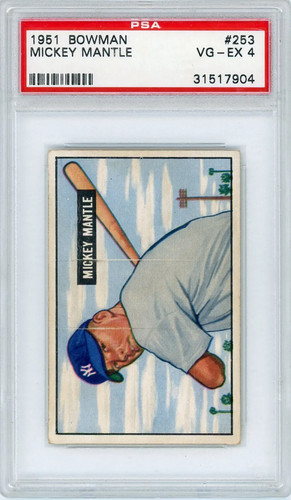
The 1951 Bowman Mickey Mantle rookie is the true Mantle rookie card and the second half of his two-card pairing. Mantle debuted with the New York Yankees in April 1951 at age 19, won the 1956 Triple Crown, and was inducted in 1974. Sold comps put a PSA 9 of this rookie in the mid six figures, with a true Gem Mint example running into seven figures. High-grade copies are thin because the 1951 Bowman set is known for centering and corner issues.
Holding both Mantles (1951 Bowman rookie + 1952 Topps #311) is the precedent-setting two-slot treatment in the modern hobby, and we have carried that precedent across several team hubs including HUB-TEAM-001 Yankees, HUB-TEAM-011 Dolphins (Marino-x2), HUB-TEAM-009 49ers (Young-x2), HUB-TEAM-002 Lakers (Kobe-x2) and HUB-TEAM-014 Warriors (Curry-x2). The 1951 Bowman is the technical rookie and the 1952 Topps is the hobby tentpole, and collectors who want the cleanest Mantle-card portfolio hold both.
7. 1948 Leaf #79 Jackie Robinson rookie
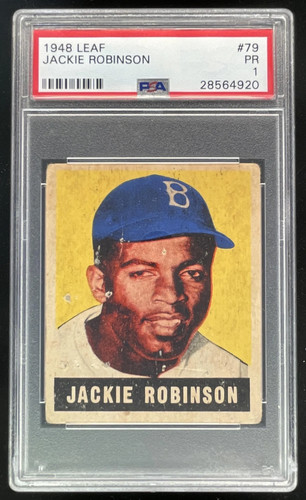
The 1948 Leaf Jackie Robinson rookie is the color-line-breaking cultural card and the tentpole of the 1947 MLB debut narrative. Robinson broke the color line on April 15, 1947, won the 1947 MLB Rookie of the Year (the award was later renamed in his honor), and was inducted in 1962. At PSA 9 this rookie lands in the mid six figures, and a Gem Mint example pushes into seven-figure territory. The 1948 Leaf set is a 168-card issue and is known for short print runs on key cards including the Robinson #79, the Satchel Paige #8 and the Stan Musial #4.
The card's cultural weight makes it one of the two most historically-loaded vintage cards on this list (the other being the T206 Wagner), and the 1948 Leaf set's print-run scarcity supports the tentpole position. The bear case is that 1948 Leaf cards have known condition challenges including centering, color registration and corner wear, and high-grade copies (PSA 8 and above) are thin enough that condition premium stretches the price band significantly. A PSA 7 NM copy typically trades at one tier below a PSA 8 and the tiering is not smooth.
8. 1948 Bowman #36 Stan Musial rookie
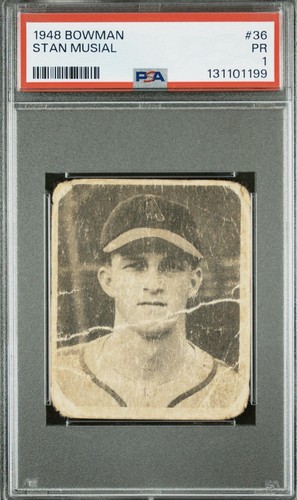
The 1948 Bowman Stan Musial rookie is the career-Cardinal HOF rookie and the 1948 Bowman set tentpole. Musial played his entire 22-season career with the St. Louis Cardinals (1941-1963), won three NL MVPs (1943, 1946, 1948), finished with 475 home runs and a .331 career batting average, and was inducted in 1969. The PSA 9 grade changes hands in the mid five figures, and Gem Mint examples clear six figures. The 1948 Bowman set is a 48-card issue and is smaller than the 1948 Leaf.
The Musial card sits below the Robinson 1948 Leaf on this list because the cultural weight of the color-line-breaking card is greater than the career-Cardinal HOF anchor, but the Musial card is the single tentpole Cardinal vintage card and would be the first card on a St. Louis Cardinals franchise list. The 1948 Bowman set has better condition sensitivity than the 1948 Leaf, so PSA 8 copies are less thin than the Leaf equivalents. A collector building the 1940s-50s HOF rookie vintage portfolio should hold both the 1948 Bowman Musial and the 1948 Leaf Robinson.
9. 1955 Topps #164 Roberto Clemente rookie
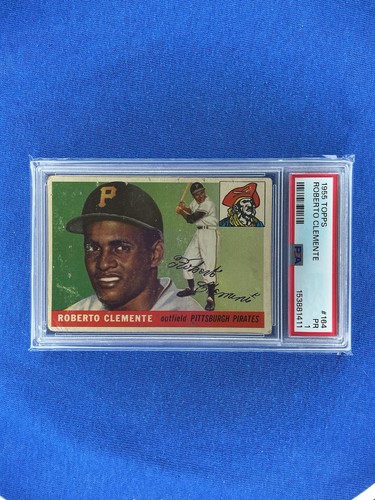
The 1955 Topps Roberto Clemente rookie is the 2,000-hit Pirate HOF tentpole and the 1972 plane-crash-legacy card. Clemente played 18 seasons with the Pittsburgh Pirates (1955-1972), finished with 3,000 hits exactly (his last regular-season plate appearance resulted in his 3,000th hit on September 30, 1972), won 12 Gold Gloves, and was killed in a plane crash on December 31, 1972 while delivering earthquake relief to Nicaragua. He was inducted in 1973 via a special waiver of the five-year waiting period. At PSA 9 this rookie sits near the top of the six-figure band, with Gem Mint examples nudging toward seven figures.
The 1955 Topps set is a 210-card issue and ships the Sandy Koufax rookie at #123, the Harmon Killebrew rookie at #124 and the Clemente at #164; the set-collecting base is the deepest of any mid-1950s Topps set. The Clemente is the tentpole rookie of the set and carries the 1972 plane-crash cultural weight on top of the 3,000-hit plus Gold Glove resume. The bear case is that the 1955 Topps set has horizontal format and known centering issues that keep PSA 8 and above thin.
10. 1957 Topps #20 Hank Aaron
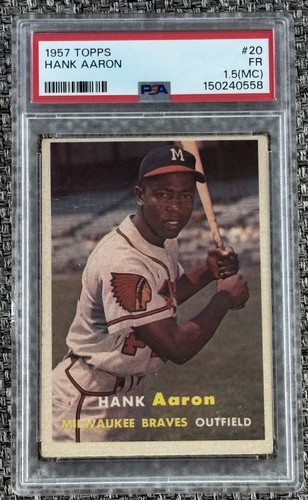
The 1957 Topps Hank Aaron is the 755-home-run franchise anchor card and the tenth card on this list. Aaron's true rookie card is the 1954 Topps #128 (which we cite as the tentpole of the Atlanta Braves list HUB-TEAM-016), and the 1957 Topps #20 is a second-year card that is sometimes cited as a competing tentpole because the 1957 Topps set has cleaner photography and stronger condition structure than 1954 Topps. The 1957 Topps set is a 407-card issue and carries the transitional-era feel between the early-Topps black-background aesthetic and the 1958-1959 color aesthetic. Recent sales place the PSA 9 in the mid five figures, with Gem Mint examples a step above.
We list the 1957 Topps #20 here rather than the 1954 Topps #128 rookie because the rookie is already the tentpole of the Braves franchise list and because the 1957 Topps set presents the card with cleaner photography that makes high-grade copies easier to source. A purist list would swap in the 1954 Topps rookie at rank 5 or 6 and push the 1957 Topps off the list. The knock on the 1957 Topps Aaron is that the card is a second-year issue and competes for attention with the 1954 rookie. The slot is defensible because the tenth rank on a vintage list can reasonably be a second-year anchor and because the 1957 Topps Aaron is a tentpole on its own condition-tier structure.
What these ten tell you
First, the T206 Wagner is a one-of-one in the vintage category and it occupies the top rank without debate. Every other card on this list sits in a tier that depends on sold-comp structure, print-run scarcity and cultural weight in different proportions. The Mantle 1952 Topps is the second tentpole and sits at rank 2 because its eight-figure PSA 10 sold-comp ceiling is the closest of any card here to the T206 Wagner tier. The 1933 Goudey Ruth, 1933 Goudey Gehrig and 1939 Play Ball Williams form a three-card pre-war block that anchors the 1933-1941 segment of the list.
Second, five of the ten cards are rookies (the 1939 Williams, the 1951 Mantle, the 1948 Robinson, the 1948 Musial, the 1955 Clemente) and the remainder are non-rookie set-anchor cards. This balance is the one most vintage collectors use in practice: rookie cards earn tentpole status when the player is HOF-tier and the rookie card is the hobby's first-mention card, and non-rookie cards earn tentpole status when the set itself is the hobby's first-mention set for the player. The Wagner, the two 1933 Goudey cards and the 1957 Aaron are all set-anchor rather than rookie-specific placements.
Third, the 1940s-to-1950s rookie cluster (Robinson 1948 Leaf, Musial 1948 Bowman, Williams 1939 Play Ball, Mantle 1951 Bowman, Clemente 1955 Topps) is the single most durable vintage-rookie portfolio a collector can build. Five HOF rookies across a 17-year window, each carrying its own cultural narrative, is unmatched by any other decade on this list. Collectors who can build this five-card rookie portfolio in any consistent grade tier have a vintage core that will hold value across macro cycles.
Fourth, the list is a list of candidates and not a list of investment recommendations. The condition tier and the provenance band for each card is where the actual price is decided, and the list above is useful as a framing tool rather than as a shopping list. A PSA 1 Poor copy of a T206 Wagner and a PSA 10 Gem Mint copy of a 1952 Topps Mantle are in the same conversation on this list but are separated by several orders of magnitude in sold-comp ceiling.
Cards that almost made the list
Several vintage cards were considered and excluded on rank or era grounds. 1910-1915 Cracker Jack Joe Jackson is a pre-war tentpole whose Shoeless-Joe cultural weight is comparable to the 1933 Goudey Ruth framing, and the card is a defensible bump-up candidate on any future list refresh. 1911 T205 Gold Border Ty Cobb is the T205 set's tentpole and the highest-Cobb card outside of the T206 issues. 1933 Goudey #149 Babe Ruth (yellow background) is the fourth of the four Ruth variations in that 1933 Goudey run and a defensible substitute for the #53 at rank 3. 1909 E90-1 American Caramel Joe Jackson rookie is the true Shoeless-Joe rookie and trades at a tier below the Cracker Jack cards. 1914 Cracker Jack Christy Mathewson is a pre-war HOF pitcher tentpole.
Rookie near-misses cover several HOF players whose rookies sit just outside the tenth rank: 1911 T205 Gold Border Walter Johnson, 1916 M101-4 Sporting News Babe Ruth rookie (a pre-Goudey Ruth rookie with deep print-run scarcity), 1933 Goudey #181 Babe Ruth (4th variation), 1909 E95 Philadelphia Caramel Ty Cobb, 1933 Goudey #160 Lou Gehrig (second variation), 1934 Goudey #61 Lou Gehrig, 1934 Goudey Lou Gehrig (all four variations), 1914-1915 Cracker Jack Walter Johnson, 1909-1911 T206 Ty Cobb, 1941 Play Ball #14 Ted Williams (Williams two-slot candidate per HUB-TEAM-006 Red Sox), 1954 Topps #128 Hank Aaron rookie (per HUB-TEAM-016 Braves tentpole), 1953 Topps #82 Mickey Mantle (Mantle third-year), 1951 Bowman Willie Mays rookie #305, 1957 Topps Brooks Robinson rookie, 1960 Leaf Roberto Clemente, and 1955 Topps #123 Sandy Koufax rookie (per HUB-TEAM-013 Dodgers tentpole). Each of these sits just outside the ten above and any of them could reasonably take a slot on an eleventh-card list.
How to use this list
Three habits carry most of the work when you trade these ten. First, price everything against 90-day sold comps. The vintage tier has the largest spread between condition grades of any segment of the hobby, and the trading band is the only way to separate a defensible price from an aspirational ask. A PSA 8 and a PSA 9 of the same vintage card can differ in sold-comp ceiling by an order of magnitude, and the only way to work through that gap is to actually look at recent comps in the grade tier you're shopping.
Second, treat condition as a first-class factor rather than an afterthought. The condition-tier premium on vintage cards is the single most important variable after player identity, and the trading band at PSA 7 NM is often a different conversation than at PSA 9 Mint or PSA 10 Gem Mint. A collector who understands the condition-tier structure of 1933 Goudey or 1952 Topps or T206 has a significant edge over collectors who treat grade as a secondary concern.
Third, hold the list as a list of candidates for portfolio-level decisions rather than as a shopping list. The T206 Wagner at the top and the tenth-ranked Aaron at the bottom are in the same conversation on this list but are separated by several orders of magnitude in sold-comp ceiling. The list is useful as a framing tool for which cards to pay attention to at auction and at the major vintage shows, but it is not a recommendation that every collector should own all ten. Most serious vintage collectors build a portfolio of three to five of the ten above, in a consistent condition tier, rather than chasing all ten. For collectors who treat their vintage stack as cross-sport, our 10 most valuable vintage hockey cards listicle covers the same pre-1990 framing on the hockey side, with the OPC versus Topps split as the structural read.
Frequently asked questions
What is the most valuable vintage baseball card?
The T206 Honus Wagner, the hobby’s holy grail, with only around 60 known copies. It sits at the top of any vintage ranking without debate.
Why is the 1952 Topps Mantle ranked above the rookie cards?
Its eight-figure PSA 10 sold-comp ceiling is the closest of any card here to the Wagner tier. It is a second-year card, but it is the modern Topps tentpole.
Is the 1952 Topps Mantle his rookie card?
No. Mantle’s rookie is the 1951 Bowman #253, which sits at rank 6 on this list. The 1952 Topps #311 is his iconic second-year card.
Why aren’t any modern cards on this list?
Vintage here means pre-war through the 1950s set-anchor and rookie cards. Modern cards are covered on the rookie and parallel lists instead.
Which cards almost made the list?
The closest bump-up candidates are the 1910-1915 Cracker Jack Joe Jackson, the 1911 T205 Gold Border Ty Cobb, and the 1954 Topps Hank Aaron rookie.
How should I value a vintage card before buying?
Vintage has the widest grade-to-grade spread in the hobby, so price everything against 90-day sold comps in the exact grade tier. This page is reference information, not financial advice.