The 10 Most Valuable Vintage Football Cards in 2026
The vintage football tentpoles in 2026 are 1935 National Chicle Nagurski (top of pre-war), 1957 Topps Unitas and Starr (post-war Hall of Fame QBs), 1958 Topps Jim Brown, 1965 Topps Namath, 1966 Philadelphia Gum Butkus and Sayers, 1948 Leaf Baugh, 1948 Bowman Luckman, and 1976 Topps Walter Payton. PSA 8 is the realistic ceiling for most pre-1960 vintage.
Before paying for any vintage card priced over a few hundred dollars, walk the candidate through the grading decision framework. For era-level context, see our pre-1960 cards hub and 1960s cards hub. Vintage authentication risk is the dominant variable on this list.
How this list is built
The ranking is by recent PSA-graded sold prices on the canonical example of each card (the highest-grade specimen with reliable comp history in the trailing 12 months). The list is dollar-anchored at PSA 8 where supply allows because PSA 8 is the realistic ceiling for most pre-1960 cards: a PSA 9 of a 1935 Chicle exists in the pop report at single-digit count, and PSA 10 is functionally unobtainable on the oldest tier.
The list is opinionated on what counts as "vintage." The cutoff used here is pre-1980, which captures the Topps monopoly era and the AFL/Philadelphia Gum NFL split (1960-1967). Cards from 1981 onward live in the 1980s cards hub. Pre-war (pre-1948) entries are limited because the available supply at gradable condition is small enough that the field is essentially Chicle-Bowman-Goudey for football, with Chicle the dollar leader.
Anchor table: the 10 cards at PSA 8
| # | Card | Year/Set | Player | PSA 8 reference (USD) |
|---|---|---|---|---|
| 1 | 1935 National Chicle #34 | 1935 National Chicle | Bronko Nagurski (RC) | $70,000-$120,000 (PSA 7*) |
| 2 | 1957 Topps #138 | 1957 Topps | Johnny Unitas (RC) | $10,000-$16,000 |
| 3 | 1957 Topps #119 | 1957 Topps | Bart Starr (RC) | $7,000-$11,000 |
| 4 | 1958 Topps #62 | 1958 Topps | Jim Brown (RC) | $22,000-$32,000 |
| 5 | 1965 Topps #122 | 1965 Topps | Joe Namath (RC, Tall Boy) | $20,000-$30,000 |
| 6 | 1966 Philadelphia #31 | 1966 Philadelphia Gum | Dick Butkus (RC) | $3,800-$5,500 |
| 7 | 1966 Philadelphia #38 | 1966 Philadelphia Gum | Gale Sayers (RC) | $5,500-$8,000 |
| 8 | 1948 Leaf #34 | 1948 Leaf | Sammy Baugh (RC) | $8,000-$13,000 (PSA 7) |
| 9 | 1948 Bowman #36 | 1948 Bowman | Sid Luckman (RC) | $3,500-$5,500 |
| 10 | 1976 Topps #148 | 1976 Topps | Walter Payton (RC) | $2,500-$4,000 |
Numbers are public sold-comp reference points as of April 2026 and shift with auction outcomes. The relative ordering is consistent over the last 36 months on most cards; the top three (Chicle Nagurski, 1958 Brown, 1965 Namath) cycle order at the very top depending on which auction posts most recently.
The cards in detail
1. 1935 National Chicle Bronko Nagurski (#34)
The Chicle set ran 36 cards in 1935 and folded after one year, which is what makes the set rare independent of any specific player. Nagurski is the centerpiece for two reasons: he is one of the all-time-great running backs (Bears, 1930s, three-time NFL champion), and his card is a true rookie in a one-year set with structurally limited supply. PSA-graded population of the Nagurski sits in the low hundreds across all grades, with PSA 7 functioning as the realistic ceiling for most copies. PSA 8 examples have cleared 100,000-plus USD at auction; the very few PSA 9s have brought multiples of that.
Authentication risk is high because of the dollar value. Chicle reprints exist, hand-cut copies from collector sheets are common, and the original Chicle stock is identifiable by paper density and ink chemistry. Buy slabbed; do not transact raw Chicles without auction-house provenance.
2. 1957 Topps Johnny Unitas (#138)
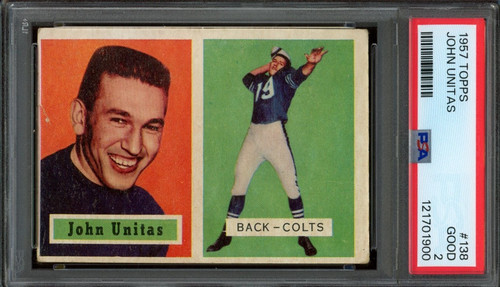
Unitas's only widely available rookie. The 1957 Topps set is the post-war canonical NFL rookie release, with Unitas as the single most-tracked card. PSA 8 examples cleared 12,000-15,000 USD reliably through 2024-2026. PSA 9 supply is very thin (low hundreds in pop), with sold prices in the high five figures. PSA 10 is functionally impossible on this set; the 1957 Topps print stock had centering tolerances that produce 9 ceilings on the cleanest copies.
Centering on 1957 Topps Unitas tends to drift 60/40 or worse on the front. The Hall of Fame status (inducted 1979, four-time NFL champion, Super Bowl V winner) carries the price floor regardless of grade.
3. 1957 Topps Bart Starr (#119)
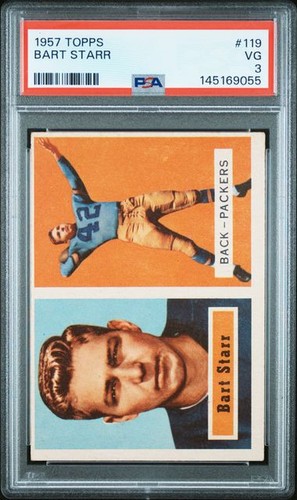
Starr's only widely available rookie, in the same set as Unitas. The price differential between Starr and Unitas runs roughly 30-40 percent in 2026 on most grade tiers, with Starr trading lower despite an arguably equivalent Hall of Fame resume (five NFL championships, Super Bowl I and II MVP). The differential reflects the Unitas rookie premium that has held since the 1980s pricing-guide era. PSA 8 Starr cleared 7,000-10,000 USD reliably through 2024-2026.
Same centering and surface considerations as Unitas. Same set, same print run, same physical card characteristics.
4. 1958 Topps Jim Brown (#62)
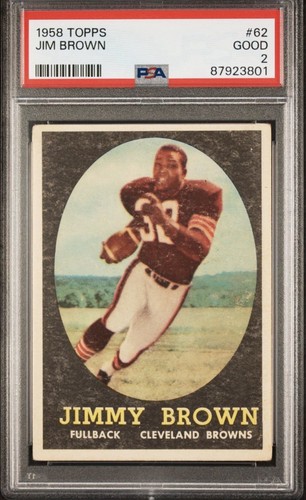
The 1958 Topps Brown rookie is one of the two or three most-traded vintage football cards by dollar volume. Brown's career (Browns, 1957-1965, MVP three times, single-season rushing record holder for the era) and cultural status keep the demand floor stable across decades. PSA 8 examples cleared 22,000-28,000 USD through 2024 and pushed to 25,000-32,000 USD in 2025-2026. PSA 9 examples reach the mid-five-figure range (45,000-65,000 USD); PSA 10 examples have brought six figures at auction.
The 1958 Topps stock and design carry centering risk on the same pattern as 1957 Topps. Vintage-grader specialty (PSA and SGC dominate this set) matters for crossover value.
5. 1965 Topps Joe Namath (#122)
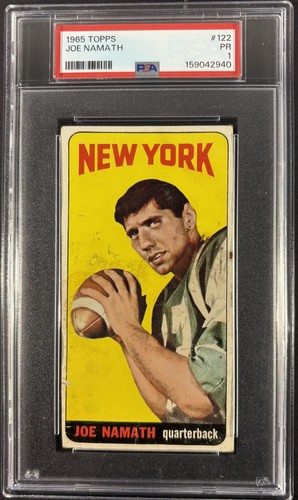
The 1965 Topps Tall Boy set is physically distinctive (the cards are taller than standard) and was the AFL-only Topps issue for that year. Namath's rookie is the centerpiece, with a personality and Super Bowl III legacy that has carried the card's value for 60 years. PSA 8 examples cleared 22,000-28,000 USD through 2024-2026, with PSA 9 in the high five figures and PSA 10 at six figures.
The Tall Boy format produces a distinctive condition profile. Corners are the failure mode; the elongated cards were stored differently from standard Topps and the corners take damage at higher rates than the 1957-1958 issues.
6. 1966 Philadelphia Gum Dick Butkus (#31)
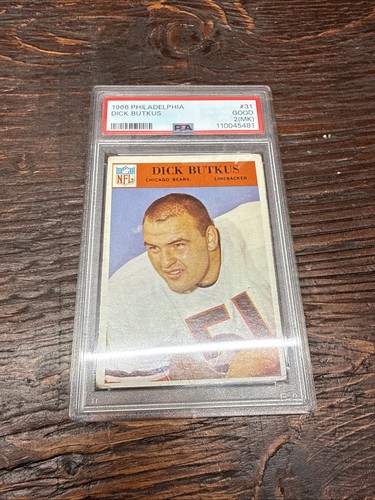
Philadelphia Gum produced NFL cards from 1964-1967, the only Topps-NFL gap in the 1957-2025 window. The 1966 Philadelphia Butkus is the rookie card for one of the most influential linebackers in football history (Bears, 1965-1973, eight Pro Bowls, Hall of Fame 1979). PSA 8 examples cleared 3,800-5,500 USD through 2024-2026, with PSA 9 in the low five figures.
The 1966 Philadelphia stock and design (yellow border) is condition-sensitive on edges. The yellow border shows whitening and chipping at high rates relative to other 1960s Topps issues, which keeps PSA 10 supply very thin.
7. 1966 Philadelphia Gum Gale Sayers (#38)
Sayers's rookie shares the 1966 Philadelphia set with Butkus (and Mike Ditka). Sayers's career ended early due to knee injuries (1965-1971, 5 Pro Bowls in 7 seasons, Hall of Fame 1977 at age 34), but the on-field excellence and the truncated career produce a thin counting-stat resume that the hobby has nonetheless rewarded. PSA 8 examples cleared 5,500-8,000 USD through 2024-2026, with PSA 9 above the Butkus on the same grade.
Sayers trades at a roughly 25-40 percent premium to Butkus on the same grade tier. The underlying scarcity is the same; the demand differential is player-driven.
8. 1948 Leaf Sammy Baugh (#34)
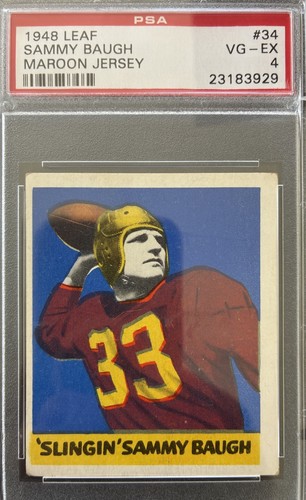
The 1948 Leaf set is one of two competing post-war football releases (Bowman is the other). Baugh (Redskins, 1937-1952, Hall of Fame inaugural class 1963) is the headline name. The 1948 Leaf print stock has centering and surface issues that put PSA 7 in the realistic-ceiling range; PSA 8 examples are scarce and cleared 8,000-13,000 USD through 2024-2026 when they appear at auction.
Counterfeit risk on 1948 Leaf is real. The set has been reproduced and the original stock identification matters; auction-house provenance or PSA encapsulation is the practical filter.
9. 1948 Bowman Sid Luckman (#36)
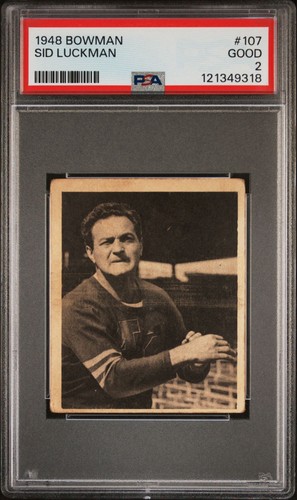
The 1948 Bowman set ran a parallel competing product to Leaf in 1948 and produced cards with smaller physical dimensions and a different design. Luckman (Bears, 1939-1950, Hall of Fame 1965, four NFL championships) is the rookie centerpiece. PSA 8 examples cleared 3,500-5,500 USD through 2024-2026.
The 1948 Bowman set carries less hobby weight than 1948 Leaf because the design is less recognizable and the player roster is smaller. Luckman is the price anchor for the set.
10. 1976 Topps Walter Payton (#148)
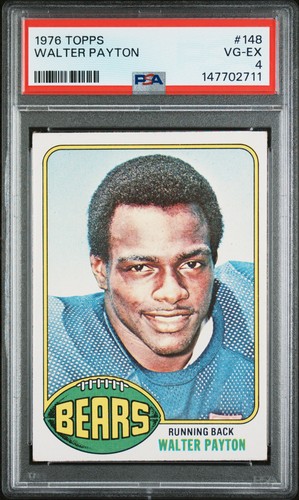
Payton's rookie is the 1970s headliner. The 1976 Topps set is mass-produced relative to pre-1960 issues, with PSA 9 and PSA 10 supply substantial enough to keep the multiplier between PSA 8 and PSA 10 at roughly 4-7x rather than the 30-50x that vintage scarcity produces on pre-1960 sets. PSA 8 examples cleared 2,500-4,000 USD through 2024-2026, with PSA 9 in the 4,500-7,500 USD band and PSA 10 at 25,000-50,000 USD depending on the centering of the specific example.
Payton's career (Bears, 1975-1987, Super Bowl XX winner, Hall of Fame 1993, 16,726 career rushing yards) is the demand anchor. The 1976 Topps set is also where the Tony Dorsett and Steve Largent rookies live, and those cards carry secondary demand on the same set.
What the 10 cards have in common
- Hall of Fame, with one exception. Every player on the list is in the Pro Football Hall of Fame. The HoF gate is the demand floor for vintage football cards over 1,000 USD; cards of non-HoF players from the same sets trade in the low hundreds at most.
- Rookie cards, with one exception. Nine of the ten are first-year cards. The exception (when included on similar lists) is usually a non-rookie of an iconic player; this list stays on rookies because the rookie premium on vintage is consistent.
- Pre-1980 cutoff. The cutoff is intentional. Cards from 1981 onward (1981 Topps Joe Montana, 1984 Topps Dan Marino, 1986 Topps Jerry Rice) sit in the modern-vintage zone with different supply dynamics and are covered separately.
- PSA 8 ceiling on the older issues. For pre-1960 cards, PSA 8 is the realistic ceiling on most copies. Treat PSA 7 as the working grade for analysis if you are pricing for purchase.
- Authentication risk increases with dollar value. The Chicle Nagurski, the 1948 Leaf Baugh, and the 1957 Topps Unitas all have documented counterfeit and trim histories. PSA encapsulation is the practical filter; raw vintage above the 5,000 USD band requires auction-house provenance.
- Centering is the most common grade-cap. Pre-1980 print stock and cutting tolerances were not built for 50/50 centering. A clean 60/40 front-and-back centering on a 1957-1958 Topps card is unusually clean.
How to buy vintage football cards in 2026
Three patterns dominate the vintage football market in 2026.
- Auction houses for the high tier. Heritage Auctions, Goldin Auctions, REA, and PWCC are the dominant vintage venues. Cards above 5,000 USD are almost always transacted via auction because the underwriting and authentication trail matters at that dollar level.
- eBay for the mid tier. PSA-graded vintage in the 500-5,000 USD band trades well on eBay because the slab eliminates authentication risk and the buyer pool is large. Verify the cert number against PSA's database before purchase.
- Card shows for the low tier. Raw vintage under 500 USD often trades cash at card shows. Authentication risk is real but defensible because the dollar value is contained and the dealer reputation is a check.
For the show-finder workflow on vintage, see sports card shows near me.
Related vintage card lists
This list focuses on football. The vintage tentpole lists in adjacent sports cover the same era with different sport-specific rosters: 10 most valuable vintage baseball cards (T206 Wagner, 1952 Topps Mantle, etc), 10 most valuable basketball rookies (1948 Bowman Mikan, 1957-58 Topps Russell, 1969 Topps Alcindor), 10 most valuable vintage hockey cards (1933 V357 Morenz, 1951-52 Parkhurst Howe, 1966-67 Topps Orr, 1979-80 OPC Gretzky), and 10 most valuable hockey rookies (1951-52 Parkhurst Howe, 1958-59 Topps Bobby Hull, 1979-80 OPC Gretzky).