
Grading is the single most expensive decision most collectors make, and most people get it backwards. They grade the cheap stuff and sit on the expensive stuff. The card that decides whether grading pays is not the one that looks clean at a glance. It is the one where a grade actually moves the price. A 1996 Fleer Decade of Excellence Michael Jordan #4 is a clean example. Raw it sells around $45. In a PSA 9 it runs about $112, and a PSA 10 jumps to roughly $452. That is the kind of spread that justifies a fee. Most modern base does not behave that way.
What PSA and BGS Each Do Well
PSA carries the deepest market liquidity. A PSA 10 is the most widely recognized grade in the hobby, and on high-volume modern cards it almost always commands the strongest premium and the fastest sale. That is the case for the Jordan above and for nearly every flagship rookie with thousands of recorded comps behind it. If your endgame is the broadest possible buyer pool, PSA is usually the default.
BGS earns its keep on a different shelf. Its subgrades and the Black Label appeal to collectors chasing a perfect, documented copy, and BGS often turns submissions faster than PSA when the queues back up. For high-end TCG and for modern parallels where presentation drives demand, BGS is a real option rather than a fallback. The right answer is the service whose buyers pay the most for that specific card, not the service with the better reputation in the abstract.
When the Grade Pays For Itself
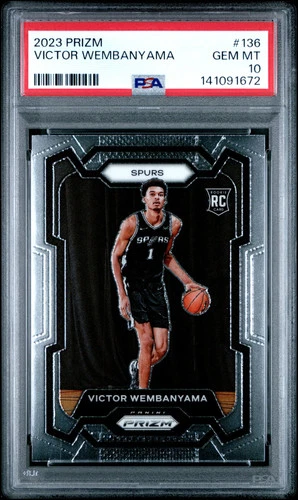
The math is simple. Compare the raw price to the graded price, subtract the fee and the wait, and decide if the spread is worth the risk that the card grades a 9 instead of a 10. The Jordan clears that bar easily. A Victor Wembanyama 2023 Panini Mosaic Jam Masters tells the other story. Raw it sells near $12, the PSA 9 lands around $32, and even a PSA 10 only reaches roughly $73. On a card like that, you need a clean 10 just to come out modestly ahead after the fee. The downside on a 9 wipes out the upside. That card sells fine raw.
High-end serial-numbered autos are the strongest grading candidates because the population stays thin and the raw price is already high. A 2024 Panini Eminence Patch Autograph of Shai Gilgeous-Alexander trades around $3,218 raw. The Anthony Edwards from the same set runs about $2,475, and a Reed Sheppard Eminence Rookie Patch Auto sits near $3,000. Cards at that level rarely flood a pop report, so a strong grade tends to hold its premium. When the raw number is already four figures and the print run is tiny, grading is almost always the play.
The Parallels and the Raw Play
Parallels reward judgment. A Jayden Daniels 2024 Panini Prizm Silver #347 sells around $128 raw, climbs to roughly $146 in a PSA 9, and reaches about $872 in a PSA 10. That is a wide enough gap to grade a clean copy and a thin enough one to think twice about a card with soft centering. Rarity and eye appeal can carry a slightly lower grade further than people expect, so a sharp BGS 9.5 on a low-numbered parallel often outperforms a chase for a flawless 10.
Then there is the case for staying raw entirely. Mass-produced base rookies are the obvious one. A Justin Herbert 2020 Panini Legacy #150 sells for about $2.35 raw and roughly $25 in a PSA 10. The grade triples the price on paper, but the fee eats the gain and you have tied up cash for weeks to net a few dollars. Cards like that belong in a binder or a quick raw sale, not a submission queue.
Centering, Light, and Timing
Centering decides more modern grades than collectors admit. A faint edge ding or a tiny print line often slips past the eye. Off-center borders do not. Inspect every card under strong, direct light before you commit a fee, and be honest about what you are looking at. The fastest way to waste grading money is to send in cards that were never 10s.
Timing matters just as much on hot rookies. If comps on a card are climbing week to week, a long turnaround can mean missing the peak. In those windows a faster, pricier service or even a clean raw sale can beat waiting on a slab. The choice is always specific to the card, the moment, and your reason for owning it.
The Read on the Market
The grading market rewards discipline, not volume. High-grade vintage stays strong on its own merits. A 1952 Bowman Mickey Mantle #101 sells around $2,060 raw and roughly $103,000 in a PSA 10, a spread that justifies almost any fee. The ultra-modern high-end keeps moving too, with serial-numbered autos commanding four figures before they ever hit a slab. The trouble lives in the middle, with common modern base, where rising fees and longer waits make grading a losing trade more often than not. Grade what the spread earns. Leave the rest raw.