
Grading is not free money. Every card you send out costs a fee, and it ties up your capital for months while you wait. So the question is never whether a card can be graded. The question is whether the grade pays you back more than the cost and the wait. For a lot of modern cards, the honest answer is no.
The math comes down to one number: the spread between the raw price and the graded price. When that spread is wide, you chase it. When it is thin, you sell raw and move on.
The PSA 10 Premium Is Not Always There
Look at a base 2018 Panini Prizm Luka Doncic. It sells raw around $61, a PSA 9 around $74, and a PSA 10 around $161. The PSA 9 barely clears the raw price. Almost all of the value lives in that PSA 10. Now compare a base 2020 Panini Prizm Anthony Edwards: roughly $9 raw, $25 graded a 9, and $105 once it hits a PSA 10. Same story. The slab does nothing for you unless you hit the 10.
That is the trap on modern base cards. The premium is real, but it is concentrated entirely in the perfect grade. Send in a card that comes back a 9 and you have paid a fee and waited months for a result that the open market barely rewards. On a centering miss or a soft corner, you can come out behind.
When Chasing the 10 Makes Sense
The picture flips on cards with real raw value and a wide graded spread. A 2018 Prizm Luka Silver sells around $417 raw, a PSA 9 near $480, and a PSA 10 near $1,578. Now the 10 is worth chasing, because the gap between raw and gem is large enough to cover the fee, the wait, and the risk. A 2020 Prizm Edwards Silver tells the same tale: about $164 raw against $875 in a PSA 10.
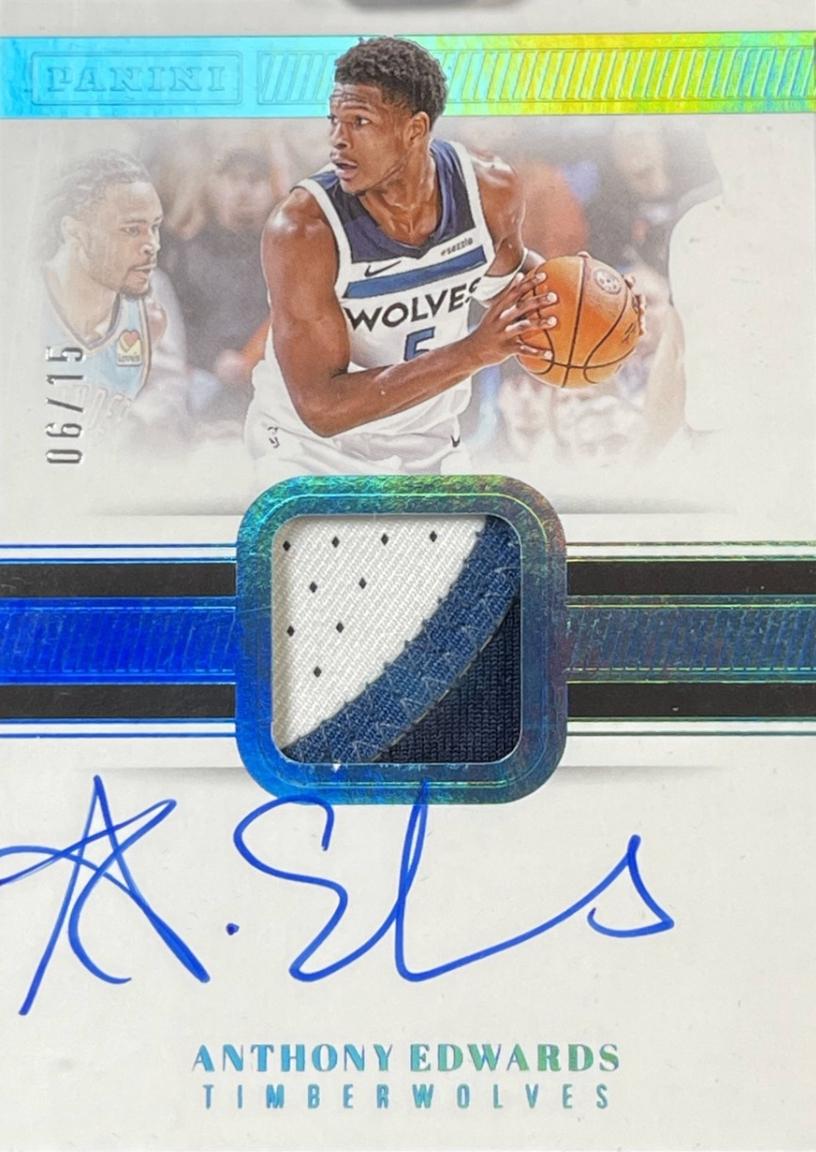
High-end autographs sit in their own world. A 2024 Panini Eminence Special Patch Autograph Shai Gilgeous-Alexander goes for roughly $12,829 raw. The Anthony Edwards from the same set sits near $6,804, and a Luka Doncic Emerald from Eminence Optimum runs about $4,727. On five-figure raw cards, you are protecting the asset as much as chasing upside. A slab from PSA, BGS, or SGC verifies the card and the autograph, and that authentication alone justifies the submission. These are the cards you grade without thinking twice.
The PSA 9 Is an Underrated Play
Hitting a PSA 10 on a modern card is hard, and it is getting harder as grading standards tighten on surface and centering. That makes the PSA 9 a smart target on cards that are clean but not flawless. You will not catch the top-tier number, but you sidestep the real risk, which is paying for a submission and getting back an 8.
Consider a base 2024 Prizm Jayden Daniels, a heavily traded modern rookie. It sells around $4 raw, $16 in a PSA 9, and $68 in a PSA 10. The Silver parallel jumps to roughly $128 raw, $146 in a PSA 9, and $872 in a PSA 10. On the Silver, the gem premium is enormous and worth the swing. On the base card, the 9 is a respectable, lower-risk outcome that still beats raw. Match the grade you target to the spread in front of you.
Know When to Stay Raw
Plenty of cards should never see a slab. A base 2020 Panini Select Randy Arozarena sells for about $2 raw. Grading a card like that is pure cost. The fee and the months of waiting wipe out any gain a 10 could ever deliver, and most of these never grade clean enough to matter anyway. Sell it raw, or hold it raw if you believe in the player.
The filter is simple. If a card is unlikely to grade a 9 or better, or if its raw value sits low enough that the fee eats the upside, leave it raw. Reserve your submissions for cards where the graded spread is wide, the raw value is meaningful, or the price tag makes authentication worth it on its own.
Grading should make you money, not just feel productive. Run every raw card through the same test. Look at the real raw price, look at the real PSA 9 and PSA 10 comps, and weigh that spread against the fee and the wait. The cards that pass are the cards you send. Everything else stays raw. Pick your battles.