
Aaron Judge has been one of the most-traded names in the hobby since his 2017 debut. His rookies ran up hard during the 2022 home-run chase, corrected with the rest of the market, and have since settled into prices that tell you a lot about where collector demand really lives. The cards that held their floor are not the loud parallels. They are the foundational rookies and the genuinely scarce Bowman Chrome hits.
Here is what the real sold comps say right now, and how to read them.
The Base Topps Chrome Is Still the Anchor
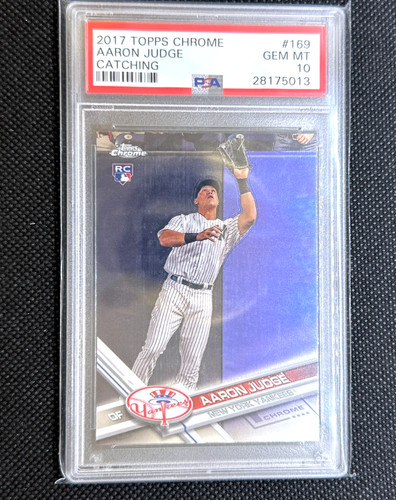
The 2017 Topps Chrome Aaron Judge #169 is the card most collectors think of first, and it remains the anchor of his rookie market. A raw copy trades around $202, and a PSA 10 sits near $450. That is off the 2022 peak, but it has not cratered. The volume tells the story: this card moves constantly, which is exactly why it holds. Liquidity is value. When a card sells every day, the price has nowhere to hide and nowhere to crash to in a panic.
The Topps Chrome Update #HMT50, his Rookie Debut subset card, runs a bit cheaper at roughly $113 raw and $365 in a PSA 10. Strong card, real rookie-year tie, and a more accessible entry point than the flagship Chrome.
Paper Rookies: Cheaper, And Often Overlooked
Everyone chases the shiny stuff first. That is exactly why the paper rookies are worth a hard look. The 2017 Topps Update Aaron Judge #US99 Rookie Debut is the highest-volume Judge rookie in the catalog. It trades around $35 raw, and a PSA 10 still pulls about $280. Think about that gap. The raw card is cheap, but graded demand is real, which means the upside lives in the grade.
The 2017 Topps Heritage rookie #214 is another quiet one. Around $36 raw and $134 in a PSA 10. Heritage has a dedicated collector base that does not overlap much with the Chrome crowd, and that separate demand pool is what keeps the floor steady.
These paper cards will never command refractor money. That is the point. They are foundation pieces for a collector who wants the real rookie at a fair number, not a lottery ticket.
Bowman Chrome Is Where the High End Lives
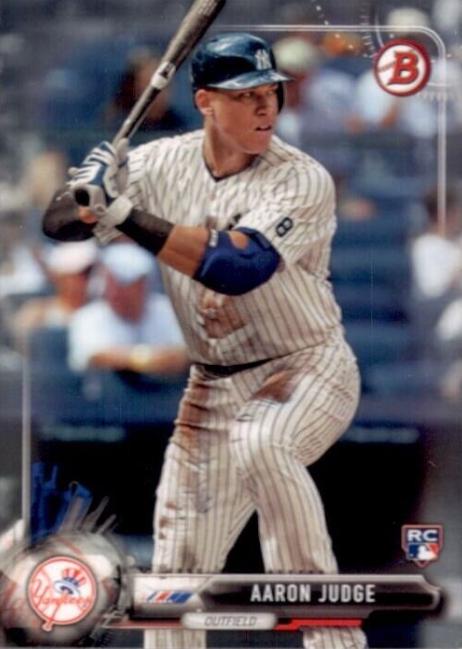
If you want the cards that define Judge's ceiling, you go to 2017 Bowman Chrome #56. The base card already trades higher than Topps Chrome, around $193 raw and $682 in a PSA 10. The refractor is where it gets serious. The Batting Refractor #56 sits near $564 raw and $1,609 for a PSA 10. That is the card the boom remembers, and the rarest grades have held a premium through the correction.
Then there is the short print. The Bowman Chrome In Dugout #56 variation trades around $927 raw and $2,202 in a PSA 10. Low volume, hard to find, and the kind of card that only moves when a real collector decides to add a cornerstone. These pieces are not liquid. They are not for flippers. They sell when someone serious wants one, and the scarcity means they shrug off the daily noise that pushes the base cards around.
How to Read the Judge Market
The pattern across all of these is the same. The cards with the deepest collector demand, the base Topps Chrome and the high-volume Update, held their floors. The genuinely scarce Bowman Chrome refractors held a premium. The cards that bled hardest were the mid-tier parallels that only ever traded on hype.
That is the lesson for any modern player market, not just Judge. Scarcity and liquidity protect value. Hype does not. A card that sells every single day at $450 is safer than a flashier parallel that sells once a month at a number nobody can verify.
So if you are building a Judge run, the playbook is simple. Anchor it with a graded base Topps Chrome or a high-volume Update rookie, both of which you can buy and sell on demand. If you have the budget and the patience, the Bowman Chrome refractor and the In Dugout short print are the true blue-chip holds. Buy the cards real collectors actually want, check the sold comps before you pay, and ignore the daily swings. That is how the Judge market has always rewarded the people paying attention.