
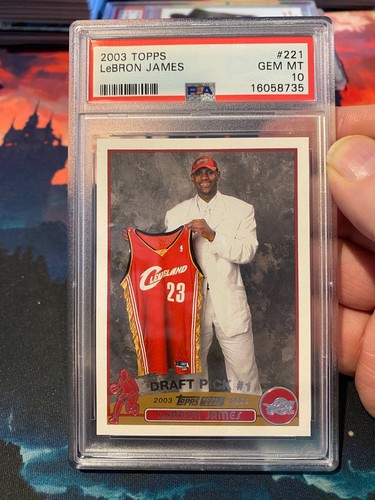
The blue-chip rookie market is the part of the hobby that does not flinch. While prospect hype and short-print parallels swing wildly week to week, the foundational modern rookies of LeBron James, Shohei Ohtani, and Mike Trout hold a floor that has only firmed up over the years. The numbers back it up. Here is where the heavy hitters actually sit on real sold comps, and what the gap between a raw copy and a graded gem is really telling you.
LeBron's Rookie Still Sets the Standard
The 2003 Topps Chrome LeBron James #111 is the single most important modern basketball rookie, and it prices like it. A raw copy trades around $1,400. Take that same card to a PSA 10 and the comp jumps to roughly $12,600. That spread defines the high-end modern basketball market. Condition is not a tiebreaker here. It is the price.
Most copies of this card never grade clean. Topps Chrome from that era is notorious for surface lines and edge chipping, so the population of true gems stays thin while demand only grows. That scarcity is why a $1,400 raw card becomes a five-figure asset with the right label. For a foundational piece tied to one of the greatest careers the sport has seen, collectors treat it less like a card and more like a holding.
Ohtani Is the Baseball Anchor
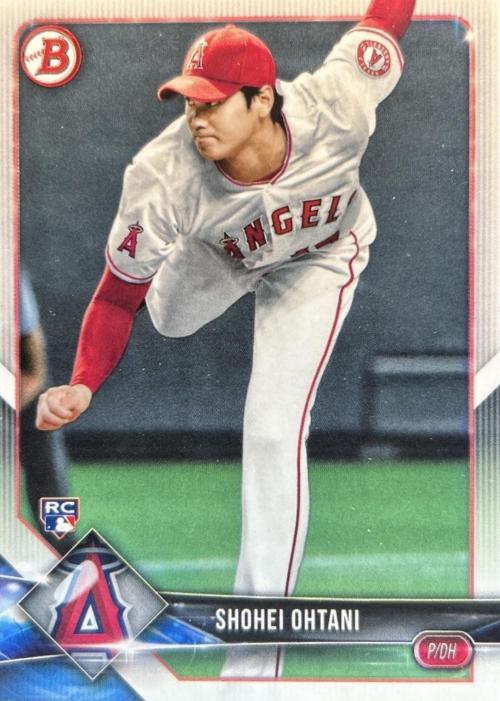
On the baseball side, the 2018 Topps Chrome Shohei Ohtani #150 is the rookie everyone wants. A raw copy sits near $476, and a PSA 10 runs about $1,040. The card carries a double weight that nothing else in the modern game matches, because Ohtani is both an elite hitter and an elite arm. That two-way résumé is a permanent demand driver, and the base Chrome rookie is the cleanest, most liquid way to own a piece of it.
Notice the raw-to-gem spread is tighter here than on the LeBron. A roughly $560 jump from raw to PSA 10 is far gentler than the LeBron's five-figure leap. That tells you the Ohtani print run grades better and the gem population is deeper. For a collector, that is a feature. It means a clean copy is attainable without chasing a near-impossible grade.
Trout and the Cost of Scarcity
The 2011 Topps Update Mike Trout #US175 is the textbook modern baseball rookie, and it shows how a parallel reshapes the entire equation. The base card trades around $340 raw and about $1,145 in a PSA 10. Step over to the Cognac Diamond Anniversary parallel of the same card and the floor moves to roughly $1,054 raw, with a PSA 10 comp near $4,351.
Same player, same set, same card number. The only difference is scarcity, and the market prices that scarcity at a steep premium. This is the core lesson of the modern rookie market. A base rookie gives you the name and the liquidity. A low-print parallel gives you the same card with a multiplier attached, and collectors pay up for it every time the supply is genuinely thin.
Where the Active Stars Sit
Beyond the established anchors, the market reflects on-court performance fast. Shai Gilgeous-Alexander has played his way into the MVP conversation, and his mid-tier inserts have responded. His 2023 Panini Mosaic Razzle Dazzle sits near $46 raw and about $110 in a PSA 10. Those are not blue-chip numbers yet, but they are climbing on the back of real production, and the pattern is familiar. A player dominates, and his low-pop parallels get scooped up by collectors looking to get in early.
Football tells a quieter story right now. Tua Tagovailoa's 2020 Panini Prizm Silver rookie trades around $10 raw and jumps to roughly $140 in a PSA 10. That is a big raw-to-gem multiple on a relatively affordable card, which makes it a sensible grade-and-flip target if you can find clean copies. It also shows how a quarterback's market can stay subdued at the raw level while the gem-mint tier still carries real value.
The Takeaway for Collectors
The pattern across all of these is consistent. Established rookies of generational players hold their floor, and the premium lives almost entirely in the grade. If you want the steadiest hold, a base rookie of a proven legend like LeBron, Ohtani, or Trout is the anchor. If you want upside, a genuinely scarce parallel of that same card multiplies your exposure, but only when the print run is truly limited. And if you want value, look at quality gem-mint copies of strong but underpriced players, where the raw card is cheap and the PSA 10 still commands a real number. Know the population, respect the grade tiers, and let scarcity, not hype, set your ceiling.