
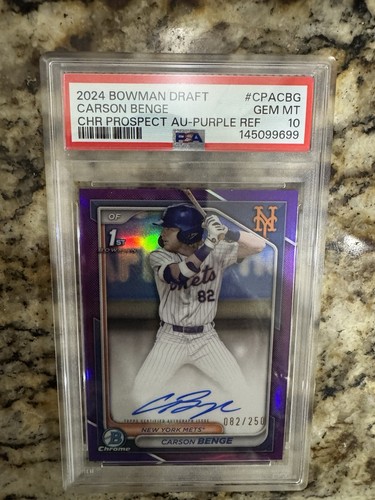
Every prospect card is a bet. The scouting report can be perfect, the swing can look clean, and the kid can still wash out at Double-A. Half of them never make it. Another chunk turns into useful big leaguers with no hobby value. A tiny few become stars. That math never changes, and it is exactly why prospect paper swings so hard.
Take Carson Benge. His 2024 Bowman Draft Chrome Prospect autograph runs about $153 raw, and the PSA 10 sits near $363. That is real money for a player who has not reached the majors. It is also a fraction of what these cards command if a prospect breaks out, and a multiple of what they are worth if he stalls.
The Prospect Play
The honest entry point on Benge is not the on-card auto. The base Bowman Draft Chrome Prospect card sits at $2.50 raw, and even a clean PSA 10 lands around $99. The refractor is barely different, roughly $4.81 raw and $89 graded. That spread tells you something. The market is paying for the signature, not the player, because the player is still a question mark.
This is where the prospect game actually gets won. You buy the cheap base or refractor, you submit, and you wait. If Benge hits, the auto and the higher parallels move first and the base follows. If he busts, you are out forty bucks and a grading fee instead of a few hundred. That asymmetry is the reason to play it this way.
Drake Baldwin is the same shape. His 2025 Topps Cosmic Chrome card is a sharp-looking parallel, and it trades around $3.48 raw with a PSA 10 near $45. Baldwin is a catcher in the Braves system, not a household name. At those numbers you are not betting much, and that is correct. The grading upside is thin unless he turns into a real bat, and Cosmic Chrome surfaces are tough to gem. Pay accordingly.
Graded Stars Behave Differently
Now flip to the other side of the board. A 2018 Panini Crown Royale Kaboom of Giannis Antetokounmpo trades around $695 raw, and a PSA 10 clears $2,500. Kabooms are short-print case hits, instantly recognizable, and Giannis is a proven superstar. The value is not just the player. It is the scarcity of the card and the grade stacked on top of it.
That combination is why graded stars hold up when prospects crater. Mike Trout makes the case cleanly. His 2011 Bowman Chrome refractor sits around $290 raw and pushes past $1,900 in a PSA 10. The Bowman Chrome Draft refractor runs higher raw, near $618, and grades out around $1,365 at PSA 10. These are not lottery tickets. They are established assets with deep sales history and steady demand.
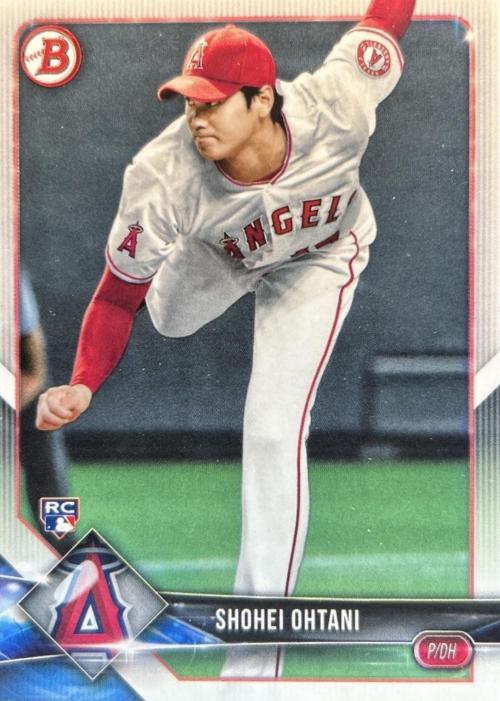
Shohei Ohtani sits in the same tier. His 2018 Topps Chrome base trades around $476 raw and over $1,000 in a PSA 10, on enormous volume. You are not hoping he develops. He already did. The price reflects certainty, and certainty is what you pay a premium for.
Where the Quiet Value Hides
Most buyers chase the flashy refractors and the top-ranked prospects. There is value below that line if you are willing to look. Consider Sam LaPorta. His 2023 Panini Prizm base trades for about $1.55 raw, and the graded copies clear $20 in a PSA 10. The silver parallel runs $4.64 raw and around $45 graded. That is a productive tight end you can own for the cost of lunch.
Cards like that will not explode. They also will not crater. They give you steady, predictable value while you wait to see whether a young player keeps producing. Pick up a low-numbered parallel of a solid contributor, submit it, and you have a clean piece for the collection or a modest flip later. The downside is small because the price was small to begin with.
What To Actually Do
The framework is simple. Prospect autos and parallels are the high-upside, high-risk side. Graded cards of proven stars are the stability side. If you are sitting on mid-tier prospect autos with no call-up in sight, rotate them into proven assets while the comps support it. If you believe in a name like Benge, buy the cheap base or refractor at four to five dollars, submit, and stay in the game without betting the farm.
The mistake is paying star prices for prospect risk, or prospect prices for star certainty. Match the price you pay to the bet you are actually making. Check the sold comps before you buy, and let the numbers tell you which side of the board you are on.