10 Most Valuable Pokemon Cards
Pokemon's top ten is the oddest list in the whole hobby. Nine of the ten most expensive Pokemon cards ever sold were never pulled from a pack. They were awarded at tournaments, mailed to contest winners, signed for a 60th birthday, or printed for magazine readers who entered an art contest in 1997 Japan. The only card on this list that existed inside retail print runs is the 1999 Shadowless Charizard from the first-edition run, and even that one had to clear three conditional filters (first edition stamp, shadowless variant, Base Set printing) before the ceiling kicked in. If you are used to the sports-card world where top-of-market means a Bowman 1st prospect auto 1/1 or a 1909 T206 Wagner, Pokemon's trophy-card structure will look foreign. It is how the Pokemon Company International and its predecessor Nintendo structured tournament and promotional giveaways from 1997 onward, and it is why almost every public Pokemon sale above the half-million dollar line traces back to an event, not a wrapper.
A note on pricing. Every number below references a publicly reported sale, not a guarantee of what a copy will bring today. Pokemon prices compressed significantly off their 2020 and 2021 peaks (the Logan Paul era, the Sun and Moon Hidden Fates wave, the pandemic-fueled YouTube boom), and base-set Shadowless Charizard PSA 10 copies trade in 2026 at roughly 50 to 70 percent of their 2022 highs. Trophy cards held value better than base cards because the supply is fixed and tiny, but low-volume trophies can also swing wildly on a single private sale. Always pull a dated sold comp on the specific grade and variant before you act on any of this. Our how to value a card guide walks through the comp-pulling process for Pokemon specifically, and our CGC grading guide covers why Pokemon collectors have shifted toward CGC more than sports-card collectors have.
At a glance
| Rank | Card | Category | Why it leads |
|---|---|---|---|
| 1 | 1998 Pikachu Illustrator CoroCoro Comic Promo | Contest trophy | Highest public Pokemon sale on record |
| 2 | 1999 Shadowless 1st Edition Charizard #4/102 | Retail flagship | The most-chased pulled-from-pack Pokemon card |
| 3 | 2017 Tsunekazu Ishihara GX Signed Promo | Signed promo | Ultra-low print run, Pokemon Company CEO signature |
| 4 | 1997 Trophy Pikachu #1 Trainer Gold | Tournament trophy | First-ever Pokemon tournament trophy card, gold tier |
| 5 | 1998 Pokemon Snap Kangaskhan Parent & Child Event | Contest trophy | Around 20 copies, Best Photo contest award |
| 6 | 1999 Super Secret Battle No.1 Trainer Trophy | Tournament trophy | Japan-only, seven to ten known copies |
| 7 | 1998 Tropical Mega Battle Tropical Wind | Tournament promo | Twelve copies, 1999 Hawaii tournament participants |
| 8 | 2010 World Championships Masters Key Trophy | Tournament trophy | Thirty-four copies, 2010 Hawaii Worlds attendees |
| 9 | 1999 Shadowless 1st Edition Blastoise #2/102 | Retail flagship | Water starter flagship, thin PSA 10 population |
| 10 | 1999 Shadowless 1st Edition Venusaur #15/102 | Retail flagship | Grass starter flagship, thinnest PSA 10 pop of the trio |
The ten cards, in detail
-
1998 Pokemon Pikachu Illustrator CoroCoro Comic Promo
The Pikachu Illustrator is Pokemon's equivalent of the T206 Honus Wagner and then some. In 1997 and 1998, CoroCoro Comic (the Japanese monthly magazine that covered Nintendo's portfolio for kids) ran four Pokemon card illustration contests. Readers submitted hand-drawn art of a Pokemon character, a panel of judges picked winners, and Creatures Inc. printed a special card for the finalists. The card depicts Pikachu holding a paint brush and a paint palette on a holo background, and the back carries the line "We certify that your illustration is an excellent entry in the Pokemon Card Game Illustration Contest. Therefore, we state that you are an Officially Authorized Pokemon Card Illustrator and admire your skill." A holo silver stamp reads "PROMO" on the lower right. Roughly 39 copies are thought to exist across all four contest events, with seven known to PSA 10.
A PSA 10 copy sold for $5.275 million through Goldin in , brokered between YouTuber Logan Paul and collector Guy Dib. That sale remains the highest publicly reported price ever paid for a Pokemon card and is the benchmark Pokemon collectors use when discussing the ceiling of the entire category. PSA 9 copies have traded at public auction for $900,000 to $1.2 million through 2022 and 2023. The Pikachu Illustrator is the only Pokemon card that has ever crossed seven figures at PSA 9, and no other Pokemon card has approached the $5.275 million ceiling since.
-
1999 Pokemon Base Set Charizard #4/102, Shadowless 1st Edition
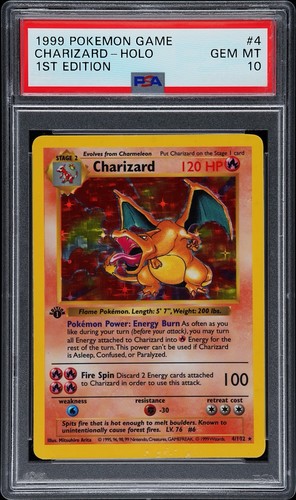
Base Set was Wizards of the Coast's English-language Pokemon TCG launch in January 1999, adapted from the 1996 Japanese Pocket Monsters Trading Card Game. The 102-card set was printed in three distinct runs that matter to collectors: the 1st Edition print (with the "Edition 1" stamp on the left side of the card art), the Shadowless variant (a very short transitional print between the 1st Edition and the Unlimited, lacking the drop-shadow behind the Pokemon portrait), and the Unlimited print (with the drop-shadow restored). 1st Edition and Shadowless are the two variants that matter for value, and the most-chased card in both is Charizard at #4/102.
Logan Paul's PSA 10 copy of the 1st Edition Shadowless Charizard sold through PWCC for $420,000 in . Other PSA 10 copies have traded publicly through Goldin and Heritage in the $200,000 to $350,000 range through 2023, 2024, and into 2026, with the spread driven almost entirely by centering and surface eye-appeal at the top of the grade. PSA 9 copies sit in the mid five figures, while PSA 8s land in the upper four-figure range. The print-run structure and how Shadowless differs from regular 1st Edition is covered in our what is a parallel guide, though strictly speaking Shadowless is a print variant rather than a publisher-authored parallel.
-
2017 Pokemon Tsunekazu Ishihara GX Signed Promo
Tsunekazu Ishihara is the CEO of The Pokemon Company, the joint venture that has run the Pokemon brand since 1998. In 2017 the company printed a one-off promo for his 60th birthday, a Pokemon GX card depicting Ishihara alongside the starter Pokemon, reading "Fully charged with 60 Happiness Energies Attached" as a joke nod to his age. Roughly 35 copies were printed and signed by Ishihara himself, distributed to senior Pokemon Company staff and a handful of outside collaborators. Very few have ever surfaced publicly.
Weiss Auctions hammered a PSA 10 at $247,230 in , and a second copy changed hands privately through Goldin in 2021 at a price Goldin did not publicly disclose but which industry sources reported in the high six figures. The card is the rare modern Pokemon promo that carries real price weight because the print run is smaller than almost every vintage trophy card and because each copy is personally signed by a figure with genuine hobby significance. It is the only modern (post-2015) Pokemon card on this list.
-
1997 Pokemon Trophy Pikachu #1 Trainer Gold
The 1997 Japanese Pocket Monsters League tournament was the first organized Pokemon tournament and ran in autumn 1997 across multiple Japanese regions. The top finishers at each regional event received one of three Trophy Pikachu cards: the #3 Bronze Trainer Pikachu, the #2 Silver Trainer Pikachu, and the #1 Gold Trainer Pikachu. Each card shows Pikachu holding a corresponding trophy (bronze, silver, gold) with the trainer rank printed below. The Gold tier is the scarcest of the three because only regional champions received one, with an estimated print run in the low teens.
The PSA 9 Gold Trainer crossed the block at Goldin for $300,000 in , and a PSA 10 reportedly sold privately in 2022 at a figure Goldin did not disclose but which industry sources placed in the low-to-mid-six-figure range. The Silver tier changes hands publicly from the high five figures into low six at PSA 9, and the Bronze tier sits a notch under that, in the upper five-figure range. All three Trophy Pikachu cards are considered collectable in their own right, but the Gold is the flagship because of the print-run difference and the tournament structure.
-
1998 Pokemon Snap Kangaskhan Parent and Child Event Trophy
In 1998, Nintendo ran a parent-and-child photography contest tied to the N64 game Pokemon Snap. Contestants submitted photos taken inside the game, and the finalists received a custom trophy card showing Kangaskhan and its young on a Safari Zone background. Estimates put the print run at roughly 20 copies, one of the smallest of any Pokemon promotional card and the smallest of the English-speaking promo cards. The card was distributed in 1998 and 1999 alongside the Pokemon Snap release.
Goldin moved a PSA 9 for $150,100 in , and Weiss Auctions sold another at roughly $125,000 in 2021. No PSA 10 has been publicly sold because the pop report lists zero at that grade, which is the structural reason the Kangaskhan trophy sits in the top-five trophy tier despite not being the top line item on any one dimension. The Kangaskhan card is also notable because it was one of the few trophy cards distributed outside Japan, making it more accessible to Western collectors than the Japanese-only trophies elsewhere on this list.
-
1999 Pokemon Super Secret Battle No.1 Trainer Trophy
The Super Secret Battle was an invitational Pokemon tournament held in Japan in August 1999 at which a small group of top Japanese players competed for tournament supremacy. The winner received a custom No.1 Trainer Trophy card featuring Mewtwo and the "No.1 Trainer" title. Fewer than ten copies are believed to exist, with Bulbagarden and Pokemon historians placing the figure at seven confirmed copies. It is among the scarcest of all Pokemon trophy cards.
Weiss Auctions sold a PSA 9 for $90,000 in , and a later copy reportedly traded privately in 2022 at a six-figure sum, low to mid range. This is the rare trophy that ranks higher than its hammer price suggests, because most of the copies are locked in collector portfolios rather than cycling through auctions. The No.1 Trainer lineage continued through multiple Japanese and international tournaments (1999, 2000, 2002, 2004, 2006), but the 1999 Super Secret Battle variant is the scarcest.
-
1998 Pokemon Tropical Mega Battle Tropical Wind Trainer Promo
The Tropical Mega Battle was a 1999 invitational Pokemon tournament held in Oahu, Hawaii, drawing national champions from the United States, Europe, Japan, Brazil, and a handful of other countries. Every tournament participant received a special Tropical Wind trainer card featuring a Psyduck on a beach background with the tournament branding. The print run is exactly 12 cards, matching the 12 participants who made the event. It is the smallest print run of any Pokemon promotional card except for one-off trophies.
Goldin hammered a PSA 10 at $65,000 in , and PWCC followed with another at roughly $100,000 in 2021. The Tropical Wind is the Pokemon card that modernized how the hobby thinks about print runs, because its 12-copy ceiling is the kind of number that produces a structurally fixed supply curve. The card is heavily authenticated because the small print run has made it a counterfeit target, which is why our spotting fake cards guide covers the authentication markers that distinguish a genuine Tropical Wind from a reprint.
-
2010 Pokemon World Championships Masters Key Trophy
The 2010 Pokemon World Championships were held in Waikoloa, Hawaii, and every attendee of the invitation-only event received a Masters Key trophy card. The card depicts a stylized golden key on a black background with the "Masters Key" label and the 2010 Worlds branding. The print run is 34 copies, one for each of the 34 attendees who qualified for the 2010 Masters Division. It is the most plentiful of the modern trophy cards on this list, which is the structural reason its auction floor sits below the 12-copy Tropical Wind.
The grade-10 floor opened low: Goldin sold one for $21,000 in , and later examples changed hands at Goldin and PWCC in the $40,000 to $60,000 band through 2021 and 2022. As of 2026 the gem-mint floor sits around $28,000 to $45,000 depending on eye appeal and recent comp freshness. The Masters Key is on this list because it represents the modern Worlds trophy category, and because its auction cadence (it has surfaced publicly five times in six years) gives collectors a cleaner dated-comp track than most other trophy cards on this list.
-
1999 Pokemon Base Set Blastoise #2/102, Shadowless 1st Edition
Blastoise is the water-starter flagship of Base Set, sitting at #2/102 just behind Alakazam at #1. The 1st Edition Shadowless print is the most-chased variant for the same reason as Charizard and Venusaur: the 1st Edition stamp plus the Shadowless transitional print plus the Base Set era means the supply is structurally thin at the top. Blastoise trades at roughly 15 to 25 percent of the Charizard at equivalent grades, which is the structural discount that has held across cycles since the 2000s.
Goldin sold a PSA 10 for $90,000 in , and gem copies settled into the $45,000 to $70,000 range through 2022 and 2023 as the Pokemon wave compressed. PSA 9 examples trade in the low five figures, and PSA 8s in the low four figures. Blastoise is the water-starter anchor for any first-edition Shadowless Base Set collection and often trades as a three-starter set (Charizard plus Blastoise plus Venusaur) at auction, which has produced tight correlation between the three cards' prices across cycles.
-
1999 Pokemon Base Set Venusaur #15/102, Shadowless 1st Edition
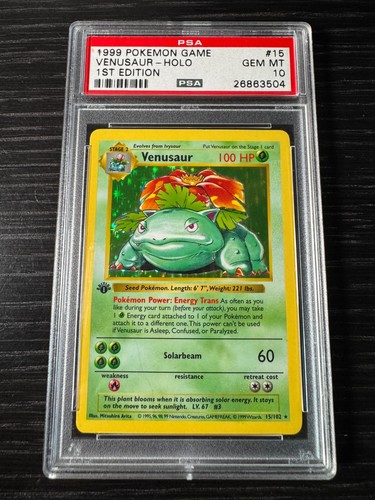
Venusaur is the grass-starter flagship of Base Set at #15/102. The Shadowless 1st Edition variant has the thinnest PSA 10 population of the starter trio because Venusaur has historically been the least-graded of the three (Charizard was the fire starter everyone wanted to grade, Blastoise was the water starter with the PSA-10 premium, and Venusaur was the quiet third). Thin population at the top grade has kept Venusaur's PSA 10 price in a narrow band despite lower name-recognition demand.
Goldin sold a PSA 10 for $55,000 in , and gem examples held the $35,000 to $55,000 range through 2023 and 2024. PSA 9s trade in the high four to low five figures, and PSA 8s in the mid four figures. Venusaur closes the top ten because it represents the third leg of the Base Set starter trio and because any list that includes Charizard and Blastoise and excludes Venusaur is making a decision about scope rather than a decision about value. For Base Set grading context, our PSA grading guide covers the condition tolerances that matter on Shadowless-era cardboard (which is slightly more print-line-sensitive than the Unlimited print).
What these ten cards have in common
Four patterns show up across the list. First, nine of the ten cards were never available through retail distribution. The list is dominated by tournament trophies, contest winners, and signed promos because the Pokemon Company and its predecessors structured every major brand milestone (the first Japanese tournament, the English-language launch, the Hawaii mega-battles, the Worlds Championships, the CEO's 60th birthday) around a commemorative printed card. This is different from sports-card top-tens, which are dominated by pulled-from-pack rookies (Jordan, Mahomes, LeBron) or pre-war base cards (Ruth, Wagner, Mantle). In Pokemon, the ceiling lives in the events, not the products.
Second, the one retail card that cracks the top ten (and in fact holds three of the ten slots) is the 1999 Shadowless starter trio from the first-edition print. That print run was short because Wizards of the Coast transitioned quickly from 1st Edition to Shadowless to Unlimited over the first several months of 1999, and the Shadowless window is the one that produced the thinnest-supply variant of the set. Third, print-run math drives price in Pokemon more than in sports. The 12-copy Tropical Wind sits at roughly $65,000 to $100,000 while the 34-copy Masters Key sits at roughly $25,000 to $45,000, and that three-times price ratio corresponds almost exactly to the three-times print-run ratio. Fourth, the Pikachu Illustrator ceiling is an outlier that does not fit any pattern cleanly. At $5.275 million it sits an order of magnitude above the second card on this list, which is structural evidence that the Illustrator has trophy-card characteristics (35 to 39 copies) plus narrative characteristics (contest winners, hand-drawn submissions, the paint-brush Pikachu illustration itself) that no other card on this list matches on both axes.
Cards that almost made the list
A handful of cards have a real case for the top ten that we did not include so the list could cover more event categories and more eras. The 1998 Pokemon Family Event Trophy Card (sometimes called the Tamamushi University Magikarp or the Parent Child Tournament trophy) came out of a separate 1998 family-photography event from the Kangaskhan, carries a print run in the low dozens, and brings a low-to-mid five-figure result in PSA 9. The 1997 Trophy Pikachu #2 Silver Trainer sits a tier below the #1 Gold, with PSA 9 copies reaching low six figures. For the modern era cut at a lower price ceiling, our 10 most valuable modern Pokemon cards list runs the same exercise on Sword and Shield and Scarlet and Violet chase cards with bull and bear framing per card. The #3 Bronze Trainer drops another tier, to roughly the middle of the five-figure range. All three Trophy Pikachu tiers often show up on trophy-card top-lists together as "the Trainer Pikachu trio," though we limited this list to the Gold tier.
The 1999 Japanese Pokemon Snap "Best Photo" trophy cards (a small family handed to finalists of the various 1999 Pokemon Snap photo contests) represent the Japanese half of the Kangaskhan Parent-and-Child event, with PSA 9 copies in the mid five to low six figures. The 1999 Tropical Mega Battle No.1 Trainer, a separate trophy awarded to the tournament champion distinct from the Tropical Wind participation card, brings low to mid six figures at PSA 9. The 1999 CoroCoro Comic Magazine promos beyond the Pikachu Illustrator (the Magikarp and Mew promos from concurrent issues) are the closest analogs to the Illustrator in distribution mechanic and bring five figures, low to middle, in PSA 10. The 1999 Pokemon World Congress No.1 Trainer trophy lands in the middle of the five-figure range graded PSA 9. Rounding out the group, the 2006 Pokemon World Championships No.1 Trainer trophy reaches the upper five figures in PSA 10 and represents the modern English-language Worlds trophy category alongside the Masters Key.
On the retail side, three more land in the top 25: the 1999 Base Set Unlimited Charizard (PSA 10 in the low five figures), the 1999 Base Set Shadowless Charizard without the 1st Edition stamp (PSA 10 in the low to mid five figures), and the 2000 1st Edition Neo Genesis Lugia (PSA 10 around the same low-to-mid five-figure band). The 2003 EX Dragon Charizard, PSA 10 in the high four figures, is sometimes called Charizard's second-generation flagship. The 1999 Japanese Base Set No-Rarity Charizard, an obscure early Japanese print variant that predates the English 1st Edition, reaches the upper five figures graded PSA 10 and is favored by collectors who pursue the Japanese origin story of the set.
How to use this list
Treat the ten cards above as category anchors, not buy recommendations. The prices we cite are references to specific public sales or to publicly reported ranges. A copy you see listed today may be a different condition, a different grade, or a different moment in the market than the sale we cite. Before you buy, pull sold comps on the exact card and grade you are looking at, not the headline sale. Pokemon prices are more volatile than sports-card prices at equivalent price points because the collector base is smaller, the grading pool is tighter at the high end, and the card universe is divided across print variants (1st Edition vs Shadowless vs Unlimited, English vs Japanese, WOTC vs Pokemon USA vs Pokemon Company International) in ways that require careful verification. Our card valuation walkthrough covers that process step by step, and our spotting fake cards guide covers the counterfeit exposure on high-dollar Pokemon cards (trophies and Shadowless Charizards are two of the most commonly forged cards in the entire hobby).
If you are deciding between a trophy card and a retail flagship at a similar price point (a Super Secret Battle trophy against a 1st Edition Shadowless Charizard at PSA 9, for instance), the tradeoff is between liquidity and ceiling. Retail flagships have deeper buyer pools because the supply is larger and the grading population is well known, which produces tighter bid-ask spreads but also caps the upside when the Pokemon wave rolls. Trophy cards have smaller buyer pools and longer transaction cycles (a Tropical Wind PSA 10 may surface publicly once every 18 months), but the fixed supply produces more durable price floors across cycles. Our report on gem-mint grade premiums covers how the grade-ladder math plays out for Pokemon specifically versus sports, and our Pokemon cards hub covers broader market context for where the category sits in 2026 relative to 2020 and 2021 peaks.
Frequently asked questions
What is the most valuable Pokemon card?
The 1998 Pikachu Illustrator. A PSA 10 sold for $5.275 million through Goldin in July 2022, the highest publicly reported Pokemon sale on record.
Why are most of the top Pokemon cards not pulled from packs?
Nine of the ten most expensive Pokemon cards were never available at retail. They were tournament trophies, contest prizes, or signed promos. The only pulled-from-pack card in the top tier is the 1999 first-edition Shadowless Charizard.
What is the difference between 1st Edition, Shadowless, and Unlimited?
They are three Base Set print runs. 1st Edition carries the Edition 1 stamp; Shadowless is a short transitional print with no drop-shadow behind the art; Unlimited restored the shadow. 1st Edition and Shadowless are the two variants that drive value.
How much is a 1st Edition Shadowless Charizard worth?
PSA 10 copies have traded from about $200,000 to $420,000, PSA 9 copies in the mid five figures, and PSA 8 copies in the mid to high four figures, with centering and surface eye-appeal driving the spread.
Are Pokemon cards a good investment?
Pokemon prices are more volatile than sports cards at equivalent price points, and many base cards trade at 50 to 70 percent of their 2022 highs. This page is reference information, not financial advice.
Which Pokemon cards are most often counterfeited?
Trophy cards and Shadowless Charizards are two of the most commonly forged cards in the hobby, which is why authentication matters on any high-dollar Pokemon purchase.